Tips to Improve Your Mental Health
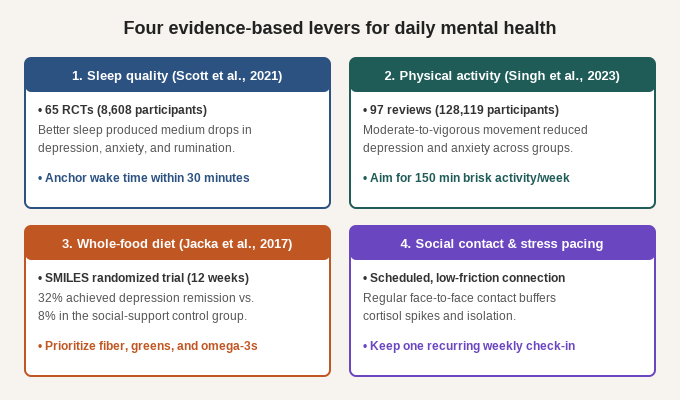
You can improve your mental health measurably by stabilizing four daily inputs: sleep timing, brisk physical activity, whole-food nutrition, and recurring face-to-face social contact. Large clinical trials show these habits reduce depression and anxiety symptoms on their own and strengthen the effect of therapy or medication when you use them together.
Most mental health advice fails because it asks people who already feel exhausted to overhaul ten habits at once. Pick one physical lever first, track it for two weeks, and let the extra energy fund the next change. I have seen more people stick to a 20-minute morning walk than to any elaborate evening wellness routine.
How much does sleep quality affect mood and anxiety?
Fixing your sleep schedule produces direct, measurable drops in depression, anxiety, and repetitive negative thinking. In a 2021 meta-analysis published in Sleep Medicine Reviews, Alexander J. Scott and colleagues analyzed 65 randomized controlled trials covering 8,608 participants and found that behavioral sleep interventions led to medium-sized improvements in composite mental health alongside clear reductions in depression, anxiety, and rumination.
Scott and his co-authors also identified a dose-response pattern: the more a participant's sleep improved, the larger their mental health gain became. That finding matters because clinicians used to treat poor sleep as a passive side effect of mood disorders rather than an active driver of them.
Locking in a consistent wake-up time works faster than trying to force yourself asleep earlier. Your circadian clock anchors to morning light hitting your retina within 30 to 60 minutes of waking, which sets a timer for melatonin release roughly 14 to 16 hours later.
- Set one wake-up window: Keep your wake time within a 30-minute range seven days a week, even after a rough night, so your sleep drive rebuilds naturally by evening.
- Get outdoor daylight early: Spend 10 to 15 minutes outside soon after waking, because outdoor overcast light delivers several thousand lux compared to roughly 300 lux indoors.
- Reserve the bed for sleep: If you lie awake watching the clock for more than 20 minutes, move to a dimly lit chair and read something dull until your eyelids feel heavy.
- Cut caffeine eight hours before bed: Caffeine has a half-life of roughly five to seven hours in most adults, meaning a 3:00 PM coffee still leaves a quarter of its dose active at midnight.
How much exercise reduces depression and anxiety symptoms?
Regular moderate-to-vigorous movement lowers depression and anxiety symptoms across healthy adults, people with clinical diagnoses, and patients managing chronic illness. In a 2023 umbrella review in the British Journal of Sports Medicine, Ben Singh and colleagues synthesized 97 systematic reviews covering 1,039 trials and 128,119 participants, concluding that physical activity interventions outperform usual care with moderate positive effects across all three outcomes.
Earlier clinical meta-analyses pointed in the same direction. Felipe B. Schuch and co-authors (2016) adjusted randomized controlled trial data for publication bias and still found a large antidepressant effect from exercise, particularly aerobic training at moderate-to-vigorous intensity in people diagnosed with major depressive disorder.
Short, consistent sessions beat ambitious gym plans that collapse by week three. A 25-minute brisk walk five days a week meets standard cardiovascular guidelines and requires zero special gear or commute time.
Intensity plays a practical role here: Singh and colleagues (2023) observed larger symptom reductions with higher-intensity activity than with light stretching alone. Pushing your heart rate into a brisk, slightly breathless pace three times a week gives your nervous system a controlled stress rehearsal that makes everyday stressors feel less threatening.
Does diet change depression and stress levels?
Shifting from ultra-processed snacks toward minimally processed whole foods lowers depressive symptoms within three months. In the 2017 SMILES randomized controlled trial led by Felice Jacka at Deakin University, 67 adults with moderate-to-severe depression were assigned either to seven dietary counseling sessions emphasizing a modified Mediterranean diet or to a social-support control group.
After 12 weeks, 32.3 percent of participants in the nutrition group met criteria for depression remission, compared with 8.0 percent in the social-support group. Neither group stopped their existing therapy or medication, which shows whole-food eating works alongside clinical care rather than against it.
Stable blood glucose also protects afternoon mood and focus. Meals built around refined sugar or white flour spike blood glucose and trigger a sharp insulin drop two hours later, which feels remarkably similar to rising anxiety: shaky hands, irritability, and brain fog.
Adding one serving of fermented food or high-fiber legumes per day supports gut microbes that produce short-chain fatty acids and communicate with the brain via the vagus nerve. You do not need an expensive supplement stack; canned sardines, oats, frozen berries, olive oil, and lentils cover the core nutrients studied in clinical nutrition trials.
Comparison of four core mental health habits
Each daily habit targets a different biological pathway and requires a different timeline before you notice results. Comparing the evidence side by side helps you pick the single change with the highest payoff for your current bottleneck.
| Daily habit | Research evidence | Minimum effective dose | Typical time to feel a shift |
|---|---|---|---|
| Consistent sleep timing | Scott et al. (2021): 65 RCTs, 8,608 participants | Fixed wake time within 30 min daily | 7 to 14 days |
| Brisk physical activity | Singh et al. (2023): 97 reviews, 128,119 participants | 20 to 30 min brisk movement, 4 to 5 days/week | 2 to 4 weeks |
| Whole-food nutrition | Jacka et al. (2017): SMILES RCT, 67 adults | Swap 1 ultra-processed meal daily for fiber + protein | 3 to 12 weeks |
| Scheduled social contact | Holt-Lunstad et al. (2010): 148 studies, 308,849 people | 1 live conversation or shared meal per week | Immediate to 2 weeks |
Why does social connection protect mental health?
Recurring face-to-face or voice contact lowers baseline stress reactivity and reduces long-term mortality risk as strongly as quitting smoking. Julianne Holt-Lunstad, Timothy B. Smith, and J. Bradley Layton (2010) analyzed 148 longitudinal studies covering 308,849 participants in PLOS Medicine and found that stronger social relationships predicted a 50 percent higher likelihood of survival across follow-up periods.
Passive social media scrolling does not deliver the same buffer because it lacks real-time vocal tone, eye contact, and mutual responsiveness. Texting memes back and forth keeps a thread alive, but hearing a friend laugh on a 15-minute phone call settles your nervous system far more reliably.
Put social contact on a calendar so it stops depending on willpower after a long workday. A standing Tuesday walk with a coworker or a Sunday coffee with a neighbor removes the friction of coordinating schedules from scratch every week.
How to shrink rumination when your mind loops
Rumination traps you in repetitive "why did I say that" loops that feel like problem-solving while generating zero solutions. Breaking that loop requires shifting from abstract self-criticism to concrete action or externalized writing.
- Run a 10-minute worry window: Write down every looping concern on paper at 5:00 PM for ten minutes, then close the notebook. Deferring intrusive thoughts to a scheduled slot reduces late-night bedtime spiraling.
- Label the emotion precisely: Naming a feeling in two or three words ("I feel resentful and overtired") dampens amygdala reactivity faster than telling yourself to calm down.
- Ask a concrete next-step question: Replace "Why am I always behind?" with "What is one 10-minute task I can finish before noon?" Action narrows attention back to what you control.
- Move your eyes and body: Changing rooms, splashing cold water on your face, or stepping onto a porch interrupts the sensory sameness that feeds mental loops.
When self-help habits are not enough
Daily habits build a sturdier baseline, yet they cannot replace professional care during a severe depressive episode, panic disorder, or trauma response. If persistent low mood, insomnia, or intrusive hopelessness lasts longer than two consecutive weeks and interferes with work or relationships, book an evaluation with a licensed therapist or primary care physician.
Cognitive behavioral therapy (CBT), acceptance and commitment therapy (ACT), and prescribed medication exist precisely for moments when biological or psychological load exceeds what lifestyle changes can carry alone. Treating therapy as a practical tune-up rather than a last resort saves months of unnecessary strain.
Frequently asked questions
Which single habit improves mental health the fastest?
Stabilizing your morning wake time and getting 10 to 15 minutes of outdoor light usually produces noticeable energy and mood improvements within 7 to 14 days. Better sleep directly lowers emotional reactivity and makes exercise, food choices, and social plans easier to maintain.
Can exercise replace therapy or antidepressant medication?
Exercise produces moderate-to-large reductions in mild and moderate depression in clinical trials, but severe depression or suicidal thoughts require direct medical and psychological care. Most clinicians recommend using physical activity alongside therapy or prescribed medication rather than stopping treatment on your own.
How many minutes of social time per week makes a difference?
Even one unhurried 30-minute in-person meetup or phone call per week measurably lowers feelings of isolation compared to text-only communication. Consistency matters more than crowd size, so one reliable weekly check-in with a close friend beats sporadic large parties.
Why do mental health routines fail after the first week?
Most people try to change sleep, diet, exercise, and screen habits simultaneously while already fatigued, which overwhelms daily bandwidth. Choosing one small anchor, such as a 20-minute walk after lunch, lets the habit stabilize before you add a second change.
Does cutting caffeine completely cure anxiety?
Stopping caffeine eliminates stimulant-driven jitters and heart palpitations for people sensitive to adenosine blockade, though it will not resolve underlying generalized anxiety or chronic life stressors on its own. Shifting your last caffeinated drink at least eight hours before bedtime is a practical first test.

- Bird Personality : Dove
- Bird Personality : Mild Dove
- Bird Personality : Smart Dove
- Bird Personality : Brave Dove
- Bird Personality : Genius Dove
- Bird Personality : Wizard Dove
- Bird Personality : Reverse Thinking Dove
- Bird Personality : Changeable Dove
- Dove Personality in Relationships: How They Show Love