How to Achieve Your Goals by Harnessing Willpower
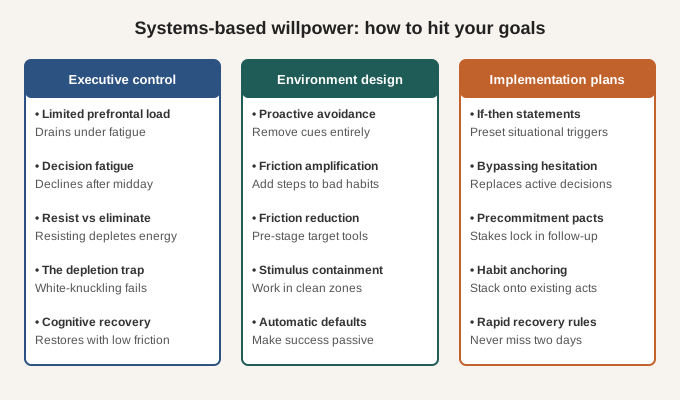
Relying on raw willpower to achieve complex long-term goals guarantees failure. Willpower is an executive control resource governed by the prefrontal cortex that degrades under physical exhaustion, stress, and continuous decision-making. Individuals who consistently execute ambitious plans do not possess superhuman reserves of moral grit; they design external systems that eliminate temptation and automate constructive action. Achieving major objectives requires shifting effort from conscious, agonizing restraint to deliberate environmental and behavioral architecture.
Psychological research over the past three decades reveals that self-control succeeds when treated as a structural design challenge rather than an internal character test. Delegating executive decisions to situational triggers, manipulating physical friction, and understanding neurological delay mechanisms transforms erratic motivation into reliable daily momentum. Strategic design beats white-knuckling every time.
The biological limits of prefrontal executive control
Conscious self-regulation depends directly on the prefrontal cortex, the seat of top-down inhibitory control, working memory, and goal-directed planning. Forcing yourself to decline a sugary snack, concentrate on dense financial reports, or suppress an impulse to check social media notifications consumes significant cognitive bandwidth in your prefrontal circuits. Neuroimaging studies confirm that sustained inhibitory demands generate measurable neural fatigue, impairing performance on subsequent executive tasks.
Social psychologists Roy Baumeister and Kathleen Vohs documented this vulnerability in early experiments on ego depletion, observing that resisting an immediate temptation sharply reduced persistence on challenging analytical puzzles immediately afterward. While contemporary researchers debate the metabolic glucose mechanisms behind this effect, the behavioral consequence remains undeniable: willpower is a finite operational burst, not an engine built for twenty-four-hour endurance.
Expecting raw willpower to sustain a six-month business launch or a thirty-pound weight loss program ignores biological reality. By late afternoon, accumulating occupational micro-decisions erode prefrontal inhibition, leaving people defenseless against conditioned impulses. Sustainable goal achievement requires preserving prefrontal energy for creative problem-solving by outsourcing basic self-discipline to automated environmental defaults.
Why high-discipline individuals rarely use willpower
The cultural archetype of the disciplined person portrays a grim ascetic locked in constant, heroic combat with internal temptation. Modern behavioral research shatters this myth completely. In a landmark 2012 experience-sampling investigation published in the Journal of Personality and Social Psychology, behavioral scientist Wilhelm Hofmann and his colleagues tracked 205 adult participants across 7,827 daily temptation reports using mobile devices.
The findings upended traditional assumptions about self-discipline. Participants who scored highest on trait self-control did not spend their days heroically resisting desires through sheer willpower. They reported significantly fewer daily temptations and experienced far less acute internal conflict than individuals with low trait self-control. Highly disciplined people do not win willpower battles; they proactively avoid fighting them.
Disciplined individuals structure their routines, physical spaces, and social commitments so that distracting stimuli rarely cross their sensory paths. A professional writer with high discipline does not sit in a room with a buzzing smartphone and exert willpower to ignore incoming messages; the writer leaves the phone in another room entirely. Proactive avoidance preserves cognitive reserves, allowing focused attention to pour unimpeded into core execution tasks.
Implementation intentions: the mathematical power of if-then planning
Transforming abstract aspirations into concrete reality requires reprogramming the brain's prospective memory systems. In 1999, psychologist Peter Gollwitzer at New York University introduced the concept of implementation intentions. Rather than relying on vague goal intentions like "I plan to exercise regularly" or "I want to finish my business plan," implementation intentions formulate strict contingency algorithms: "If situation X arises, then I will initiate response Y."
A meta-analysis conducted by Peter Gollwitzer and Paschal Sheeran in 2006 evaluated 94 independent studies encompassing over 8,000 participants across diverse health and productivity domains. The analysis demonstrated a substantial average effect size of d = 0.65 for implementation intentions over standard goal setting. Pre-specifying the exact environmental cue (the "if") links the cognitive representation of the situational cue with the mental representation of the target action (the "then").
Environmental recognition happens unconsciously. The sensory cortex detects the designated environmental trigger, such as stepping out of bed or sitting at an office desk, and immediately triggers the predetermined behavior without requiring active prefrontal debate. Bypassing internal negotiation eliminates the hesitation where decision fatigue and rationalizations typically sabotage constructive action.
Choice architecture and friction manipulation
Human behavior follows the path of least physical and psychological resistance. Behavioral scientist Wendy Wood at the University of Southern California demonstrated across decades of habit research that small adjustments to environmental friction dramatically alter behavioral outcomes. Friction refers to the number of physical steps, time delays, or cognitive barriers required to initiate an action.
To extinguish counterproductive habits that undermine your primary goals, deliberately amplify friction. Placing distracting smartphones in a timed lockbox, uninstalling time-wasting software, or storing processed snacks on the highest pantry shelf creates brief temporal buffers. A twenty-second delay provides enough time for executive deliberation to override compulsive dopaminergic urges. Impulsive behaviors dissolve when they demand deliberate physical effort.
Conversely, achieving high-priority goals requires stripping all possible friction from target behaviors. If your objective is morning creative writing, stage your desk the night before: boot the laptop, open the designated text document in fullscreen mode, and place a notebook and pen beside the keyboard. Awakening to an environment where execution requires zero preparatory friction invites immediate immersion into deep cognitive output.
Cognitive reappraisal in delay of gratification
Delaying gratification is essential for long-term goal completion, yet the internal experience of waiting often feels painful. Psychologist Walter Mischel demonstrated through his iconic Stanford Marshmallow Experiments in the early 1970s that successful delay does not stem from grim, teeth-gritting self-restraint. Mischel identified two cognitive operational modes: the "hot" emotional system, driven by the amygdala and limbic structures, and the "cool" cognitive system, driven by the prefrontal cortex.
Children who successfully delayed gratification did not stare intently at the tempting treat while demanding that themselves refrain from eating. They actively cooled the temptation using cognitive reappraisal, imagining the marshmallow as an abstract white cloud, a picture inside a frame, or a tasteless cotton ball. Transforming the subjective representation of the reward neutralizes its visceral, dopamine-driven pulling power.
Applying cognitive reappraisal to adult ambitions involves re-coding distracting temptations. Instead of viewing three hours of binge-watching as a tempting indulgence you are martyring yourself to skip, reframe the entertainment as an intentional trap designed to drain your cognitive energy and derail your financial independence. Cooling the perceived value of distractions makes sustained focus feel liberating rather than punitive.
| Goal execution strategy | Primary cognitive mechanism | Willpower consumption | Long-term success rate |
|---|---|---|---|
| Conscious white-knuckling | Reactive prefrontal inhibition against active temptation | Extreme depletion; fails under fatigue and stress | Low (under 15 percent over six months) |
| Implementation intentions | Automated contingency cues linking triggers to actions | Minimal; bypasses conscious prefrontal negotiation | High (effect size d = 0.65 across meta-analyses) |
| Choice architecture design | Manipulating physical friction to block or enable behaviors | Zero; environment makes desired choices default | Extremely high (durable across environmental changes) |
| Habit stacking | Anchoring novel routines onto stable existing neural pathways | Very low; leverages established behavioral baselines | High (compounds predictably over twelve months) |
Tailoring willpower systems to your DOPE personality archetype
Standard productivity advice assumes all individuals encounter identical behavioral roadblocks. The DOPE framework demonstrates that each personality archetype battles specific cognitive leaks requiring customized structural remedies.
Eagle personalities possess aggressive drive and rapid decision speed, but their impatience causes them to burn out through unsustainable sprint cycles. An Eagle attempts to achieve a year-long revenue goal in two months, demanding extreme hours from themselves until cognitive exhaustion forces a crash. Eagles must build hard physical boundaries into their schedules: mandated downtime, sleep hygiene rules, and structured recovery days that prevent physiological collapse.
Peacock personalities bring enormous creative enthusiasm to initial project launches, but their Achilles heel is novelty distraction. A Peacock starts ten ambitious initiatives simultaneously, abandoning each as soon as the initial dopamine rush fades. Peacocks require externalized social accountability pacts: public deadlines, project partnerships with disciplined peers, and strict rules limiting active projects to two at any given time.
Dove personalities excel in steady loyalty and consistent execution, but their desire for relational harmony causes them to sacrifice their personal goals to accommodate other people's requests. A Dove delays writing a book or pursuing a credential because family members and colleagues constantly absorb their working hours. Doves must implement assertive calendar shielding: designated, unnegotiable blocks of solitary work protected from external interruptions.
Owl personalities bring unmatched analytical precision and rigor to goal planning, yet they frequently fall victim to analysis paralysis. An Owl spends six months researching the perfect project management software, compiling spreadsheets, and identifying hypothetical failure modes without shipping a single operational asset. Owls must implement strict time-boxed constraints: an irrevocable deadline after which an asset must launch, regardless of perceived imperfections.
A four-week roadmap to build automated discipline
Systemic discipline develops through progressive environmental calibration rather than sudden emotional epiphanies. A four-week progression establishes sustainable behavioral infrastructure without exhausting cognitive reserves.
Week one focuses exclusively on an environmental friction audit. Do not attempt to overhaul your diet, write thousands of words, or launch an intense workout regimen yet. Spend seven days cataloging every environmental trigger that derails your attention: notification sounds, cluttered physical desks, visible snacks, or television placements. End the week by adding significant physical friction to your two most destructive behavioral triggers.
Week two establishes your core implementation intention blueprints. Select your single highest-priority goal and draft three precise "if-then" algorithms addressing scheduling, physical location, and obstacle management. For instance: "If the morning alarm sounds at 6:00 AM, then I will put on my running shoes placed by the bed within five minutes." Write these blueprints on cards posted in plain sight.
Week three optimizes your choice architecture for seamless execution. Strip away all preparatory hurdles for your target behavior. Stage your workspace, assemble your tools, and eliminate preliminary setup tasks twenty-four hours in advance. Combine this with habit stacking, anchoring your new objective immediately after an immutable daily habit, such as drinking your morning espresso.
Week four locks in automated accountability mechanisms. Establish an empirical tracking ledger where you record binary daily completions: a simple "yes" or "no" with zero space for qualitative excuses. Pair this record with a reliable accountability partner or financial pre-commitment pact where failure to execute triggers a designated monetary donation to a cause you dislike. By day thirty, the behavior transitions from an effortful willpower struggle into an automated daily standard.
Frequently asked questions
Can you expand your baseline willpower through deliberate practice?
Consistent engagement in small, structured acts of self-control, such as maintaining posture or tracking expenditures, produces modest improvements in general stamina over time. The primary cognitive gain comes from habituation and improved tolerance for discomfort rather than dramatic muscular expansion of the prefrontal cortex. Structural environmental adjustments deliver far greater behavioral consistency than attempts to increase raw willpower capacity.
How does physical sleep quality impact next-day self-control?
Sleep deprivation impairs glucose metabolism and neural communication between the prefrontal cortex and the amygdala. Getting fewer than six hours of sleep reduces top-down inhibitory control, increasing impulsivity, emotional reactivity, and cravings for short-term dopamine fixes. Prioritizing seven to eight hours of restorative sleep restores executive functioning far more effectively than motivational techniques.
What is the most effective way to recover after falling off track with a goal?
Self-criticism and guilt prolong lapses by triggering stress, which pushes individuals back toward comfort-seeking distractions. Psychological research by Kristin Neff demonstrates that self-compassion, combined with an immediate return to structured routines, produces faster behavioral recovery. Acknowledge the missed execution neutrally, review the environmental breakdown that enabled it, and execute the next scheduled action without compensatory over-exertion.
Why do implementation intentions outperform standard to-do lists?
Standard to-do lists outline tasks without specifying temporal or spatial execution triggers, forcing the prefrontal cortex to continually decide when and where to begin work. Implementation intentions pre-wire behavioral responses to vivid situational cues, converting conscious decisions into automatic perceptual triggers. Bypassing conscious deliberation eliminates the hesitation where procrastination takes root.
Should you pursue multiple ambitious goals simultaneously?
Pursuing multiple disparate goals simultaneously dilutes attentional resources and accelerates prefrontal fatigue. Each distinct goal demands unique cognitive processing, scheduling coordination, and behavioral inhibition. Limiting focus to one primary developmental goal and one maintenance routine maximizes cognitive bandwidth, ensuring rapid progression toward measurable milestones.
- Understanding Your Money Personality Type
- Why Might You Doubt Yourself?
- Discovering the Link Between Low Self-Esteem, Lack of Self-Awareness, and Projection
- Dermatoglyphics Multiple Intelligence Test (DMIT)
- What Are Cognitive Distortions
- Saving Your Relationship: The Importance of Marriage Counseling
- 30 Ways to Live with More Passion
- Bird Personality : Dove
- Bird Personality : Mild Dove
- Bird Personality : Smart Dove
- Bird Personality : Brave Dove
- Bird Personality : Genius Dove
- Bird Personality : Wizard Dove
- Bird Personality : Reverse Thinking Dove
- Bird Personality : Changeable Dove
- Dove Personality in Relationships: How They Show Love