What Is Positive Reinforcement?
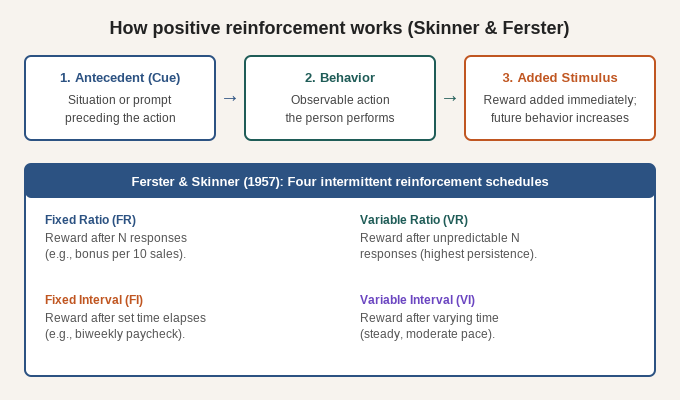
Positive reinforcement is a behavioral principle in which adding a rewarding stimulus immediately after an action increases the likelihood that the action will happen again. B.F. Skinner formalized the concept inside operant conditioning in the 1930s, building on Edward Thorndike's Law of Effect.
People routinely confuse positive reinforcement with praise in general or with "being nice," which blurs why it works. In behavioral psychology, "positive" does not mean "good" or "pleasant"; it means adding something to the environment, just like a plus sign in arithmetic.
How does positive reinforcement work in the brain and behavior?
Positive reinforcement works through a three-part sequence called the ABC contingency: an Antecedent cue sets the stage, a Behavior occurs, and a Consequence follows right away. When that added consequence satisfies a need or triggers a dopamine prediction signal, the neural pathway linking the cue and the action strengthens.
Timing determines whether the link forms. Adding a reward 200 milliseconds to a few seconds after a dog sits or a child puts away a plate binds the reward tightly to that exact action; waiting three hours until bedtime weakens the connection dramatically.
Note the strict contrast with negative reinforcement, which is the most misunderstood term in psychology. Negative reinforcement is not punishment: it strengthens a behavior by removing an unpleasant stimulus, such as fastening a seatbelt to silence a loud car chime.
Positive reinforcement vs. negative reinforcement and punishment
Behavioral scientists separate four operant consequences based on two questions: are you adding or removing a stimulus, and does the target behavior increase or decrease afterward? This 2x2 grid clears up decades of textbook confusion.
| Quadrant | Action taken | Effect on behavior | Everyday example |
|---|---|---|---|
| Positive reinforcement | Add a valued stimulus | Increases behavior | Giving specific praise right after a teammate shares a clear status update |
| Negative reinforcement | Remove an aversive stimulus | Increases behavior | Taking ibuprofen to stop a tension headache |
| Positive punishment | Add an aversive stimulus | Decreases behavior | Receiving a $150 speeding ticket for driving 20 mph over the limit |
| Negative punishment | Remove a valued stimulus | Decreases behavior | Losing screen privileges for 24 hours after breaking curfew |
What did Ferster and Skinner prove about reinforcement schedules?
In 1957, Charles B. Ferster and B.F. Skinner published Schedules of Reinforcement, a massive experimental analysis showing that *when* you deliver a reward shapes behavior persistence even more strongly than *what* the reward is. Continuous reinforcement—rewarding every single instance—builds a brand-new habit quickly, while intermittent schedules make an established habit remarkably resistant to quitting.
Ferster and Skinner grouped intermittent schedules into four core patterns based on response count (ratio) or elapsed time (interval):
- Fixed Ratio (FR): A reward arrives after a set number of actions, such as a coffee shop punch card giving a free drink on the tenth visit. People work briskly right up to the target, then pause briefly afterward.
- Variable Ratio (VR): A reward arrives after an unpredictable number of actions, such as slot machines or sales cold calls. Variable ratio schedules produce the highest, steadiest response rates and resist extinction longest.
- Fixed Interval (FI): A reward becomes available once a set time passes, such as biweekly paychecks or checking an oven timer. Activity tends to spike right before the deadline and drop immediately after.
- Variable Interval (VI): A reward arrives after varying lengths of time, such as checking email for an important reply or waiting for fish to bite. This schedule produces a steady, moderate pace of behavior.
Primary vs. secondary reinforcers and shaping complex skills
Behavioral psychologists divide reinforcers into two categories: primary and secondary. Primary reinforcers satisfy biological needs without prior learning—food, water, warmth, and relief from physical discomfort. Secondary (or conditioned) reinforcers acquire their power because people learn to associate them with primary rewards or social security; money, verbal praise, gold stars, and high-fives all fall into this group.
In animal training, handlers pair a secondary cue like a clicker sound with a small treat dozens of times until the click alone signals incoming food. That conditioned sound solves a practical timing problem because you can click the exact millisecond a dog's paws touch the floor, even if reaching into your treat pouch takes two seconds longer.
Shaping uses that same immediate feedback to teach complex behaviors that a learner never performs spontaneously at full difficulty. Instead of waiting for a shy speaker to deliver a flawless 10-minute presentation, you reinforce each successive approximation: first making eye contact with two people, then speaking for 60 seconds without notes, and finally fielding one audience question. Each small win builds momentum toward the full skill.
Why Alan Kazdin's "positive opposite" beats constant punishment
Yale psychologist Alan E. Kazdin spent decades translating Skinner and Ferster's lab findings into clinical Parent Management Training for children with severe oppositional behavior. Kazdin's research showed that relying primarily on scolding or punishment suppresses unwanted acts temporarily while teaching zero replacement skills.
Instead, Kazdin recommends defining the "positive opposite" of any annoying habit and reinforcing it systematically. If a child yells when frustrated, the positive opposite is asking for help in a calm voice or taking two minutes in a quiet corner; reinforcing those specific moments builds the new habit far faster than lecturing about yelling.
Kazdin also emphasizes labeled praise over vague praise. Saying "Good job" bounces off most kids and adults alike, whereas saying "I noticed you started your homework right at 4:00 PM without being asked, and that made our evening much smoother" tells the brain exactly which behavior earned the payoff.
How to use positive reinforcement effectively at home and work
Most failed reward systems collapse because people accidentally reinforce the wrong moment or let the reward turn stale. Applying four practical rules keeps the system clean and effective.
- Deliver the consequence immediately: Acknowledge finished work, helpfulness, or focused effort while the action is still fresh, rather than saving all feedback for an annual performance review or Friday night.
- Match the reinforcer to the person: A stimulus only counts as a reinforcer if the recipient values it and repeats the behavior. Stickers motivate five-year-olds; autonomy, public credit, or leaving early on Friday motivate adult employees.
- Start continuous, then thin the schedule: Reward every successful rep during week one of a new habit, then shift to intermittent praise or occasional bonuses once the routine runs smoothly.
- Avoid bribing during a meltdown: Offering ice cream *while* a toddler is screaming to make them stop teaches the child that screaming produces ice cream. Wait for a calm breath, prompt a small cooperative step, and reward that step instead.
Self-reinforcement works on personal habits using the exact same rules. Pairing a tedious chore like tax prep or inbox cleanup with a specific podcast you save exclusively for that task gives your brain an immediate payoff right when you sit down to start.
Common mistakes that make rewards backfire
Positive reinforcement fails when managers or parents treat rewards as manipulation rather than clear feedback. Edward Deci and Richard Ryan's self-determination research showed that handing out predictable cash prizes for tasks people already enjoy purely out of curiosity can occasionally dampen intrinsic interest once the cash stops.
That overjustification risk shrinks dramatically when rewards stay informational—highlighting competence and genuine progress—rather than controlling. Unexpected recognition, specific skill feedback, and earned autonomy rarely undermine intrinsic motivation and frequently boost it.
Another trap is moving the goalpost too fast. Raising expectations before a beginner has succeeded three or four times in a row turns reinforcement into frustration and causes people to quit trying altogether.
Delayed or inconsistent follow-through also breaks trust in any incentive plan. If you promise a team lunch or a weekend outing for hitting a Friday target and then push it off for three weeks because you got busy, the reward loses its motivational pull the next time you announce a goal.
Frequently asked questions
Is positive reinforcement the same as bribery?
No. Bribery happens before or during misbehavior to persuade someone to stop acting out ("Stop crying and I will buy you a toy"), whereas positive reinforcement happens immediately after a desired behavior to strengthen that habit.
How fast does positive reinforcement change a habit?
Simple behaviors reinforced immediately on a continuous schedule often show measurable increases within days. Complex habits like independent studying or calm conflict resolution usually take two to four weeks of consistent reinforcement and gradual schedule thinning.
Does positive reinforcement work on adults at work?
Yes, adult behavior responds strongly to immediate, specific recognition, autonomy, and fair performance bonuses. Vague annual reviews are too delayed to shape daily habits, whereas timely feedback right after a strong presentation or clean handoff reinforces those exact actions.
Can you accidentally reinforce unwanted behavior?
Yes, attention itself acts as a strong reinforcer. Arguing for ten minutes with a disruptive student or replying instantly only when a coworker sends frantic all-caps emails often increases those exact behaviors because they reliably trigger a reaction.
What is a token economy in behavioral psychology?
A token economy is a structured reinforcement system where individuals earn points, chips, or checkmarks immediately for target behaviors and later exchange them for larger backup rewards. Alan Kazdin and clinical behavior analysts use token systems widely in classrooms and family programs because tokens bridge the gap between immediate feedback and bigger privileges.
- Bird Personality : Changeable Eagle
- Tips for Creating a Plan to Achieve Your Goals
- How Different Personality Types Handle Conflict in Relationships
- How Childhood Personality Predicts Adult Relationship Patterns
- What is a Victim Complex?
- What is Hoarding Disorder?
- What Are Temperaments? Understanding the Human Psyche
- Bird Personality : Dove
- Bird Personality : Mild Dove
- Bird Personality : Smart Dove
- Bird Personality : Brave Dove
- Bird Personality : Genius Dove
- Bird Personality : Wizard Dove
- Bird Personality : Reverse Thinking Dove
- Bird Personality : Changeable Dove
- Dove Personality in Relationships: How They Show Love