5 Calming Smartphone Apps for Better Mental Health
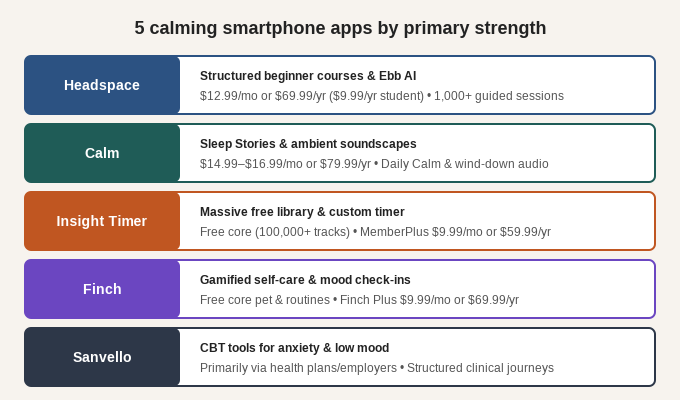
Headspace, Calm, Insight Timer, Finch, and Sanvello are five of the most reliable calming smartphone apps for lowering daily stress, improving sleep wind-down, and building steady mood habits. Choosing the right one comes down to whether you want structured beginner meditation, audio sleep stories, a large free library, gamified self-care, or cognitive behavioral therapy (CBT) exercises.
Randomized trial data backs up the broader category, even if no app replaces a licensed therapist during a crisis. In a 2017 meta-analysis in World Psychiatry, Joseph Firth and colleagues pooled 18 randomized controlled trials covering 3,414 participants and found that smartphone-based mental health interventions reduced depressive symptoms significantly compared with control conditions, with larger gains when the app did not require constant human coaching just to stay usable.
Side-by-side comparison of 5 calming mental health apps
Pricing and access models differ sharply across these five platforms. Reviewing the cost and primary strength up front saves you from paying for a year-long subscription whose format annoys you by week two.
| App | Best for | Pricing (USD) | Standout feature |
|---|---|---|---|
| Headspace | Structured beginner meditation | $12.99/mo or $69.99/yr ($9.99/yr student) | Step-by-step courses, Sleepcasts, and Ebb AI guide |
| Calm | Sleep wind-down and audio relaxation | $14.99 to $16.99/mo or $79.99/yr ($499.99 lifetime) | Celebrity-narrated Sleep Stories and Daily Calm |
| Insight Timer | Free meditation library and timer | Free core; MemberPlus $9.99/mo or $59.99/yr | Over 100,000 free tracks and customizable bell timer |
| Finch | Gamified self-care and check-ins | Free core; Finch Plus $9.99/mo or $69.99/yr | Virtual pet bird that grows as you log daily habits |
| Sanvello | CBT mood tracking and anxiety tools | Primarily via employer or health-plan benefits | Structured CBT journeys and coping worksheets |
1. Headspace: structured courses for people who want clear progression
Headspace excels when you have tried sitting quietly on your own and given up after four minutes because your thoughts felt too loud. The app organizes mindfulness into short, sequential 10-day courses that teach one concrete skill per session, such as noting wandering thoughts or scanning physical tension from head to toe.
Beyond basic meditation, Headspace includes more than 1,000 guided tracks, gentle movement videos, focus playlists, and Sleepcasts designed to quiet racing thoughts at bedtime without jarring volume spikes. Its newer Ebb conversational tool helps match you to an exercise when you feel too scattered to browse menus.
Cost is $12.99 per month after a 7-day trial, or $69.99 per year with a 14-day trial, while verified college students pay $9.99 per year and families can share up to six accounts for $99.99 annually. If you drop out of unguided routines quickly, that structured progression earns its subscription fee.
2. Calm: sleep stories and high-production audio for racing nights
Calm focuses less on teaching formal meditation theory and more on down-regulating an overstimulated nervous system at the end of the day. Its flagship Sleep Stories feature slow-paced narration by familiar voices over soft ambient soundscapes, giving your brain a gentle narrative track to follow instead of rehearsing tomorrow's inbox.
During the day, Calm offers a 10-minute Daily Calm session, breathing timers, stretching videos under Calm Body, and long focus mixes engineered for reading or deep work. The audio production quality is noticeably warmer and less clinical than standard wellness apps.
Subscriptions run around $14.99 to $16.99 per month depending on app store billing, or $79.99 per year with a 7-day trial, plus a $119.99 family plan for six adults and a $499.99 one-time lifetime option. The catch is that Calm's free tier is thin, so expect to commit to a paid plan if you rely on it nightly.
3. Insight Timer: over 100,000 free tracks without a paywall
Insight Timer flips the subscription model by keeping its core library free permanently. You get access to more than 100,000 guided meditations from thousands of teachers, live community groups, and a clean customizable meditation timer with interval bells and ambient background sounds.
Having that much variety lets you test different accents, pacing styles, and traditions—from body scans and loving-kindness practice to yoga nidra—without paying upfront. I prefer Insight Timer for unguided 15-minute morning sits because the interval bells sound crisp and the app does not nag you with upsells every time you open it.
Upgrading to MemberPlus ($9.99 per month or $59.99 per year) adds multi-session structured courses, offline downloads for flights, and audio rewind controls. Most casual users never need to pay a dollar to get full daily value.
4. Finch: gentle habit building for low-energy days
Finch approaches mental health from behavioral activation rather than audio meditation, which makes a huge difference if sitting still with your eyes closed makes you more anxious. You adopt a small virtual bird that gains energy and goes on daily adventures whenever you check off basic self-care tasks: drinking water, stepping outside for five minutes, or naming three things that went well.
That light gamification lowers the friction of depressed or burned-out mornings without punishing you for missed streaks. Unlike harsh productivity apps that reset your progress to zero after one bad day, Finch keeps its tone encouraging and lets you log brief mood check-ins, breathing exercises, and grounding prompts in under two minutes.
Core pet care, habit lists, reflections, and mood tracking stay free forever. Finch Plus costs $9.99 per month or $69.99 per year and unlocks extra outfit shops, extended soundscapes, and bonus reflection prompts, though the free version covers all essential mental health tools.
5. Sanvello: structured CBT tools through health plans
Sanvello is built around cognitive behavioral therapy (CBT) and mindfulness rather than pure relaxation audio. Inside the app, you work through guided journeys for anxiety, social stress, and low mood, log daily thought distortions, and track how specific triggers affect your energy over weeks.
Sanvello shifted away from standard direct-to-consumer subscriptions toward employer benefits and health insurance partnerships. Before paying out of pocket anywhere else, check your workplace Employee Assistance Program (EAP) or health insurer portal to see if Sanvello is already covered at zero cost for you.
Because CBT asks you to challenge unhelpful thoughts on paper rather than just listen passively, Sanvello feels closer to a digital workbook than a spa soundtrack. That active work takes slightly more effort per session and pays off well for people dealing with recurring worry loops.
How to pick the right calming app and actually stick with it
Downloading three apps at midnight and opening none of them by Thursday is the most common mistake people make. Matching one app to one concrete daily trigger keeps the habit alive past week one.
- Pick your main bottleneck first: Choose Calm or Headspace Sleepcasts if your issue is falling asleep; pick Finch if you struggle to get out of bed and complete basic routines; pick Insight Timer if you want free daytime resets; check Sanvello if you want structured CBT thought logs.
- Attach the app to an existing anchor: Open a 5-minute session right after brushing your teeth at night or immediately after closing your laptop at 5:30 PM, rather than waiting until you "feel stressed."
- Turn off noisy wellness notifications: Keep one gentle daily reminder and mute streak-shaming badges, which tend to add guilt rather than calm.
- Use grayscale or Do Not Disturb after opening: Opening a calming app on a phone packed with red notification bubbles pulls your attention back into work messages within seconds.
When a smartphone app is not enough
Calming apps work well for mild daily stress, sleep hygiene, and building emotional awareness, yet they cannot treat severe panic attacks, clinical depression, bipolar disorder, or trauma on their own. Research reviews consistently show smaller symptom drops for standalone apps than for live cognitive behavioral therapy with a trained clinician.
If an app leaves you feeling agitated, or if low mood and sleeplessness last longer than two weeks and disrupt your job or relationships, use the app as a temporary log to bring concrete mood notes to a licensed therapist or doctor. Having two weeks of sleep and trigger entries ready saves time during your first intake session.
Frequently asked questions
Which calming mental health app has the best free version?
Insight Timer offers the largest free audio library with more than 100,000 guided meditations and a customizable timer at no cost. Finch also keeps its core habit tracker, mood check-ins, breathing tools, and virtual pet completely free without locking essential features behind a trial.
Are meditation apps scientifically proven to reduce anxiety?
Clinical meta-analyses show modest, reliable reductions in stress, anxiety, and mild depressive symptoms when people use mindfulness or CBT apps consistently for four to eight weeks. A 2017 meta-analysis by Joseph Firth and colleagues across 18 randomized trials confirmed significant drops in depressive symptoms compared with waitlist controls.
Is Calm or Headspace better for beginners?
Headspace is usually easier for complete beginners who want step-by-step instruction on how meditation works and what to do when thoughts wander. Calm works better if you care less about learning formal meditation and mainly want soothing sleep stories and ambient background music.
Can calming apps replace therapy?
No, smartphone apps serve as daily support tools for stress management, sleep wind-down, and self-reflection rather than replacements for clinical diagnosis or psychotherapy. Moderate-to-severe anxiety, persistent depression, and trauma respond much better to professional care.
How many minutes a day should you use a mindfulness app?
Starting with five to ten minutes once a day builds consistency far more reliably than aiming for 30-minute sessions and quitting after three days. Most clinical trials on app-based mindfulness see measurable stress benefits from 10 minutes of daily practice over four to six weeks.
- Insomnia : Prevention and Treatment
- 12 Ways to Inject More Positivity into Your Love Life
- Being Mindful and Open-Minded
- Cognitive Behavioral Therapy for Better Mental Health
- Eating Disorders : Symptoms, Types, Causes and Treatments
- Owl Personality Type: Traits, Strengths, and Weaknesses
- What You Need to Know to Deal with a Narcissistic Husband
- Bird Personality : Dove
- Bird Personality : Mild Dove
- Bird Personality : Smart Dove
- Bird Personality : Brave Dove
- Bird Personality : Genius Dove
- Bird Personality : Wizard Dove
- Bird Personality : Reverse Thinking Dove
- Bird Personality : Changeable Dove
- Dove Personality in Relationships: How They Show Love