What is the Law of Attraction?
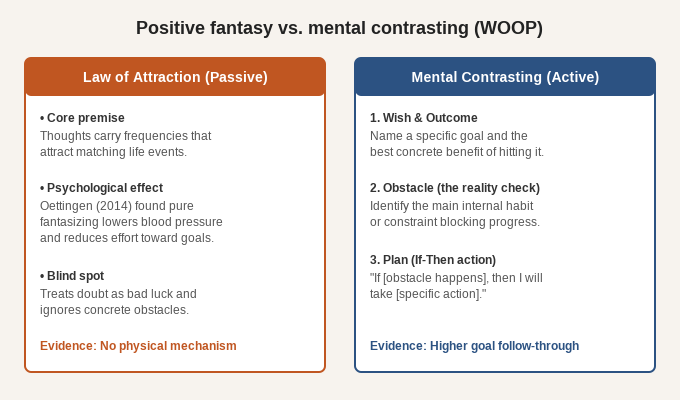
The Law of Attraction is a New Thought belief claiming that positive or negative thoughts carry energetic frequencies that magnetically draw matching experiences, wealth, or relationships into your life. Physics and neuroscience offer zero evidence that human thoughts emit signals capable of rearranging external reality, though expectations do change how you notice opportunities and act on them.
Knowing where the mystical claim stops and real psychology begins saves you from two common traps: waiting passively for a vision board to pay your rent, or blaming yourself when illness or layoffs hit because you supposedly "attracted" bad luck.
Where did the Law of Attraction come from?
Although modern influencers talk as if the Law of Attraction is an ancient law of physics, the phrase grew out of the 19th-century American New Thought movement. Writers like Phineas Quimby and Prentice Mulford argued that mental attitudes shape physical health and prosperity.
Author William Walker Atkinson popularized the exact term in his 1906 book Thought Vibration or the Law of Attraction in the Thought World, comparing human thoughts to radio waves tuning into matching frequencies. Exactly a century later, Rhonda Byrne's 2006 film and book The Secret turned the concept into a global pop-culture phenomenon, selling tens of millions of copies worldwide.
That publishing history explains why the vocabulary mixes loose spiritual metaphors with borrowed physics terms like "vibration," "quantum," and "energy." None of those terms carry their actual scientific definitions inside Law of Attraction books. Still, those books often tuck practical habits—writing clear goals, reading daily reminders, and networking bravely—inside cosmic packaging, which creates the illusion that the cosmic claim caused the result.
What does psychology say about positive fantasies?
Indulging in pure positive fantasies—imagining a promotion, clean health report, or dream apartment as if it has already happened—often reduces your actual effort toward achieving it. Gabriele Oettingen, a psychology professor at New York University and the University of Hamburg, summarized two decades of experiments in her 2014 book Rethinking Positive Thinking.
Across multiple studies of dieters, college graduates seeking jobs, and surgery patients, Oettingen measured how vividly participants fantasized about effortless success versus how realistically they expected to succeed. Participants who spent more time daydreaming about wonderful outcomes showed lower systolic blood pressure—a sign of physical relaxation—and put in less effort, applied to fewer jobs, and earned lower starting salaries two years later.
Your brain partially mistakes a vivid daydream for an accomplished fact, releasing a quiet wave of satisfaction before you have done any work. Positive expectations grounded in past preparation help you persist; ungrounded fantasies sedate you.
Law of Attraction vs. Mental Contrasting (WOOP)
Replacing wishful manifesting with a structured reality check turns optimism into usable fuel. Oettingen's Mental Contrasting with Implementation Intentions—widely taught under the acronym WOOP—bridges the gap between wanting something and changing your behavior.
| Dimension | Law of Attraction | Mental Contrasting (WOOP) |
|---|---|---|
| Core mechanism | Assumes thoughts vibrate outward to attract matching events | Pairs desired outcome with concrete internal obstacles and if-then plans |
| View of obstacles | Treats doubt or problem-spotting as negative energy to suppress | Requires naming the main obstacle directly so you can plan around it |
| Effect on energy | Often lowers blood pressure and reduces follow-through (Oettingen, 2014) | Raises physiological energy when the goal is realistic and achievable |
| Empirical backing | No controlled physical or clinical evidence for "manifesting" | Tested across randomized trials in health, academics, and time management |
Why does the Law of Attraction feel true to believers?
Millions of smart people swear the Law of Attraction worked for them because several genuine psychological effects mimic "manifesting" in everyday life. You do not need cosmic magnetism to explain why writing down a goal sometimes coincides with landing a new client.
- Selective attention (the Baader-Meinhof effect): Once you decide you want a red hatchback or a remote marketing role, your brain's reticular activating system filters out background noise and flags matching cars or job postings you walked past for months.
- Self-fulfilling expectations (the Pygmalion effect): In 1968, Robert Rosenthal and Lenore Jacobson told elementary teachers that randomly chosen students were "intellectual bloomers." By year's end, those students scored higher on IQ tests because teachers unconsciously gave them warmer feedback, harder material, and more encouragement.
- Behavioral confidence: When you genuinely expect a networking coffee chat to go well, you smile more, ask sharper questions, and follow up two days later—actions that directly raise your odds of getting referred.
- Survivorship and confirmation bias: People post loud social media stories the week a visualization coincided with a lucky break, while quietly deleting or forgetting the 20 vision-board goals that never happened.
The hidden harm: toxic positivity and self-blame
Believing that thoughts alone govern reality turns painful when life delivers something genuinely outside your control. Under strict Law of Attraction logic, chronic illness, bereavement, or economic recessions happen because the victim held "low-vibration thoughts" or doubted too much.
I find that moralizing twist the ugliest side of manifestation culture. Telling someone grieving a diagnosis or laid off during an industry downturn that they "manifested" their hardship adds unnecessary shame onto real pain and discourages people from seeking practical medical, legal, or financial help.
Healthy optimism acknowledges external constraints—rent prices, family caretaking, uneven job markets—without surrendering agency over the next small move you can make. Accepting what is hard right now does not curse your future; it gives you an honest starting point for solving real problems.
How to use WOOP instead of passive manifesting
If you like the clarity of setting intentions and visualizing goals, you can keep that habit and make it scientifically effective in under five minutes using Gabriele Oettingen's four-step WOOP sequence.
- Wish: Name one specific, challenging, achievable goal for the next four weeks, such as finishing your portfolio site or running three times a week.
- Outcome: Spend 60 seconds picturing the best concrete result of hitting that goal and how it would feel in daily life.
- Obstacle: Ask yourself what *internal* habit, emotion, or distraction inside your own control is most likely to derail you—for instance, scrolling on your phone after dinner until 10:00 PM.
- Plan: Write one clear if-then rule: "If I feel the urge to scroll after dinner, then I will put my phone on the kitchen charger and open my laptop for 20 minutes."
Actionable habits that beat vision boards
Turning a vague wish into measurable progress relies on concrete cues rather than repeating affirmations in a mirror. Pair WOOP with three practical habits that keep your attention on execution.
First, track leading inputs rather than lagging outcomes. You cannot control whether a hiring manager replies on Tuesday, yet you can control sending four tailored applications and two informational interview requests before Friday at noon.
Second, ground any self-talk in values you already live by instead of wild financial claims. Geoffrey Cohen and David Sherman's self-affirmation studies showed that writing for 10 minutes about a personal value you care about—such as family, curiosity, or craftsmanship—lowers stress reactivity during high-stakes tasks. By contrast, Joanne Wood and colleagues (2009) at the University of Waterloo found that repeating overly rosy statements ("I am completely lovable") actually lowered mood among people with low self-esteem because their internal skepticism pushed back.
Third, schedule a 10-minute Sunday review to inspect what actually moved forward and where your plan stalled. Adjusting an obstacle strategy after one missed week builds real competence, whereas staring harder at a collage of luxury cars changes nothing on Monday morning. Over six months, small weekly adjustments compound into tangible results that passive manifesting cannot match.
Frequently asked questions
Is there any scientific proof for the Law of Attraction?
No controlled scientific study supports the claim that thoughts emit physical frequencies capable of attracting external objects or events. Psychological research does show that clear goals, realistic expectations, and structured action plans improve follow-through and help you spot relevant opportunities.
Why can positive visualization sometimes backfire?
Research by psychologist Gabriele Oettingen (2014) found that indulging in pure positive fantasies tricks the brain into relaxing as if the goal is already complete, lowering blood pressure and reducing effort. Pairing visualization with an honest look at obstacles fixes that drop in energy.
What is the difference between the Law of Attraction and the Pygmalion effect?
The Law of Attraction claims thoughts directly reshape the universe through invisible energy, whereas the Pygmalion effect (Rosenthal & Jacobson, 1968) is an observable social mechanism where higher expectations cause people to treat others differently—giving more feedback, warmth, and attention—which improves real performance.
Do affirmations work at all?
Brief self-affirmations reminding you of core personal values can buffer stress before a tough exam or interview, especially when you already believe the statement is plausible. Repeating exaggerated claims like "I am a billionaire" when your bank account is overdrawn often triggers internal disbelief and lowers mood.
What should you do instead of making a vision board?
Use Gabriele Oettingen's WOOP method (Wish, Outcome, Obstacle, Plan) to pair your goal with the main habit likely to block you and a concrete if-then rule. Tracking weekly inputs—such as hours practiced, applications sent, or workouts completed—produces far more reliable progress than passive collage boards.
- Anxiety Disorders : Types, Symptoms and Treatments
- What is Bipolar Disorder?
- How to be Successful in Life - 40 Powerful Tips
- Intelligence Quotient (IQ) and Tips to Improve It
- Bird Personality : Changeable Owl
- How Culture Shapes the Way We Express Personality
- 11 Things You Must Give up To Have a Better Future
- Bird Personality : Dove
- Bird Personality : Mild Dove
- Bird Personality : Smart Dove
- Bird Personality : Brave Dove
- Bird Personality : Genius Dove
- Bird Personality : Wizard Dove
- Bird Personality : Reverse Thinking Dove
- Bird Personality : Changeable Dove
- Dove Personality in Relationships: How They Show Love