How to Stop Guilt Tripping
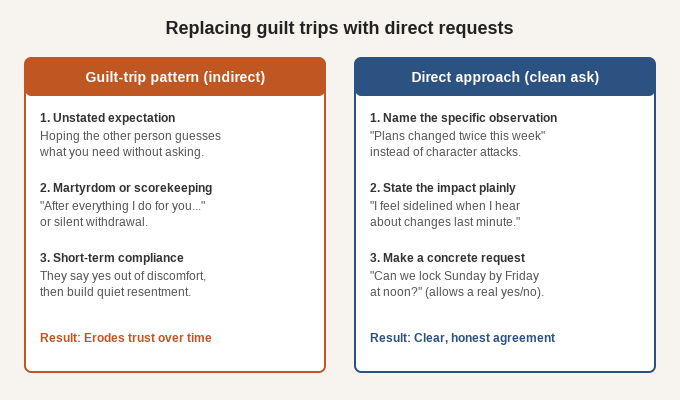
To stop guilt tripping, replace indirect hints, scorekeeping, and martyred silence with plain requests that state what you observed, how it affected you, and what specific action you want next. Guilt trips persist because they often get short-term compliance, even though they quietly erode trust and build resentment on both sides.
Most people do not set out to manipulate anyone when they guilt trip a partner, child, or coworker. They usually feel unheard, scared of direct rejection, or exhausted from carrying unspoken expectations. Naming the habit without melodrama is the fastest way out of it.
Why do people guilt trip in close relationships?
People guilt trip because human beings are wired to feel distress when they believe they let down someone they care about, and an indirect hint exploits that wiring without risking an open confrontation. In a landmark 1994 paper in Psychological Bulletin, Roy F. Baumeister, Arlene M. Stillwell, and Todd F. Heatherton argued that guilt is primarily an interpersonal emotion built to protect communal relationships.
Baumeister and his colleagues showed that guilt happens most intensely between people who share mutual care expectations: spouses, parents, adult children, and close friends. They also noted that partner-induced guilt often serves as leverage for someone who feels less powerful in a relationship, forcing the other person to share emotional distress and comply.
Normal guilt says, "I broke my promise and hurt you, so I want to make it right." A guilt trip says, "Look how much I suffer because of you; now give me what I want so I stop hurting."
How to tell if you are guilt tripping someone
Spotting your own guilt trips feels uncomfortable because the habit often disguises itself as generosity or wounded loyalty. Watch for these four behavioral cues in your daily conversations:
- Keeping an unspoken ledger: You remind someone of past favors ("After everything I gave up for you...") right when you want a current favor or concession.
- Using absolute blame words: Phrases starting with "You always forget..." or "You never care..." frame a single missed task as a permanent moral flaw.
- Playing the silent martyr: You insist "No, go ahead, I will just stay home alone and clean up" while sighing loudly enough to force the other person to cancel their plans.
- Withdrawing warmth as leverage: Instead of saying "I felt hurt when you canceled," you go cold for two days until the other person guesses what went wrong and apologizes.
Guilt tripping vs. direct communication
Seeing the contrast between an indirect guilt hook and a direct request makes it much easier to rewrite your sentence before you hit send. The table below pairs common everyday lines with direct alternatives that allow a real yes or no.
| Situation | Guilt-trip version | Direct request version |
|---|---|---|
| Skipped family dinner | "I cooked for three hours, but clearly work matters more than us." | "I missed you at dinner tonight. Can we lock Sunday at 6:00 PM on both calendars?" |
| Unanswered text message | "I guess I am just not a priority anymore." | "I get anxious when I do not hear back before evening. Can you send a quick thumbs-up if you are swamped?" |
| Chore imbalance | "Nobody helps around here unless I beg." | "I am wiped out after work. Will you handle dishes tonight while I fold laundry?" |
| Friend declining plans | "Real friends make time for each other." | "I miss hanging out. Are you free for coffee next Saturday morning?" |
Five steps to stop guilt tripping others
Breaking an ingrained communication habit takes deliberate pauses in the moment rather than vague promises to be nicer. Follow these five steps the next time you feel overlooked or frustrated.
- Pause for 60 seconds before speaking: Sharp resentment pushes you toward dramatic exaggerations. Taking one slow breath or stepping into another room gives your prefrontal cortex time to choose plain words.
- State the concrete fact without mind-reading: Replace "You do not respect my time" with "You arrived 35 minutes after we agreed to meet." Facts are much easier to discuss than character verdicts.
- Own your feeling in one short sentence: Say "I felt frustrated waiting outside" instead of "You made me look foolish." Owning the emotion keeps the other person from getting defensive before hearing your point.
- Ask for one specific behavior change: Vague complaints like "Be more considerate" leave people guessing. Ask for a concrete action: "Text me by 5:00 PM if traffic is going to delay you."
- Accept a real "no" without punishing them: A request only counts as a request if the other person can decline without facing silent treatment. If they say no, negotiate an alternative date or solve the task another way.
Why direct asks feel scarier than guilt trips
Direct requests expose you to immediate, unambiguous rejection, whereas guilt trips keep rejection blurry. If you ask a friend for help and they say no, you have to tolerate that disappointment out in the open. If you drop a hint about how overwhelmed and alone you feel, you protect your pride while nudging them to volunteer.
That short-term emotional shield carries a steep tax. Partners and coworkers eventually recognize the hook, stop feeling genuine empathy, and start avoiding you altogether to escape the constant sense of owing a debt.
I have noticed that people who grew up in households where open disagreement was punished often rely on guilt trips well into adulthood because indirect pressure was the only safe tool they saw modeled. Unlearning it feels clumsy at first, like speaking a second language, and that awkwardness fades quickly once you see how cleanly direct conversations resolve tension.
How to respond when someone guilt trips you
Stopping your own guilt trips is half the equation; you also need a steady response when a parent, partner, or colleague tries to steer you with guilt. Reacting with anger feeds the drama, while caving in teaches them the tactic works.
- Acknowledge their feeling without accepting blame: Say "I hear you are disappointed I cannot make Friday" instead of defending your entire week's schedule.
- State your boundary calmly and once: Follow up with "I still cannot shift my Friday deadline, and I would love to see you Sunday afternoon." Repeating long excuses invites debate over which excuse is valid.
- Separate care from compliance: You can care deeply about someone's disappointment without fixing it by abandoning your own limits.
- Name the dynamic gently in close relationships: With a partner you trust, say "When you say I never put you first, I shut down. Tell me what specific plan you want this week."
How guilt tripping differs in family vs. workplace settings
Guilt tripping takes different shapes depending on whether the relationship runs on personal affection or professional obligation. At home, parents, partners, and siblings lean on history, sacrifice, and loyalty ("I drove you to practice for ten years, and you cannot visit for one weekend?"). Because family bonds carry deep attachment history, those remarks trigger instant obligation even when the request is unreasonable.
At work, guilt tripping wears a team-spirit disguise. A manager or coworker might say, "Everyone else stayed until 8:00 PM to finish the deck, so I assumed you cared about the launch too," or "No worries, I will just cover your section over the weekend myself." Both lines try to extract unpaid overtime by framing a normal boundary as selfishness.
Handling workplace guilt trips works best when you bring the conversation back to written priorities and capacity. Ask, "Which deliverable should move to Tuesday if I take on this urgent task today?" That single question forces a trade-off out into the open without sounding defensive or resentful.
When guilt tripping signals a deeper pattern
Occasional guilt-laced remarks happen in stressed families and tired marriages, and most people adjust once someone points it out respectfully. Chronic guilt tripping paired with humiliation, isolation from friends, or threats of self-harm crosses into emotional abuse rather than sloppy communication.
If someone punishes every boundary you set with days of hostility or insists you owe them total access to your time, individual counseling or couples therapy provides a structured space to reset expectations safely. Healthy relationships leave room for both people to say no without fear.
Frequently asked questions
Is guilt tripping always intentional manipulation?
No, many people guilt trip out of habit or fear of asking directly for help, especially if they grew up watching relatives communicate through hints and martyrdom. Regardless of intent, the effect on trust is the same, so replacing hints with direct requests fixes the pattern.
What is the difference between valid guilt and a guilt trip?
Valid guilt follows an actual broken commitment or hurt and motivates you to apologize and repair the mistake. A guilt trip exaggerates obligation or weaponizes past favors to pressure someone into complying against their own boundaries.
How do I apologize if I just caught myself guilt tripping?
Keep the apology short and specific without making the other person comfort you. Say, "That comment about nobody helping me was unfair and passive-aggressive. What I actually meant to ask is whether you can take out the trash before 8:00 PM."
Can children learn guilt-tripping habits from parents?
Yes, children absorb conversational patterns by watching how adults handle disappointment and conflict at home. Modeling direct requests and apologizing cleanly teaches kids to express needs without emotional pressure.
What should I do if my boundary triggers an even bigger guilt trip?
Hold your boundary calmly without arguing over your reasons, because long justifications give the other person more hooks to pull on. Repeat your limit once, offer a concrete alternative if you want one, and step back from the conversation if hostility escalates.
- Cognitive Behavioral Therapy for Better Mental Health
- How to Feel Good About Yourself?
- INFJ Personality Test: Discover Your Inner Counselor
- Tips to Achieve Your Goals
- Personality Disorders Explained: A Beginner's Guide
- Nature vs Nurture: How Much of Your Personality Is Genetic?
- What Is the Difference Between Personality and Character and Why It Matters

- Bird Personality : Dove
- Bird Personality : Mild Dove
- Bird Personality : Smart Dove
- Bird Personality : Brave Dove
- Bird Personality : Genius Dove
- Bird Personality : Wizard Dove
- Bird Personality : Reverse Thinking Dove
- Bird Personality : Changeable Dove
- Dove Personality in Relationships: How They Show Love