Peacock Personality at Work: Managing the Team's Energizer
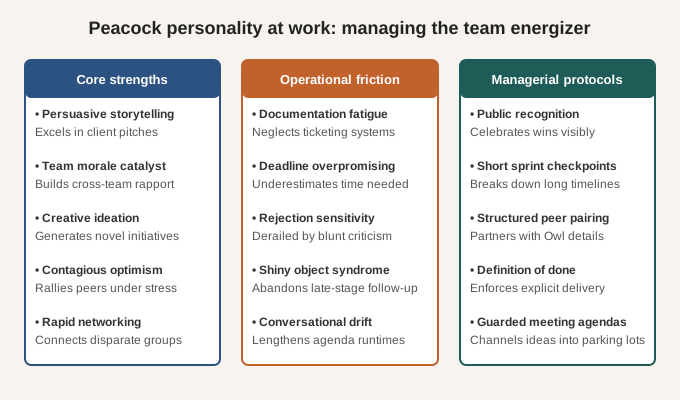
Managing a Peacock personality requires channeling social enthusiasm, enforcing concrete completion criteria, and offering visible public recognition. In the DOPE framework and William Moulton Marston's DISC assessment, the Peacock corresponds to High Influence (I), combining extraversion, verbal persuasion, and persistent optimism. Peacocks excel in client engagement, cross-functional collaboration, and creative ideation, yet they struggle with administrative follow-through, solitary data entry, and rigorous process compliance.
Directing a high-influence employee is exhilarating and exhausting in equal measure. A Peacock can walk into a skeptical client meeting and transform cold resistance into an signed contract within forty-five minutes. That same employee might fail to update their customer relationship management software for six consecutive weeks, losing critical tracking notes. Effective leadership involves building scaffolding around their operational blind spots while giving their interpersonal gifts room to breathe.
Recognizing the Peacock profile in the workplace
Peacock employees stand out through expressive communication, informal networking, and a desire to connect people across company silos. Harvard Business School researcher J. Richard Hackman spent decades studying team dynamics, finding that high-performing groups require social catalysts who generate psychological safety and conversational momentum. Peacocks fill this role instinctively. They greet coworkers by name, organize team lunches, and inject levity into tense executive updates.
Social isolation acts as kryptonite for this profile. Confining a Peacock to a solitary cubicle with spreadsheets and zero human contact causes rapid disengagement. Their productivity drops, their attention wanders toward social media or watercooler chats, and their error rate climbs. Peacocks draw cognitive focus from external feedback loops; without audience participation, their internal motor stalls.
Impulsivity also colors their work habits. If a fresh concept sparks their curiosity, they drop operational tasks to chase the new initiative. I have watched talented Peacock directors abandon critical quarterly reports because they felt inspired to spend Tuesday afternoon redesigning a sales pitch deck. Channeling this spontaneous energy requires clear organizational boundaries rather than heavy-handed micromanagement.
High-impact strengths of the high-influence employee
Sales, client success, brand evangelism, and public presentations represent natural operational domains for Peacocks. They possess an innate ability to read room dynamics, match audience tone, and translate technical specifications into compelling narratives. An analytical employee might present twenty dense data charts, but a Peacock tells three customer stories that resonate with executive decision-makers.
Crisis morale is another understated Peacock asset. During company reorganizations, stressful product launches, or market downturns, teams frequently slip into despair or cynical paralysis. A Peacock counters this gloom with optimism and infectious confidence. They remind coworkers of past victories, celebrate minor milestones, and maintain a sense of forward momentum when external conditions look bleak.
Cross-departmental collaboration flows effortlessly around a Peacock. While other personality types protect their departmental borders, Peacocks cross boundaries to make friends in engineering, legal, marketing, and finance. These informal relationships accelerate project velocity by cutting through bureaucratic red tape. If an emergency approval is required, a Peacock walks over to a colleague and secures the signature based on goodwill.
Operational friction points and administrative fatigue
Detail neglect forms the primary liability of the Peacock personality. Routine documentation, ticket logging in Jira or Asana, time tracking, and multi-step compliance checklists feel like painful drudgery to a high-influence mind. They often complete eighty-five percent of a project with immense flair, then abandon the final fifteen percent involving documentation, archiving, and handoff notes.
Chronic overpromising represents another recurring friction point. Peacocks crave interpersonal approval and hate saying no to colleagues or clients. If an executive asks whether a customized feature can launch by Friday, the Peacock will say yes with complete conviction, convinced they can pull off the miracle. By Thursday afternoon, the reality of engineering constraints crashes down, leaving technical teammates scrambling to clean up the mess.
Criticism sensitivity can also derail their performance. Because Peacocks tie their personal identity to their relationships and creative ideas, direct negative feedback feels like personal rejection. A blunt email stating "this report contains multiple calculation errors" can send a Peacock into an emotional tailspin, prompting defensive rationalizations or quiet withdrawal for several days.
Task initiation without completion forms another familiar pattern. Peacocks love the dopamine rush of launching new initiatives, writing the introductory kickoff memo, and gathering stakeholders for an exciting vision session. Once the initial novelty fades and the grueling middle phase of execution arrives, their attention wanders toward the next shiny prospect. A savvy manager anticipates this drop in enthusiasm and structures mid-project checkpoints to sustain focus.
Comparing workplace profiles across the four bird types
Aligning team responsibilities requires understanding how the Peacock differs from other behavioral profiles in the office. The table below outlines how each bird personality operates across four fundamental workplace scenarios:
| Workplace Scenario | Peacock (Influence) | Owl (Conscientiousness) | Eagle (Dominance) | Dove (Steadiness) |
|---|---|---|---|---|
| Pitching new initiatives | Charismatic storytelling and vision | Data-driven evidence and risk models | Bottom-line ROI and speed to market | Focus on team harmony and stability |
| Handling routine paperwork | Procrastinates and misses details | Meticulous, error-free execution | Delegates swiftly or rushes through | Patient, steady compliance |
| Managing tight deadlines | Rallies team spirit but overpromises | Works late to verify precision | Pushes team hard to hit metrics | Silently absorbs overtime stress |
| Receiving critical feedback | Feels personally wounded; needs warmth | Analyzes validity of critique calmly | Challenges feedback or demands proof | Apologizes quickly to restore peace |
Five managerial protocols to keep Peacocks productive
Managing a Peacock successfully requires specific operational structures that support their strengths while mitigating their administrative disorganization. Implementing five proven protocols establishes healthy workplace accountability:
- Enforce a strict definition of done before project kickoff. Avoid assigning tasks with ambiguous endpoints like "help with the marketing rollout." Specify exact deliverables: three completed case study drafts, two approved client quotes, and updated Salesforce contact cards by Thursday at four in the afternoon.
- Implement brief milestone check-ins twice weekly. Long, thirty-day deadlines invite procrastination and mid-project distraction. Breaking initiatives into seventy-two-hour micro-sprints keeps the Peacock accountable without feeling overwhelmed by distant deadlines.
- Provide visible public recognition for completed outcomes. Peacocks are motivated by social validation. Praising their successful presentation in front of the executive committee or during an all-hands meeting provides massive psychological fuel that powers weeks of sustained effort.
- Pair them with detail-oriented collaborators on complex deliverables. Coupling a Peacock's persuasive presentation skills with an Owl's rigorous data validation creates an unbeatable tandem. The Peacock sells the vision, while the Owl ensures the underlying numbers survive scrutiny.
- Direct meeting brainstorming into structured parking lots. Peacocks tend to derail operational meetings with tangent ideas. Acknowledge the creative value of their thought immediately, write it on a visible whiteboard, and redirect the conversation back to the scheduled agenda.
Giving feedback without crushing motivation
Delivering negative feedback to a Peacock demands deliberate framing. If you begin a performance review with blunt criticism, the Peacock's emotional defenses activate immediately, preventing them from absorbing your coaching. They will focus on whether you still like and respect them rather than fixing the operational error.
Managers should employ a relationship-first framework. Begin by affirming their social value to the team and acknowledging a recent success with specific details. Once emotional safety is established, address the administrative gap plainly: "Your client pitch was exceptional, but failing to log the follow-up notes in our CRM caused our fulfillment team to miss the shipping deadline. Let us establish a system to prevent that breakdown."
Conclude the conversation by asking the Peacock to design their own accountability mechanism. Peacocks resist rigid mandates imposed from above, but they embrace solutions they created themselves. If the employee suggests setting a calendar alarm each afternoon at four o'clock to complete data logging, support that idea enthusiastically.
Pairing Peacocks with other personality types
Peacocks and Owls produce extraordinary work when managed properly, but their baseline interaction is fraught with tension. The Owl views the Peacock as a loud, sloppy exaggerator who cuts corners; the Peacock views the Owl as a joyless perfectionist who strangles innovation in red tape. Managers must clarify roles explicitly: the Peacock owns the narrative and client relationship, while the Owl owns the technical methodology and data integrity.
Peacock and Eagle partnerships move at breakneck speed. Both personalities are extroverted, bold, and driven by high ambitions. They can launch products, win enterprise accounts, and conquer new markets rapidly. The risk lies in premature execution; neither type enjoys reading fine print or evaluating operational risks. Without an Owl or Dove balancing their enthusiasm, an Eagle-Peacock duo can commit the organization to unsustainable contracts.
A Peacock working alongside a Dove enjoys a warm, supportive relationship. The Dove provides patient listening, steady execution, and logistical support, allowing the Peacock to shine in outward-facing roles. The manager must monitor this dynamic carefully to ensure the loud, expressive Peacock does not unintentionally steamroll the accommodating Dove with unreasonable demands.
Frequently asked questions
What motivates a Peacock personality most at work?
Public recognition, social interaction, and creative freedom drive the Peacock profile. They thrive on verbal praise from leaders, collaborative team projects, and opportunities to present ideas to live audiences.
How can a manager prevent a Peacock from missing deadlines?
Breaking large assignments into short, two-day milestones prevents procrastination and administrative drift. Requiring tangible deliverables at each check-in provides the external accountability Peacocks need to stay focused.
What are the worst career matches for a Peacock personality?
Roles requiring solitary data entry, repetitive compliance auditing, or rigid quality control without human interaction cause rapid burnout in Peacocks. They wither in environments that lack social engagement and creative expression.
How should you resolve a workplace clash between an Owl and a Peacock?
Separate their responsibilities according to their core strengths rather than forcing them to share the same operational tasks. Assign client communication and ideation to the Peacock while granting the Owl complete authority over data verification and process standards.
Why do Peacocks struggle with administrative documentation?
Peacocks prioritize rapid human connection and novel ideas over repetitive record-keeping. Filling out detailed forms or logging tickets feels unstimulating to their high-energy, externally focused cognitive temperament.
- FAQs About Clinical Psychology Answered
- Bird Personality : Brave Owl
- Prioritizing Self-Care: Why Taking Care of Yourself is Essential for Supporting Others
- 7 Journaling Ideas to Help You Better Understand Yourself
- Tips on How to Deal With Energy Vampires
- The Ultimate Guide to Understanding the DISC Personality Test
- Bird Personality : Genius Eagle
- Bird Personality : Dove
- Bird Personality : Mild Dove
- Bird Personality : Smart Dove
- Bird Personality : Brave Dove
- Bird Personality : Genius Dove
- Bird Personality : Wizard Dove
- Bird Personality : Reverse Thinking Dove
- Bird Personality : Changeable Dove
- Dove Personality in Relationships: How They Show Love