Narcissistic Personality Traits: How to Recognize Them
Narcissistic personality traits involve an exaggerated sense of self-importance, a persistent need for admiration, and a limited capacity to empathize with other people. In clinical psychology, these traits exist on a spectrum ranging from mild interpersonal selfishness to Narcissistic Personality Disorder (NPD), diagnosed under the Diagnostic and Statistical Manual of Mental Disorders (DSM-5-TR, American Psychiatric Association, 2022). Recognizing these traits requires observing repeated behavioral patterns over time rather than reacting to a single arrogant remark or selfish decision.
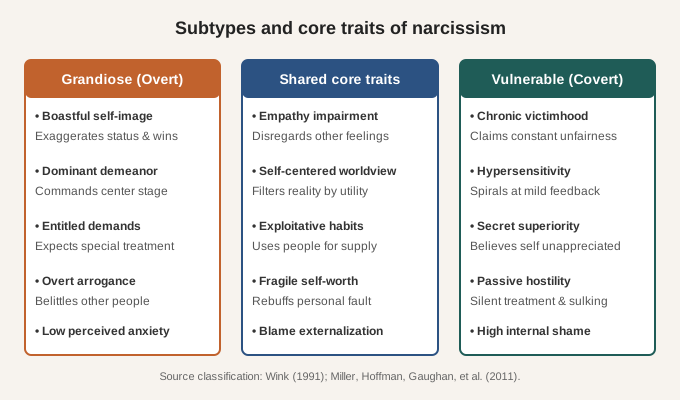
People with pronounced narcissistic traits organize their relationships around protecting an idealized self-image. They demand preferential treatment, dismiss the emotional boundaries of peers, and externalize blame whenever errors occur. In social psychology research, including foundational work by Wink (1991) and subsequent studies by Miller et al. (2011), narcissistic traits divide into two distinct expressions: grandiose and vulnerable. Grandiose narcissism presents through overt dominance, boastful confidence, and status-seeking. Vulnerable narcissism operates through chronic grievance, introversion, fragile self-esteem, and hypersensitivity to criticism. Both expressions share an identical core: an unwillingness to treat others as equals and a transactional view of human relationships.
Diagnostic criteria defined by the DSM-5-TR
The American Psychiatric Association outlines nine specific criteria for Narcissistic Personality Disorder in the DSM-5-TR. A clinical diagnosis requires meeting at least five of these nine criteria across multiple settings, such as work, family life, and social circles. Even when an individual falls short of the formal diagnostic threshold, exhibiting three or four of these traits produces severe friction in daily relationships.
- Grandiose sense of self-importance. The individual exaggerates talents and achievements while expecting recognition as superior without commensurate achievements. They recount personal stories with inflated numbers, take credit for collective victories, and minimize the contributions of collaborators.
- Preoccupation with fantasies of unlimited success and power. Daydreams and long-term plans revolve around extreme wealth, brilliant intellect, physical perfection, or ideal love. Ordinary accomplishments feel hollow to them, leading to dissatisfaction unless an outcome delivers public acclaim.
- Belief in personal uniqueness and elite status. They insist they can only be understood by, or should only associate with, other special or high-status people and prestigious institutions. This trait manifests as name-dropping, obsessive brand consciousness, and condescension toward service workers or junior staff.
- Excessive need for continuous admiration. Self-esteem in narcissistic individuals depends on external feedback rather than stable internal confidence. They fish for compliments, monopolize conversations to solicit praise, and express irritation or sullen withdrawal if their presence goes unacknowledged.
- Pervasive sense of entitlement. They hold unreasonable expectations of favorable treatment or automatic compliance with their demands. Waiting in lines, adhering to company policies, or accommodating scheduling constraints feels offensive to them because they perceive rules as restrictions meant for ordinary people.
- Interpersonal exploitation. Relationships are instruments to accomplish personal objectives. They form friendships based on what the other person can provide, such as career access, money, social standing, or continuous emotional labor, and abandon connections once the utility expires.
- Impaired empathy and lack of emotional concern. They struggle to identify with or validate the feelings and needs of others. If a partner or colleague expresses sadness or stress, the individual dismisses the emotion as an inconvenience or redirects the conversation back to their own priorities.
- Frequent envy and the projection of envy. They covet the possessions, promotions, and relationships of peers, often disparaging those who succeed. Concurrently, they assume other people are jealous of them, using this assumption to explain away legitimate criticism or social distance.
- Arrogant, haughty behaviors and attitudes. Communication features contemptuous language, eye-rolling, interruptions, and patronizing lectures. They position themselves as the final authority on topics where they possess minimal technical training.
Grandiose versus vulnerable narcissistic traits
Narcissistic behavior often looks different from loud boasting or commanding leadership. Psychologists distinguish grandiose (overt) narcissism from vulnerable (covert) narcissism because their external presentations differ sharply. Grandiose narcissists display high extraversion, low neuroticism, and aggressive pursuit of social dominance. Vulnerable narcissists score high in neuroticism and introversion, masking their entitlement behind quiet resentment, anxiety, and a perpetual sense of victimization.
The table below summarizes the operational differences between these two presentations across six behavioral dimensions:
| Behavioral dimension | Grandiose narcissism (overt) | Vulnerable narcissism (covert) |
|---|---|---|
| Self-presentation | Boastful, loud, charismatic, overtly entitled, projects invulnerability | Quiet, self-deprecating with hidden arrogance, projects martyrdom and neglect |
| Response to criticism | Aggressive defensiveness, outward rage, public counter-attacks | Sullen withdrawal, passive-aggressive remarks, spiraling shame, vindictive sulking |
| Interpersonal posture | Dominant, competitive, demands deference through intimidation or charm | Withdrawn, defensive, demands deference by appealing to personal suffering |
| Social dynamic | Seeks the center of attention, leads conversations, collects high-status contacts | Avoids large groups, observes from the periphery, harbors envy toward visible leaders |
| Relational currency | Adoration, status markers, public praise, unquestioned compliance | Sympathy, validation of grievances, agreement that society treats them unfairly |
| Underlying vulnerability | Hidden behind bluster, grandiosity, and intense pursuit of achievement | Exposed through chronic anxiety, rumination, depression, and social hypersensitivity |
Understanding this division prevents people from overlooking vulnerable narcissists. A partner or coworker who appears withdrawn, brooding, and self-effacing can exhibit the same entitlement and lack of empathy as a boastful executive. Their weapon of choice is guilt and chronic complaint rather than public humiliation.
Observable behavioral patterns in everyday life
Identifying narcissistic traits in casual acquaintances requires observing micro-interactions over weeks or months. Five recurring behavioral patterns provide reliable indicators of high narcissistic trait density in personal and professional relationships.
Conversational redirection and stagehogging
Conversations with a narcissistic individual feel like one-way streets. Sociologist Charles Derber described conversational narcissism as the systematic shift from supportive responses to shift responses. Sharing a personal milestone with them produces only a perfunctory acknowledgment before they steer the discussion toward their own experiences. If you mention that you completed a ten-kilometer run, they immediately recount how they once ran a half-marathon under severe weather conditions. Your role in the dialogue reduces to an attentive audience member.
Disproportionate anger following minor feedback
Psychoanalyst Heinz Kohut introduced the term narcissistic injury in 1971 to describe the psychological wound experienced when a narcissist's self-concept encounters contradiction. Even mild, constructive observations trigger narcissistic rage. Suggesting a formatting adjustment on a team spreadsheet or asking for quieter music in an office can produce explosive verbal attacks or days of stony silence. The severity of the reaction reflects the fragility of their internal equilibrium; any perceived flaw threatens their entire defensive structure.
Relentless boundary testing and erosion
Narcissistic traits impair respect for personal autonomy. If you state that you cannot answer phone calls after seven in the evening, the individual tests this boundary by calling at eight with a manufactured emergency. If you refuse an unreasonable request, they question your loyalty, bring up past favors they did for you, or accuse you of selfishness. Boundaries represent personal slights to someone who views other people as extensions of themselves.
The DARVO defense mechanism
Psychology professor Jennifer Freyd formulated the acronym DARVO in 1997: Deny, Attack, and Reverse Victim and Offender. This sequence occurs when you confront a narcissistic person about specific misconduct. First, they deny the event occurred ("That did not happen"). Next, they attack your credibility, sanity, or motives ("You are paranoid and distorting facts"). Finally, they reverse the roles so you end up comforting them ("After all I sacrificed for you, you accuse me of this?"). The original grievance evaporates, replaced by an argument about your supposed cruelty.
Instrumental relationships and sudden discard
People with strong narcissistic traits measure human value by utility. As long as you provide useful skills, financial backing, emotional praise, or social access, they offer intense charm and flattering attention. Once your usefulness declines, or once you begin enforcing firm boundaries, their attitude cools rapidly. They cut communication abruptly, spread disparaging gossip to mutual acquaintances, and replace you with a fresh source of validation without a trace of remorse.
Narcissistic traits compared with bird personality profiles
Personality profiling models, such as the four-style DOPE framework (Eagle, Peacock, Owl, Dove), help categorize natural behavioral tendencies. Distinguishing between healthy personality traits and pathological narcissistic patterns prevents common misunderstandings. While certain personality styles share surface similarities with narcissistic traits, their underlying motivations and boundaries are distinct.
Eagle personality vs. narcissistic dominance
The Eagle personality type is characterized by directness, decisive action, and a desire to achieve measurable goals. An effective Eagle leader makes tough decisions under pressure, delegates tasks efficiently, and values competency. Combining an Eagle style with severe narcissistic traits turns leadership into authoritarian control. The narcissistic Eagle demands absolute deference, claims sole ownership of team accomplishments, and blames subordinates for organizational failures. A healthy Eagle respects competent dissent that improves results; a narcissistic Eagle treats dissent as insubordination.
Peacock personality vs. narcissistic grandiosity
The Peacock personality type radiates enthusiasm, verbal flair, and social energy. Healthy Peacocks love public speaking, cheer up stressed teams, and build camaraderie through charisma. A Peacock with narcissistic traits, by contrast, transforms social gatherings into personal stages. They monopolize meetings with embellished anecdotes, demean quieter colleagues to remain the center of attention, and experience bitter jealousy when a coworker receives recognition. Healthy Peacocks share warmth; narcissistic Peacocks consume attention while offering no warmth in return.
Owl personality vs. narcissistic intellectual superiority
Owls focus on precision, empirical data, and systematic logic. A healthy Owl colleague checks calculations thoroughly, identifies procedural risks, and ensures regulatory compliance. A narcissistic Owl uses technical knowledge as a weapon to belittle peers. They dismiss alternative methodologies with cold contempt, obsess over minor formatting errors to derail meetings, and refuse to accept verified facts if the evidence comes from a colleague they deem intellectually inferior.
The vulnerability of Dove personalities
Dove personalities prioritize harmony, collaboration, and empathy. They listen patiently, support teammates through personal distress, and avoid interpersonal friction. These generous traits make Doves frequent targets for narcissistic individuals. A person with narcissistic traits exploits a Dove's reluctance to say no, assigning them excessive workloads and demanding constant emotional reassurance. Doves often spend years accommodating emotional outbursts before recognizing that the relationship lacks reciprocity.
Actionable strategies for handling narcissistic individuals
Ending contact with a narcissistic person is the cleanest solution, but family ties, custody arrangements, or workplace dependencies often make complete separation impossible. Handling daily interactions with someone exhibiting high narcissistic traits requires disciplined operational strategies to safeguard your well-being.
- Enforce non-negotiable boundaries with immediate consequences. State rules directly and define the specific action you will take if the boundary is crossed. For example, say: "If you shout or interrupt me, I will end this phone call." If shouting begins, hang up immediately without arguing or issuing second warnings. Following through establishes that your boundaries carry consequences.
- Implement the gray rock method. Deprive the narcissistic individual of dramatic reactions, which are fuel for their behavior. Answer inquiries with brief, neutral, matter-of-fact statements like "Understood," "The report is on the server," or "I have no opinion on that matter." Maintaining a flat, boring demeanor causes them to seek emotional drama elsewhere.
- Document all communications in writing. Avoid verbal agreements on significant matters. Send follow-up emails summarizing decisions, project deadlines, and assigned responsibilities immediately after each conversation. If the individual attempts to distort previous discussions, refer back to the written record without entering an emotional debate.
- Refuse to participate in circular arguments. Narcissistic people use diversionary tactics, personal insults, and irrelevant accusations to exhaust debate partners. If a conversation veers away from the issue at hand, repeat your core point calmly or terminate the discussion by stating that the meeting is concluded.
- Cultivate independent validation outside the dynamic. Do not look to a narcissistic parent, manager, or partner for approval or fair treatment. Build robust friendships, join professional associations, and consult a qualified mental health counselor to maintain perspective on your self-worth and reality.
Realistic expectations regarding change and clinical treatment
Expecting a person with severe narcissistic personality traits to experience a sudden epiphany about their conduct leads to disappointment. Clinical literature, including research compiled by Elsa Ronningstam (2005) and clinical reviews by Campbell and Miller (2011), notes that individuals with Narcissistic Personality Disorder rarely seek therapy voluntarily. Because their core psychological defense consists of denying personal inadequacy, they view external problems as the fault of difficult partners, incompetent colleagues, or unfair institutions.
Therapeutic engagement typically occurs only when an external catastrophe collapses their protective grandiosity. A sudden divorce, criminal indictment, financial ruin, or career termination can strip away external validation, triggering severe depression or acute panic. Even in these moments, therapy proves difficult. Patients often drop out of treatment as soon as their distress stabilizes and their defensive grandiosity reasserts itself.
Long-term therapeutic modalities, such as Transference-Focused Psychotherapy developed by Otto Kernberg and Schema Therapy developed by Jeffrey Young, produce gradual improvements in motivated patients over several years. These approaches require patients to confront underlying feelings of defectiveness and learn to tolerate vulnerability without resorting to rage or devaluation. For anyone interacting with a narcissistic individual in daily life, the focus must remain on establishing personal boundaries and managing exposure, rather than waiting for internal personality transformation.
Frequently asked questions
How common are narcissistic personality traits in the general population?
Epidemiological research, including the National Epidemiologic Survey on Alcohol and Related Conditions (Stinson et al., 2008), indicates that Narcissistic Personality Disorder affects between 1% and 6.2% of adults in community samples. Subclinical narcissistic traits, measured by instruments such as the Narcissistic Personality Inventory, appear in varying degrees across a broader segment of the population.
What separates healthy self-confidence from narcissistic traits?
Healthy self-confidence rests on realistic self-assessment, accepts personal flaws, and coexists with genuine concern for other people. Narcissistic traits rely on an unstable self-image requiring continuous external praise, often accompanied by a tendency to demean others to preserve personal status.
Can someone with narcissistic personality traits change their behavior?
Behavioral change requires sustained participation in specialized psychotherapy, such as schema therapy or transference-focused psychotherapy. Meaningful change remains uncommon in practice because the core traits involve deflecting blame and rejecting personal fault, which prevents most individuals from seeking or maintaining therapy.
How do you recognize covert or vulnerable narcissism?
Covert narcissists project self-absorption through chronic victimhood, passive-aggressive resentment, and hypersensitivity to minor feedback. They believe the world fails to recognize their unique talents, harbor deep envy of successful peers, and frequently use sulking or guilt to control conversations.
What steps protect you when working under a narcissistic manager?
Document instructions, project milestones, and performance appraisals in writing through immediate follow-up emails. Maintain emotional distance by keeping personal information private, adhering strictly to established metrics, and seeking mentorship outside that manager's direct reporting line.
- What Kind of Bird Matches Your Daily Habits?
- Eating Habits and Affect to Your Mental Health
- The Benefits of Reprogramming Your Mind with Timeline Therapy
- Unlocking the Power of Visual-Spatial Intelligence
- Owl Personality Type: Traits, Strengths, and Weaknesses
- Bird Personality : Eagle
- Exploring Personality Traits Through Color Psychology
- Bird Personality : Dove
- Bird Personality : Mild Dove
- Bird Personality : Smart Dove
- Bird Personality : Brave Dove
- Bird Personality : Genius Dove
- Bird Personality : Wizard Dove
- Bird Personality : Reverse Thinking Dove
- Bird Personality : Changeable Dove
- Dove Personality in Relationships: How They Show Love