Nature vs Nurture: How Much of Your Personality Is Genetic?

Genetics accounts for roughly 40 to 50 percent of the differences in adult personality, according to twin studies going back to the 1980s. The rest comes from environment, but not the kind most people expect: growing up in the same house with the same parents explains very little, while individual experiences, friendships, and chance events explain much more.
My brother and I grew up in the same house, ate the same food, and had the same parents who treated us, as far as either of us can tell, about the same. He is a planner who irons his shirts on Sunday night. I am the person who finds a stack of unopened mail in March. Our parents used to say one of us "took after" each side of the family, and that explanation never satisfied me. The research is more interesting than that, and a little humbling.
How much of your personality is genetic?
Personality is about 40 to 50 percent heritable, meaning that about that share of the variation between people in a population is linked to genetic differences. The figure comes from twin studies comparing identical twins, who share nearly all their DNA, with fraternal twins, who share about half.
Kerry Jang, John Livesley, and Philip Vernon ran one of the better-known studies in 1996, testing 123 pairs of identical twins and 127 pairs of fraternal twins on the Big Five traits. Heritability estimates ranged from 41 percent for agreeableness to 61 percent for openness. In 2003, Thomas Bouchard and Matt McGue reviewed the wider literature and settled on roughly 40 to 50 percent across the Big Five.
What does heritability actually mean?
Heritability describes variation in a group, not how much of one person is genetic. If a trait is 50 percent heritable, it does not mean half of your personality came from your genes and half from your upbringing. It means that across the population studied, about half of the differences between people trace to genetic differences.
The standard analogy involves height. Height is highly heritable, about 80 percent in well-fed populations, yet average height rose by several centimeters across the twentieth century in many countries because nutrition improved. Genes set the range, and the environment decides where in that range a person lands. Personality works the same way, though with a lot less certainty about which environmental factors matter.
Do identical twins raised apart have the same personality?
They are remarkably similar, though not identical. The Minnesota Study of Twins Reared Apart, led by Thomas Bouchard from 1979 onward, tracked more than 100 sets of twins and triplets separated early in life. Bouchard's group reported in a 1990 paper in Science that identical twins raised apart were about as alike in personality as identical twins raised together.
That result surprised many psychologists, because it implied that a shared childhood home was doing less work than anyone assumed. The famous anecdotes (the "Jim twins," both named James, both married women named Linda, both owning dogs named Toy) are fun but misleading. Some of that is coincidence that gets noticed because the twins were looking for it. The statistical results are the part to trust.
Does the way you were raised matter at all?
Yes, but less than most parenting books claim, and in a different way. Eric Turkheimer summarized the findings in 2000 as three laws of behavior genetics: all behavioral traits are heritable; the effect of growing up in the same family is smaller than the effect of genes; and a large share of the variation in behavior is explained by neither genes nor families.
That third point is the odd one. Studies of adopted siblings, who share a home but no DNA, find personality correlations close to zero. Robert Plomin and Denise Daniels raised this in a 1987 paper titled "Why are children in the same family so different from one another?" Their answer was that siblings experience the same family differently, and that their separate experiences (a teacher, a friend group, an injury, an illness) matter more than the shared house.
Judith Rich Harris built a book on this evidence, The Nurture Assumption, in 1998. She argued that peers shape children more than parents do. Plenty of psychologists disagreed with the strong version of her claim. Parents clearly matter for outcomes such as education, health habits, religion, and attachment to others. The disagreement is about personality traits specifically, where the parental effect looks small.
Do genes and environment work separately?
They do not, and the nature versus nurture split is a poor way to frame it. Genes influence which environments you pick and how others respond to you. A child who is naturally curious asks more questions, gets more attention from teachers, and ends up in a different classroom experience than a quiet child sitting two seats away. Researchers call this gene-environment correlation.
The other mechanism is gene-environment interaction, where the same environment affects people differently depending on their genes. The most-cited example was a 2003 paper by Avshalom Caspi and colleagues linking a serotonin transporter gene variant and stressful life events to depression. It was heavily cited for years. In 2019, Richard Border and colleagues tested the same candidate genes in large samples and found no support for the original finding, a result published in the American Journal of Psychiatry. I think that story is worth remembering: a neat nature-meets-nurture result, repeated in textbooks, and then it did not hold up.
Epigenetics adds another layer. Michael Meaney and Ian Weaver showed in a 2004 Nature Neuroscience study that rat pups licked and groomed more by their mothers developed different stress responses, and the difference was linked to chemical changes on a gene regulating the stress hormone receptor. Whether that mechanism explains much of human personality is still unsettled. The finding is solid in rats and suggestive in people.
Can your personality change if it is partly genetic?
It changes slowly and in predictable directions. Brent Roberts, Kate Walton, and Wolfgang Viechtbauer analyzed 92 longitudinal studies for a 2006 paper in Psychological Bulletin. On average, people become more socially dominant, more conscientious, and more emotionally stable between about age 20 and 40.
Rank-order consistency, meaning how well a person keeps their position relative to others, climbs with age. Roberts and Wendy DelVecchio's 2000 analysis found it was about .31 in childhood, .54 in college-age adults, .64 at age 30, and .74 between 50 and 70. Personality is not fixed, but it settles.
| Age group | Rank-order consistency of personality |
|---|---|
| Childhood | .31 |
| College age | .54 |
| Age 30 | .64 |
| Age 50 to 70 | .74 |
The rule I would draw from this is practical. A trait with a genetic base responds to deliberate effort, but the effort has to be repeated for months, and the shift is usually modest. You can become more organized than your natural tendency. You are unlikely to turn into a person who enjoys filing taxes.
Where do bird personality types fit into this?
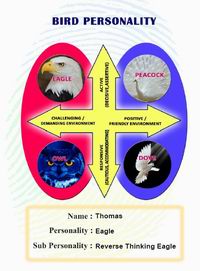
The research above uses the Big Five, not the dove, owl, peacock, and eagle types. The four bird types come from a DISC-style model that describes behavior patterns, and no twin study has measured their heritability directly. It is reasonable to expect similar findings, since DISC dimensions overlap with Big Five traits (the eagle's dominance resembles low agreeableness plus high extraversion, for example), but that is an inference.
The useful reading is that your bird type describes a tendency with genetic roots and room to move. If you score as an eagle, you probably came with a push toward directness, and your job is to decide when to use it. You can take the bird personality test to see where your tendencies sit, then treat the result as a starting description.
What should you take from all this?
Stop blaming your parents for most of your personality, and stop crediting them for it too. The evidence says genes and unshared experience do most of the work, and a family's shared environment does comparatively little. I find that both freeing and slightly unsettling, since it means neither the credit nor the fault is as clear as families like to believe.
For parents, the finding does not mean that parenting is pointless. It means that parenting works better on behavior, safety, and relationship quality than on shaping a child's temperament. Respecting the child's inborn tendencies, and noticing how siblings differ, usually goes further than trying to produce a particular kind of person.
Frequently asked questions
Is personality more nature or nurture?
Twin studies put the genetic share at about 40 to 50 percent for the Big Five traits. The remaining 50 to 60 percent comes from environment, mostly individual experiences rather than the family home that siblings share. So both contribute, and neither dominates.
Which personality traits are the most heritable?
In Jang, Livesley, and Vernon's 1996 twin study, openness to experience was the most heritable at 61 percent and agreeableness the least at 41 percent. Other studies show different rankings, but all of them place the Big Five in the 40 to 60 percent range.
Do identical twins have the same personality?
No. Identical twins are more alike than fraternal twins, but they still differ. Even with the same DNA, they have different friends, illnesses, and experiences, and those differences account for much of the remaining variation. Twin correlations for personality are typically around .40 to .50, not 1.0.
Can parenting change a child's personality?
Parenting has a modest effect on temperament and a larger effect on behavior, values, and wellbeing. Studies of adopted siblings show almost no personality resemblance, which suggests that a shared home does little to produce similar personalities. Warmth and consistency still matter for how secure and capable a child becomes.
Is personality set by age 30?
It is not fixed, but it stabilizes. Roberts and DelVecchio found the consistency of personality rises from about .31 in childhood to .64 around age 30, and to about .74 after 50. People continue to become more conscientious and emotionally stable well into middle age.
Does the bird personality test measure inherited traits?
It measures behavior patterns that likely have a partly genetic basis, though no study has tested the bird types for heritability. Results can change as your circumstances and habits change, so a result at 25 may differ from one at 45.
- The Most Inspiring Education Quotes of All Time
- About Dissociative Identity Disorder
- Can Mental Illness Change Your Personality? What Research Says
- Saving Your Relationship: The Importance of Marriage Counseling
- Are You the Toxic One? Self-Reflection Questions to Ask Yourself
- How to Deal with Workplace Stress
- Can I use a free online personality testing personality testing to understand my work style?
- Bird Personality : Dove
- Bird Personality : Mild Dove
- Bird Personality : Smart Dove
- Bird Personality : Brave Dove
- Bird Personality : Genius Dove
- Bird Personality : Wizard Dove
- Bird Personality : Reverse Thinking Dove
- Bird Personality : Changeable Dove
- Dove Personality in Relationships: How They Show Love