Personality Traits List for Students: A Classroom Guide

A personality traits list can help students describe preferences, study habits, and teamwork strengths without turning observations into fixed identities. Curiosity, persistence, organization, sensitivity, and sociability are useful starting points when students also consider context, support, and skills that can be learned.
What a trait means in a classroom
A trait is a tendency to think, feel, or act in certain ways across some situations. It is not a grade and not a complete description of a student. Curiosity may appear as questions, persistence as returning to a hard problem, and organization as tracking deadlines. Observe behavior before assigning a label.
Curiosity and intellectual risk
Curious students ask why, compare sources, and explore beyond the minimum assignment. They may also become distracted by too many possibilities. Teachers can support curiosity with inquiry questions and clear endpoints. Students can keep a question list, choose one extension task, and return to the required objective before opening another line of investigation.
Persistence versus exhaustion
Persistence helps students continue after an initial failure, but working without rest is not resilience. Break a large task into attempts, seek feedback, and change strategy when evidence says the method is not working. A student who needs support may be persistent precisely because they keep asking for an explanation instead of silently repeating confusion.
Organization as a learnable system
Organization is not a moral quality that students either possess or lack. Use one calendar, a daily priority list, visible due dates, and a ten-minute weekly review. Estimate task time, include transition time, and start with the next physical action. External systems reduce memory load and make planning less dependent on mood.
Sociability and participation
Participation can mean speaking, writing, listening carefully, facilitating, or helping a group stay focused. Extroversion does not guarantee leadership, and quietness does not mean disengagement. Offer multiple ways to contribute. Students can prepare one comment before class, use a discussion role, or submit a thoughtful question when spontaneous speaking is difficult.
Sensitivity and emotional awareness
Sensitivity may help a student notice tone, fairness, sensory details, or a classmate’s discomfort. It can also increase overload in noisy or critical environments. Name the information that is useful and add regulation strategies: a brief pause, a quieter seat, written instructions, or a conversation with a trusted adult. Sensitivity is not weakness.
Confidence and healthy feedback
Confidence grows from specific evidence and opportunities to improve, not from constant praise. Replace ‘I am bad at math’ with a description of the skill that needs practice. Feedback should identify what worked, what is missing, and the next attempt. Students can request examples, rubrics, or a chance to revise rather than treating one score as an identity.
Teamwork traits and role rotation
A group needs initiators, planners, researchers, editors, presenters, and listeners. Rotate roles so one student is not always the responsible organizer or the invisible helper. Agree on deadlines and a process for disagreement. A fair group evaluates contributions by agreed behavior, not by who speaks most often or appears most confident.
Creativity and structure
Creative students benefit from generating many possibilities, then applying constraints. A short brainstorm followed by selection criteria prevents an assignment from remaining an endless idea phase. Students who prefer structure can practice leaving a small space for alternatives. Creativity and organization are partners when each is given a deliberate stage.
Critical thinking and open-mindedness
Critical thinking involves asking what supports a claim, whose perspective is missing, and what evidence would change the conclusion. Open-mindedness does not require accepting every idea equally. Use source checks, counterexamples, and a written distinction between fact, interpretation, and opinion. These habits are more useful than calling oneself naturally analytical.
Managing procrastination without shame
Procrastination can reflect unclear instructions, fear of evaluation, low energy, task difficulty, or competing rewards. Identify the barrier before prescribing discipline. Open the document, write a poor first sentence, or work for five minutes. Then schedule a realistic next session. If concentration problems are persistent across settings, seek professional assessment rather than relying on personality labels.
Using self-assessments wisely
A quiz is a snapshot influenced by mood and interpretation. Compare results with actual examples from several classes and ask whether the trait changes with sleep, teacher, subject, or peers. Use the information to choose a strategy, not to exclude a career or excuse behavior. Reassess after practicing a new skill.
Culture, access, and individual difference
Classroom behavior is shaped by language, disability, family responsibilities, finances, technology, discrimination, and cultural expectations. A student who appears unprepared may lack a quiet place or stable internet. Good reflection includes the environment. Asking what support would make success possible is more accurate than assuming motivation from appearance.
Frequently asked questions
Is this an exact test or diagnosis?
No. It is an educational framework for noticing patterns and considering practical choices. A qualified professional is needed for assessment or treatment.
Can people change these patterns?
Yes. Skills, environments, relationships, and support can change how a tendency is expressed. Progress is measured through repeated behavior, not a perfect day.
What should I do first?
Choose one recent example, write down the observable facts, and identify one small action that protects wellbeing or improves communication.
When should I seek professional support?
Seek help when distress persists, daily functioning declines, or safety is uncertain. Urgent danger requires local emergency or crisis services.
- Signs Your Personality Type Isn't Suited for Your Current Job
- How and Why to Identify Your Life Aspirations
- Understanding Eye Movement Desensitization and Reprocessing Therapy
- How to Center Yourself and Find Peace
- How to Listen Without Interrupting
- How to Increase Emotional Intelligence?
- How To Improve Your Life?
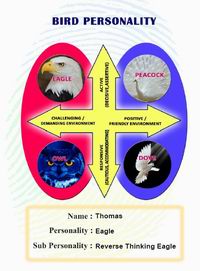
- Bird Personality : Dove
- Bird Personality : Mild Dove
- Bird Personality : Smart Dove
- Bird Personality : Brave Dove
- Bird Personality : Genius Dove
- Bird Personality : Wizard Dove
- Bird Personality : Reverse Thinking Dove
- Bird Personality : Changeable Dove
- Dove Personality in Relationships: How They Show Love