How to Catch Hindsight Bias Before It Happens
You can catch hindsight bias before it happens by recording your predictions, confidence percentages, and reasoning before an outcome occurs, then forcing yourself to list plausible alternative endings after the fact. Without a written baseline, human memory automatically edits your past uncertainty to match whatever eventually happened.
Psychologist Baruch Fischhoff documented this effect in a 1975 experiment published in the Journal of Experimental Psychology: Human Perception and Performance. Fischhoff gave participants brief historical scenarios, told different groups different outcomes, and asked them to estimate how likely those outcomes had seemed beforehand. People who knew an outcome happened rated its prior probability much higher than people who did not know the ending, even when instructed to ignore the outcome.
That mental edit feels harmless until you try to learn from a bad quarter, a failed product launch, or a messy relationship. Once your brain convinces you that a surprise was obvious, you stop examining the real uncertainty you faced at the time. You either beat yourself up for missing "clear" warning signs, or you walk into your next decision far too confident.
What happens inside your brain during hindsight bias
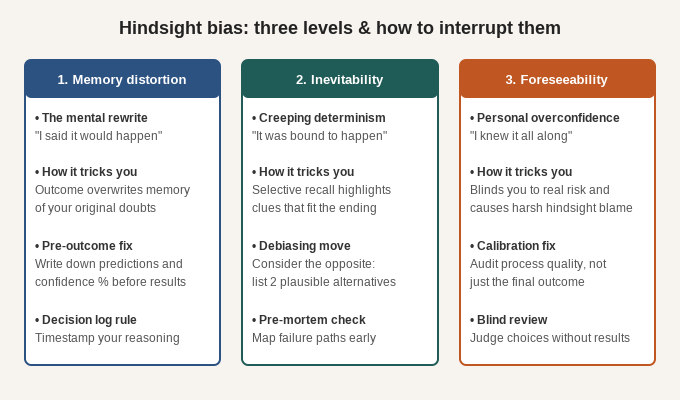
Hindsight bias is not a single memory glitch, because your mind distorts past uncertainty across three distinct levels at once. Researchers Neal J. Roese and Kathleen D. Vohs synthesized 35 years of studies in a 2012 paper in Perspectives on Psychological Science and broke the bias into memory distortion, inevitability, and foreseeability.
At the first level, memory distortion alters what you think you said or believed earlier. If you gave a project a 40% chance of failing and it later collapses, you remember thinking it had a 75% chance of failing. I catch myself doing this with sports games and hiring decisions all the time, and it is humbling to look back at old Slack messages and see how unsure I was.
At the second level, inevitability makes an outcome feel bound to happen because of fixed conditions. Your brain runs a quick search for clues that point toward the known ending and quietly drops the clues that pointed elsewhere. That selective recall creates an illusion of a straight line where there used to be five messy branches.
At the third level, foreseeability convinces you that you personally knew the ending in advance. Roese and Vohs noted three inputs behind this illusion: cognitive sense-making, metacognitive ease of processing the story, and a motivational desire to see the world as orderly rather than random.
| Level of hindsight bias | Typical internal thought | Practical interruption |
|---|---|---|
| Memory distortion | "I said this was going to fail." | Write down predictions with dates and percentages before the event. |
| Inevitability | "Given the market, it had to happen." | List two plausible outcomes that could have happened instead. |
| Foreseeability | "Anyone paying attention knew this." | Review the decision using only information available before the result. |
Why catching hindsight bias before the outcome matters
You cannot reliably talk yourself out of hindsight bias after you already know the result, because outcome knowledge is sticky. Fischhoff found in 1975 that simply warning people about the bias and telling them to try harder barely moved the needle. Once the ending enters your head, you lose direct access to how confused or torn you felt before.
Stopping the bias requires changing how you document choices ahead of time. Think of a surgeon, an investor, or a team lead deciding whether to ship software on a Friday. If the deployment breaks production, everyone in Monday's post-mortem suddenly remembers "having a bad feeling" about that release. Without a pre-launch record, the team learns the wrong lesson and punishes reasonable risk-taking while ignoring luck.
In legal and medical settings, this distortion carries steep costs. Judges, juries, and peer reviewers often evaluate a doctor's diagnosis or an engineer's safety check after an injury has already occurred. Knowing the tragic ending makes the warning signs look neon bright in retrospect, even when those same signals blended into routine noise in real time.
Five ways to catch hindsight bias before it happens
Preventing hindsight distortion relies on externalizing your thinking while the future is still fogged over. These five habits create a paper trail and a mental speed bump before your memory rewrites the past.
- Keep a timestamped decision journal. Write three sentences before any major choice: what you expect to happen, your percentage confidence from 1% to 99%, and the main reason you could be wrong. Seeing "60% confident" in your own handwriting three months later stops the "I knew it all along" reflex cold.
- Run a 15-minute pre-mortem before launch. Gather your team (or sit with a blank page) and assume the project has failed six months from now. Write down every specific reason it broke, from vendor delays to unclear ownership, so those risks exist on record before outcomes arrive.
- Use the consider-the-opposite test after results land. Roese and Vohs (2012) highlighted this method as one of the most dependable debiasing tools in experimental psychology. Force yourself to write two concrete arguments explaining how an alternative outcome could have occurred under the exact same starting conditions.
- Grade process separately from outcome. Build a two-column review sheet where one side evaluates the quality of your information and reasoning at the time, and the other records the final result. A good decision with a 20% chance of failure will still fail one time out of five, and that does not make the original call foolish.
- Conduct blind post-mortems when reviewing others. Strip the final outcome from a case file before asking a colleague or manager to judge the decision. When reviewers do not know whether a patient recovered or a trade lost money, their assessment of the decision-maker stays anchored to real-time uncertainty.
How to spot hindsight language in everyday conversations
Speech patterns give away hindsight bias seconds before people notice they are rewriting history. Listen for phrases like "obviously," "it was only a matter of time," "all the signs were there," and "I had a feeling from day one." Those phrases sound authoritative in a meeting, yet they usually signal a retrofitted story rather than an accurate memory.
I have noticed this happens fastest when someone feels defensive about a mistake or eager to claim credit for a win. If a coworker says, "We all knew that vendor would miss the deadline," ask a calm follow-up: "Did we log that risk in last month's brief, or does it look clearer now because they missed it?" That single question shifts the room away from finger-pointing toward actual forecasting.
You can also watch your own internal monologue when reading news about market crashes, layoffs, or breakups. Right after a headline drops, pundits assemble neat timelines showing why the collapse was guaranteed. Pause and ask what those same analysts wrote six months earlier, and you will see how much noise existed before the ending settled.
Does experience protect you from hindsight bias?
Expertise reduces some errors, yet seasoned professionals still fall hard for hindsight bias when they skip structured records. Doctors, financial analysts, and judges all show measurable hindsight shifts in controlled studies when asked to reconstruct prior probabilities after learning a case outcome. Knowing more facts can even backfire, because experts are faster at weaving a convincing story around whatever ending they are handed.
What protects experienced people is calibration, not raw intelligence. Superforecasters studied in long-running prediction tournaments track their Brier scores, review misses without ego, and update probabilities in small increments. They treat every forecast as a testable hypothesis rather than a test of personal cleverness.
When you treat your judgment like a lab notebook instead of a reputation to defend, catching hindsight bias becomes routine. You stop pretending you predicted the unpredictable, and you start spotting which signals actually carry weight before the next big call.
Frequently asked questions
Can you eliminate hindsight bias completely through awareness alone?
No, reading about hindsight bias or reminding yourself to stay objective does not erase it. In Baruch Fischhoff's 1975 experiments, participants who were explicitly warned to ignore outcome knowledge still overestimated the prior likelihood of the outcome they had been told. Written pre-outcome records and structured counter-arguments are required because internal memory edits happen automatically.
What is the difference between hindsight bias and outcome bias?
Hindsight bias distorts your memory of predictability ("I knew it would happen"), whereas outcome bias distorts how you judge decision quality based on the result ("It worked, so it was a smart choice"). Both biases often show up together in post-mortems, and separating process quality from final results helps correct both at once.
How detailed should a decision journal entry be?
A useful decision journal entry takes less than five minutes and fits on half a page. Record the date, the choice you are making, two or three expected outcomes with rough percentage odds, and one condition that would change your mind. Short entries are far easier to maintain consistently than long essays.
Why does the consider-the-opposite technique work?
Considering the opposite interrupts selective memory retrieval, which is the engine behind inevitability beliefs. When you force your brain to explain how a different ending could have happened using the same starting facts, you restore the uncertainty that existed before the outcome locked one story in place.
Is hindsight bias ever helpful?
In low-stakes situations, quick sense-making helps you build tidy narratives and move on without dwelling on every minor fork in the road. The trouble starts in high-stakes domains like medicine, investing, engineering, and management, where mistaking luck for predictability leads to overconfidence and unfair blame.
- Understanding the Signs That Someone Likes You
- Asperger Syndrome: Symptoms, Causes and Treatment
- Fingerprint Patterns
- How to Stop Alcohol Drinking and Lead a Healthier Life
- Emotional Regulation Tips for Each Personality Type
- Understanding Your Money Personality Type
- Special Need Children : Definition, Causes, Types and Treatment
- Bird Personality : Dove
- Bird Personality : Mild Dove
- Bird Personality : Smart Dove
- Bird Personality : Brave Dove
- Bird Personality : Genius Dove
- Bird Personality : Wizard Dove
- Bird Personality : Reverse Thinking Dove
- Bird Personality : Changeable Dove
- Dove Personality in Relationships: How They Show Love