How to Manage Negative Emotions
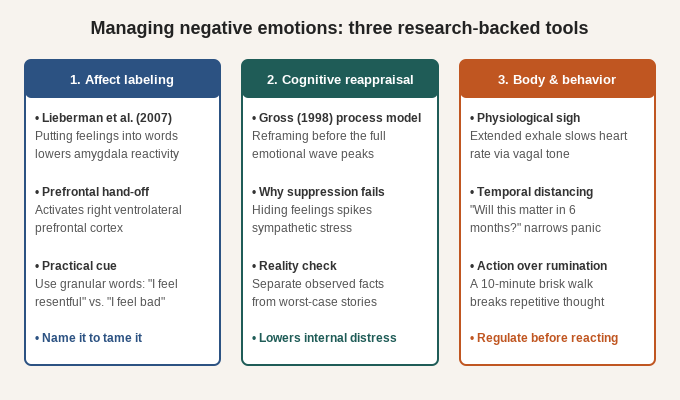
Managing negative emotions works best when you name what you feel in plain language, reframe your interpretation of the trigger early, and calm your nervous system through slow breathing or movement rather than forcing a blank face. Trying to bottle up anger, anxiety, or sadness hides outward expressions while spiking internal stress.
Psychologist James J. Gross demonstrated that contrast in a landmark 1998 study published in the Journal of Personality and Social Psychology. Gross asked participants watching a distressing film to either reappraise what they saw (change how they thought about it) or suppress their outward reaction. Reappraisal lowered both internal distress and behavioral signs of disgust, while suppression failed to reduce internal distress and triggered measurable sympathetic nervous system strain.
Most of us grow up learning the opposite lesson: smile through frustration, swallow embarrassment, and push forward. That habit looks polite on the outside, yet it leaves your heart rate elevated and your patience worn thin by mid-afternoon. Managing emotions does not mean erasing uncomfortable feelings; it means steering how long they hijack your attention and behavior.
Why suppressing negative emotions backfires
Suppression acts late in the emotional timeline, after your brain and body have already launched a stress response. By the time you clench your jaw to hide irritation in a meeting, adrenaline and muscle tension are already circulating. Holding a neutral expression requires constant mental effort, which leaves less working memory for solving the actual problem in front of you.
In Gross's 1998 framework, emotion regulation splits into antecedent-focused strategies (applied before an emotional wave peaks) and response-focused strategies (applied after the wave hits). Suppression sits in the second camp. Worse, chronic emotional suppression strains social relationships, because other people sense the mismatch between your polite words and your stiff posture.
I notice this gap immediately when I try to "power through" a frustrating email without pausing. Ten minutes later, I am snapping at an unrelated question from a colleague or rereading the same paragraph four times without absorbing a word. Taking 45 seconds to name the irritation and let my shoulders drop saves far more time than pretending I feel fine.
| Strategy | When it acts | Mental & physical effect |
|---|---|---|
| Affect labeling ("Name it") | Right as the emotion registers | Activates right ventrolateral prefrontal cortex and dampens amygdala reactivity (Lieberman et al., 2007). |
| Cognitive reappraisal | Before full emotional escalation | Reduces subjective distress without raising sympathetic cardiovascular strain (Gross, 1998). |
| Expressive suppression | After the emotion is fully active | Masks outward behavior but keeps internal distress high and spikes physiological arousal. |
| Physiological down-regulation | During acute physical arousal | Slow extended exhales and brisk movement lower heart rate and interrupt rumination loops. |
How putting feelings into words calms the amygdala
Labeling an emotion out loud or on paper acts like a manual brake on threat circuitry. Neuroscientist Matthew D. Lieberman and colleagues at UCLA tested this mechanism in a 2007 fMRI study published in Psychological Science titled "Putting Feelings Into Words."
Participants viewed photos of frightened or angry human faces inside a brain scanner. When they matched the face to an emotion word ("angry," "scared") instead of matching it by gender, activity dropped sharply in the amygdala—the brain's alarm hub—while activity rose in the right ventrolateral prefrontal cortex, an area involved in inhibitory control. Simply translating raw sensation into language handed control back to higher-order brain regions.
Precision makes this tool sharper. Calling every bad mood "stressed" blurs useful information, whereas naming "resentment," "overwhelm," or "disappointment" tells you what boundary or expectation got bumped. Psychologists call this emotional granularity, and people who use specific emotion words recover faster from setbacks.
Six practical steps to handle negative emotions in real time
You do not need an hour of quiet meditation to interrupt an emotional spiral at work or home. Combining cognitive tools with brief physical resets works in under five minutes.
- Name the exact emotion and its physical location. Say silently or write down: "I feel anxious, and my chest feels tight." Keep the label factual rather than judging yourself for having it.
- Use two physiological sighs to slow your heart rate. Take a full inhale through your nose, add a quick second top-off sip of air at the top, and exhale slowly through your mouth for twice as long as you inhaled. Longer exhales stimulate the vagus nerve and shift your nervous system out of fight-or-flight.
- Separate observed facts from the story your mind added. Write two lines: what a camera would record ("My manager left two short comments on my draft") versus your assumption ("She thinks I am incompetent"). That gap gives cognitive reappraisal room to work.
- Apply temporal distancing with a 6-month check. Ask yourself how much this exact moment will matter six days, six weeks, and six months from now. Zooming out shrinks the tunnel vision that makes temporary embarrassment feel permanent.
- Take a 10-minute brisk walk or change rooms. Rumination thrives when you sit motionless staring at the same screen that triggered you. Physical movement burns off residual restlessness and breaks repetitive thought loops.
- Choose one small, concrete action—or deliberate delay. If the emotion points to a real problem, send one clarifying question or set a boundary; if you are too heated to be constructive, schedule your reply for tomorrow morning.
How to tell useful emotional signals from unhelpful spirals
Negative emotions evolved to flag unmet needs, unfairness, and real threats, so treating every uncomfortable feeling as a malfunction misses the point. Guilt nudges you to repair a mistake you made with a friend. Anger alerts you that someone crossed a line or broke an agreement. Sadness slows you down after a loss so you can process what changed.
The trouble begins when an emotion outlasts its useful signal and turns into rumination—replaying an argument at 2:00 a.m. without gaining any new insight or action plan. A quick litmus test helps: ask whether thinking about this feeling for another five minutes produces a concrete step you can take today. If the answer is no, shift out of analysis and into physical movement or a distracting task, because staring at the same problem in bed rarely generates fresh answers.
Building a higher emotional baseline between bad days
Managing acute emotions is much harder when you run on four hours of sleep, skip meals, and stare at bad news before breakfast. Sleep deprivation amplifies amygdala reactivity by making minor annoyances feel like personal attacks, while steady blood sugar and regular aerobic exercise raise your threshold before frustration boils over.
Social support also acts as a physiological buffer rather than a soft luxury. Talking through a rough afternoon with a trusted friend who listens without immediately fixing your life lowers cortisol and helps you hear your own thoughts clearly. Even naming a pattern out loud ("I always panic right before quarterly reviews") takes half the sting out of it and reminds you that the stress is temporary.
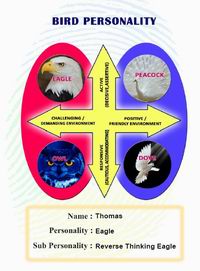
Knowing your default personality patterns also prevents blind spots. People who score high in Neuroticism or high in analytical vigilance often rehearse worst-case scenarios in advance, mistaking worry for preparation. Others who lean toward conflict avoidance—like the classic Dove personality style—swallow irritation for weeks until a tiny inconvenience triggers an outsized blowup.
Tracking what triggers your sharpest drops over two weeks—whether it is hunger, back-to-back meetings, or vague expectations—lets you fix the upstream cause instead of fighting fires all day. Once you spot the pattern, you can schedule a 10-minute buffer between tense calls, eat lunch before 2:00 p.m., and ask clarifying questions early before resentment builds.
Frequently asked questions
Is it unhealthy to feel negative emotions often?
Experiencing anger, sadness, or anxiety regularly is a normal part of human life and does not mean something is broken. Negative emotions become a clinical concern when they stay intense for weeks, interfere with sleep, work, or relationships, or push you toward isolation or self-harm.
What is the fastest way to calm down during sudden anger or panic?
Slow, extended exhalations paired with affect labeling work within 30 to 60 seconds because they address both physiology and threat circuitry at once. Stepping away from the trigger for two minutes prevents you from saying something driven purely by adrenaline.
How is cognitive reappraisal different from toxic positivity?
Toxic positivity forces a cheerful spin onto a bad situation and denies real pain. Cognitive reappraisal stays grounded in reality: it acknowledges that a situation sucks while looking for an accurate, less catastrophic interpretation or a workable next step.
Why does journaling help manage negative emotions?
Writing about a stressful event forces you to translate vague, swirling feelings into structured language, engaging the same prefrontal control pathways seen in affect labeling studies. Even five minutes of private, unfiltered writing reduces mental clutter and clarifies what actually needs your attention.
When should I seek professional help for managing emotions?
Consider speaking with a licensed therapist or doctor if negative emotions feel unmanageable most days for two weeks or longer, disrupt your ability to function at work or home, or come with persistent panic attacks, hopelessness, or substance use to cope.
- Bird Personality : Dove
- Bird Personality : Mild Dove
- Bird Personality : Smart Dove
- Bird Personality : Brave Dove
- Bird Personality : Genius Dove
- Bird Personality : Wizard Dove
- Bird Personality : Reverse Thinking Dove
- Bird Personality : Changeable Dove
- Dove Personality in Relationships: How They Show Love