Are You More 'Left-Brained' or 'Right-Brained'?
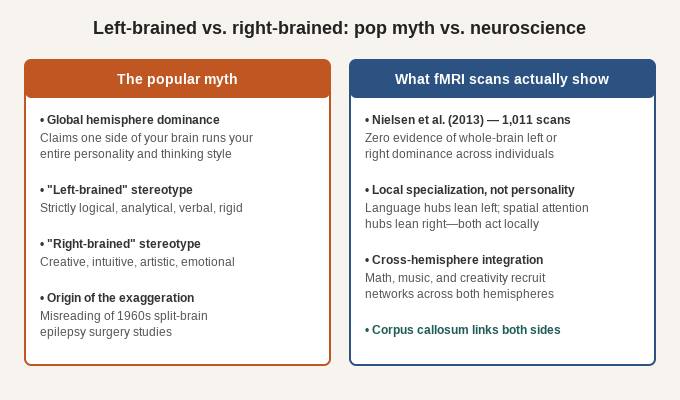
You are neither "left-brained" nor "right-brained," because healthy humans do not rely globally on one cerebral hemisphere over the other. While specific tasks like speech production and spatial attention lean toward localized networks on one side, both halves of your brain stay connected and work together during every complex thought.
Neuroscientists Jared A. Nielsen, Brandon A. Zielinski, Michael A. Ferguson, Janet E. Lainhart, and Jeffrey S. Anderson tested this popular claim directly in a 2013 study published in PLOS ONE. The University of Utah team analyzed resting-state functional MRI scans from 1,011 individuals aged 7 to 29 across 7,266 brain regions. They found zero evidence that people possess stronger overall left-hemisphere or right-hemisphere connectivity profiles.
That result puts an awkward dent in decades of online quizzes, corporate workshops, and classroom posters. People still love sorting friends into tidy boxes—"the analytical left-brainer" or "the free-spirited right-brainer"—because binary labels feel satisfying. Yet the wiring inside your skull refuses to cooperate with that neat split.
Where the left-brain vs. right-brain myth started
The myth grew out of legitimate 1960s neuroscience that pop-culture writers stretched far past what the data showed. Roger Sperry and Michael Gazzaniga studied "split-brain" epilepsy patients whose corpus callosum—the thick bundle of nerve fibers linking the left and right hemispheres—had been surgically severed to stop severe seizures.
Because the two sides could no longer talk directly in those patients, researchers could test each hemisphere in isolation. When an image flashed to the left visual field (processed by the right hemisphere), patients could point to a matching object with their left hand but could not say its name aloud, because speech centers sat primarily in the left hemisphere.
Media outlets turned those surgical findings into a sweeping personality theory. Suddenly, logical accountants were labeled "left-brained" and painters were labeled "right-brained," ignoring the obvious fact that in intact brains, the corpus callosum shuttles information back and forth in milliseconds. Even today, popular workshops repeat those simplified diagrams as settled anatomy when actual brain imaging tells a cooperative story.
What brain lateralization actually looks like
Lateralization is real, but it operates at the level of local neural networks rather than whole-brain personality types. In Nielsen and colleagues' 2013 PLOS ONE dataset, specific hubs showed clear side preferences across the 1,011 participants, yet having a strongly lateralized left-side language hub did not mean a person's other left-side networks were stronger too.
In most right-handed people (and roughly 70% of left-handed people), language production in Broca's area and language comprehension in Wernicke's area lean left. Meanwhile, networks handling certain forms of visuospatial attention and facial emotion recognition lean right.
What surprises most people is how evenly the workload splits on tasks we usually assign to one side. Solving an algebra proof recruits spatial visualization in the right parietal cortex alongside symbolic processing on the left. Composing music or painting a portrait relies on motor planning, structure, and pattern sequencing across both hemispheres.
| Cognitive domain | Pop-psychology claim | Neuroscience finding |
|---|---|---|
| Language & speech | Purely left-brain logical control | Grammar and speech lean left; tone, metaphor, and context rely heavily on right-hemisphere networks. |
| Mathematics | Strictly left-brain calculation | Exact arithmetic engages left angular gyrus; estimation and geometric intuition recruit bilateral parietal hubs. |
| Creativity & art | Strictly right-brain imagination | Creative work pairs right-side associative reach with left-side executive control and evaluation. |
| Personality style | Global left or right dominance | Nielsen et al. (2013) found no whole-hemisphere dominance across 1,011 resting-state fMRI scans. |
Why people still feel "left-brained" or "right-brained"
If your brain uses both sides equally, why do you still feel drawn toward spreadsheets over sketching, or storytelling over financial modeling? The answer lies in temperament, habit, training, and personality traits—not an lopsided cortex.
Personality psychology measures real individual differences through validated models rather than hemisphere metaphors. For example, the Big Five model tracks Openness to Experience (curiosity, aesthetic sensitivity, abstract thinking) and Conscientiousness (order, planning, follow-through). Someone high in Openness and lower in Conscientiousness often gets called "right-brained," while someone high in Conscientiousness and analytical curiosity gets called "left-brained."
Behavioral frameworks like the Bird Personality Test (Eagle, Peacock, Dove, Owl) or DISC capture these same preference patterns in plain behavioral terms. Calling yourself an analytical Owl or an expressive Peacock describes how you make decisions and communicate with teammates without inventing fake brain anatomy to justify it.
How to build skills outside your comfort zone
Dropping the hemisphere myth frees you from a lazy excuse: "I'm just right-brained, so I can't do budgets," or "I'm left-brained, so I'm not creative." Because your brain changes through use-dependent neuroplasticity rather than fixed hemisphere dominance, neglected cognitive muscles respond quickly to structured practice.
- Pair structure with open exploration. If you lean analytical, spend 10 minutes sketching rough ideas on paper before opening a spreadsheet or writing a rigid outline. If you lean spontaneous, end every brainstorming session by picking one idea and writing three dated next steps.
- Cross-train your attention habits. Practice tasks that mix verbal precision with visual-spatial thinking, such as explaining a complex workflow with a simple three-box diagram or summarizing a dense chart in two plain sentences.
- Replace brain labels with trait feedback. Take a validated personality or cognitive-style assessment to spot your actual behavioral habits—like risk tolerance, detail focus, or social energy—then build small guardrails where you tend to over-index.
- Audit your self-talk around hard tasks. Whenever you catch yourself saying "my brain isn't wired for this," swap it for "I haven't practiced this skill for 20 hours yet." That small shift keeps you from treating unfamiliarity as a biological ceiling.
Why the neuromyth causes real harm in schools and workplaces
Labeling kids or employees as "left-brained" or "right-brained" narrows their opportunities early. A 2012 survey of teachers in the United Kingdom and the Netherlands by Sanne Dekker and colleagues, published in Frontiers in Psychology, found that over 90% of surveyed educators believed in hemisphere-dominance learning styles. When a student struggles with geometry or writing, slapping a brain-type label on them hides the real instructional gap.
In offices, the same habit shows up during team assignments. Managers hand every spreadsheet to the "left-brain" analyst and every client pitch to the "right-brain" designer, starving both workers of cross-functional growth. Great work almost always happens when analytical rigor and creative framing sit in the same person or collaborate closely.
How split-brain patients actually behave vs. intact brains
To understand why the pop-culture leap failed, it helps to look at how rare and specific true hemisphere disconnection is. In Roger Sperry and Michael Gazzaniga's 1960s experiments, patients had undergone a corpus callosotomy—a last-resort surgery for severe, drug-resistant epilepsy—to stop electrical storms from jumping across the midline. Even after that surgery, patients walked, talked, and handled everyday routines so normally that casual observers noticed nothing unusual.
Specialists only detected hemisphere differences under strict lab setups where patients stared at a center dot and images flashed to one side of the visual field for less than 200 milliseconds, too fast for eye movement to share the image with both eyes. In your intact brain, roughly 200 million axons inside the corpus callosum, alongside the anterior commissure and subcortical bridges, sync signals continuously across both sides. Drawing conclusions about healthy personality types from severed-callosum lab tests is like judging how a two-engine airplane flies after someone disconnects the cockpit linkage.
You do not need a brain scan to know what comes easily to you and what takes extra effort. Use personality insights to understand your preferences, then trust both hemispheres to handle whatever skill you decide to practice next.
Frequently asked questions
Did the 2013 University of Utah study prove the left and right brain are identical?
No, Nielsen and colleagues (2013) confirmed that specific brain functions are localized more strongly in one hemisphere, such as language on the left and certain attention networks on the right. What they disproved is the idea that individuals globally favor one entire hemisphere over the other across all tasks and personality traits.
Are left-handed people more "right-brained"?
Left-handedness does not make someone globally right-brained or automatically more creative. While about 30% of left-handed people show atypical or bilateral language lateralization compared to roughly 5% of right-handed people, both hemispheres still work in continuous partnership.
What actually determines whether I am more analytical or creative?
Analytical and creative tendencies stem from a mix of genetics, personality traits like Conscientiousness and Openness to Experience, educational exposure, and daily habits. Neither trait sits exclusively inside one half of the cerebral cortex.
Can you train the "other side" of your brain with brain-training games?
You cannot selectively power up one entire hemisphere, because normal cognition already recruits networks across both sides. Practiced skills—like learning an instrument, studying statistics, or drawing—build stronger connections in the specific task networks involved rather than waking up a dormant half of your brain.
Why do online left-brain/right-brain quizzes feel accurate?
Those quizzes usually ask straightforward personality questions, such as whether you prefer tidy desks or spontaneous trips, and then wrap your answers in brain-hemisphere language. The descriptions match because they mirror what you already told the quiz about your habits, not because they measured neural dominance.
- Famous People With an Eagle Personality Type
- Bird Personality : Mild Eagle
- 15 Signs You're in a Toxic Relationship (And What to Do)
- Tips to Achieve Your Goals
- Prioritizing Self-Care: Why Taking Care of Yourself is Essential for Supporting Others
- Surviving the Holidays: Coping with Emotional Triggers
- Understanding Neuro-Linguistic Programming (NLP)
- Bird Personality : Dove
- Bird Personality : Mild Dove
- Bird Personality : Smart Dove
- Bird Personality : Brave Dove
- Bird Personality : Genius Dove
- Bird Personality : Wizard Dove
- Bird Personality : Reverse Thinking Dove
- Bird Personality : Changeable Dove
- Dove Personality in Relationships: How They Show Love