5 Ways to Be More Confident
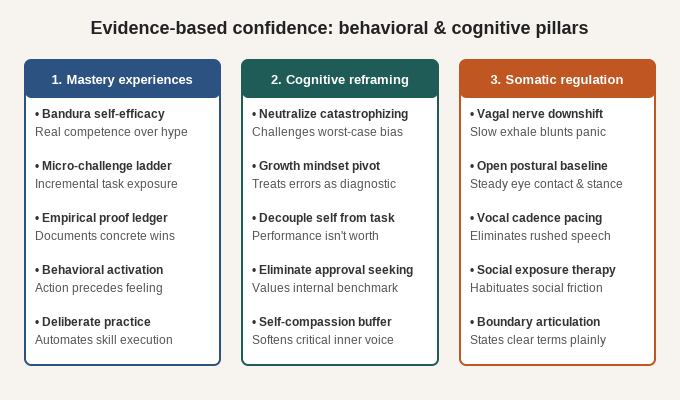
Authentic confidence is an emotional and behavioral state built through empirical competence, progressive exposure to manageable challenges, and objective cognitive restructuring rather than superficial motivational affirmations. Rooted in Albert Bandura's self-efficacy theory and cognitive behavioral therapy, durable confidence emerges when an individual repeatedly collects verifiable evidence of their own ability to survive discomfort, execute difficult tasks, and rebound from mistakes.
Popular self-help advice frequently confuses confidence with performative arrogance or loud extroversion. Reciting ungrounded positive affirmations in front of a mirror produces negligible behavioral change and often increases anxiety in individuals managing severe self-doubt. Sustainable confidence is a byproduct of competence: you trust your abilities because you have repeatedly tested them in the physical world and survived the outcome.
Understanding the psychological architecture of self-efficacy allows you to replace emotional guesswork with structured behavioral protocols. Developing confidence requires systematic training of your cognitive habits, somatic nervous system responses, and daily challenge exposure.
Psychological foundations of self-efficacy and self-belief
Psychologists distinguish between global self-esteem, which reflects general feelings of personal self-worth, and self-efficacy, which measures an individual's belief in their ability to execute specific tasks. Self-efficacy serves as the primary engine of real-world confidence.
Stanford University psychologist Albert Bandura introduced Self-Efficacy Theory in 1977, identifying four distinct inputs that build or destroy confidence. The most potent source is Mastery Experiences: successful performance of a challenging task permanently recalibrates your mental limits. The second source is Vicarious Modeling, observing peers with similar capabilities successfully complete a difficult action. The third source is Social Persuasion, receiving realistic, credible encouragement from respected mentors. The fourth source is Physiological and Affective States, interpreting somatic arousal like an elevated heart rate as focused excitement rather than paralyzing panic.
Bandura proved that mastery experiences exert five times greater influence over behavior than verbal persuasion. Hearing someone say you can accomplish a goal provides momentary motivation, but successfully executing the task with your own hands establishes indelible neural proof.
Carol Dweck's research on Growth Mindset at Stanford University, synthesized in 2006, complements Bandura's model. Individuals operating from a fixed mindset view ability as a static genetic trait. Every mistake threatens their self-worth, forcing them to avoid difficult challenges to protect their fragile self-image. Individuals cultivating a growth mindset view competence as a malleable capacity expanded through effort, treating errors as neutral diagnostic information rather than personal indictments.
Comparing confidence interventions across empirical metrics
Different therapeutic and behavioral strategies produce vastly different rates of psychological change. The table below contrasts five common approaches based on empirical research.
| Intervention strategy | Core psychological mechanism | Key scientific pioneer | Timeframe for noticeable result | Primary risk of misapplication |
|---|---|---|---|---|
| Graded mastery exposure | Incremental task mastery expands baseline self-efficacy | Albert Bandura (1977) | 2 to 6 weeks of consistent execution | Advancing through difficulty tiers too rapidly, inducing panic |
| Cognitive reality testing | Identifies and disputes automatic cognitive distortions | Aaron Beck (1979) | 3 to 8 weeks of daily journaling | Over-intellectualizing thoughts without taking behavioral action |
| Self-compassion practice | Replaces harsh self-judgment with supportive neutrality | Kristin Neff (2003) | Immediate somatic relief; 4 weeks habitual | Confusing self-compassion with passive complacency or laziness |
| Somatic down-regulation | Vagal nerve stimulation blunts sympathetic panic responses | Stephen Porges (2011) | 60 to 180 seconds during acute stress | Treating physical calming as a substitute for skill preparation |
| Positive affirmations | Conscious repetition of aspirational self-statements | Émile Coué (1922) | Negligible sustained change | Triggers subconscious resistance in individuals with low self-esteem |
5 evidence-based ways to build lasting confidence
Transforming self-doubt into durable confidence requires executing specific, measurable behavioral adjustments. Follow these five research-backed strategies.
- Construct an empirical mastery ladder using progressive micro-challenges. Break intimidating objectives into incremental sub-tasks that introduce mild discomfort without triggering overwhelming panic. If public speaking induces terror, begin by speaking for sixty seconds during a small internal team standup, advance to presenting a ten-minute technical brief to familiar colleagues, and gradually scale upward toward auditorium presentations. Each successful completion deposits undeniable empirical evidence into your cognitive memory banks.
- Execute cognitive behavioral reality testing against catastrophic assumptions. Self-doubt thrives on cognitive distortions, particularly catastrophizing, fortune-telling, and emotional reasoning. When your mind asserts that an upcoming presentation will result in professional humiliation, treat the thought as an unverified hypothesis rather than an objective fact. Write down the thought, list concrete empirical evidence supporting the claim, list opposing factual evidence, and formulate an objective, balanced counter-statement grounded in historical performance data.
- Replace self-esteem monitoring with structured self-compassion breaks. University of Texas psychologist Kristin Neff demonstrated that pursuing high self-esteem breeds narcissism, social comparison anxiety, and fragile confidence that shatters upon the first mistake. Self-compassion provides stable emotional resilience by maintaining supportive internal dialogue during failure. When an error occurs, acknowledge the emotional sting neutrally, recognize that mistakes represent an inevitable universal human experience, and offer yourself the same practical guidance you would provide to an esteemed colleague.
- Downshift somatic nervous system arousal using physiological regulation protocols. Severe self-doubt frequently originates as an involuntary bodily reflex: shallow breathing, muscle tension, and racing pulse. Clinical neuroscientist Stephen Porges demonstrated through Polyvagal Theory that physical somatic signals communicate safety or danger to the brain via the vagus nerve. Before entering a high-stakes conversation, execute three cycles of the physiological sigh: two sharp nasal inhalations followed by an extended, slow oral exhalation lasting six seconds. Lowering autonomic arousal prevents the amygdala from hijacking executive cognitive reasoning.
- Decouple your fundamental human worth from specific task performance outcomes. Performance anxiety peaks when individuals equate the success of a project with their intrinsic value as human beings. Albert Ellis, founder of Rational Emotive Behavior Therapy, emphasized the necessity of Unconditional Self-Acceptance (USA). Rate your specific behaviors, presentations, and technical code rigorously, but refuse to rate your global self. Decoupling your identity from immediate outcomes liberates you to take calculated risks without dreading psychological destruction.
Building confidence across bird personality types
Each bird personality profile encounters distinct internal doubts and requires targeted developmental focus.
Eagle personalities draw confidence from decisive authority and rapid victories. Facing failure often collapses an Eagle's confidence into defensive anger or reckless overcompensation. Eagles build resilient confidence by practicing strategic patience, realizing that losing a tactical skirmish does not diminish their long-term executive capacity.
Owl personalities derive confidence from exhaustive data, technical perfection, and meticulous preparation. Their confidence shatters when forced to act without complete information. Owls build authentic confidence by establishing minimum viable data thresholds, deliberately presenting preliminary findings when an analysis reaches 80% completion rather than waiting for nonexistent perfection.
Peacock personalities anchor confidence to public applause, social warmth, and external validation. Neutral or critical audience reactions quickly dissolve a Peacock's self-belief. Peacocks develop unbreakable confidence by building private technical competence behind the scenes, ensuring their real capabilities match their charismatic public delivery.
Dove personalities draw confidence from interpersonal harmony, steady loyalty, and team consensus. Doves struggle with acute self-doubt whenever conflict erupts, often sacrificing their own boundaries to keep peace. Doves cultivate durable confidence by practicing assertive communication, learning that expressing disagreement directly strengthens professional relationships rather than destroying them.
Common traps: fake-it-till-you-make-it and performative arrogance
Popular culture often recommends faking confidence through exaggerated physical posturing and manufactured bravado. This approach carries severe psychological liabilities.
Faking confidence increases cognitive dissonance and intensifies imposter syndrome. Pretending to possess skills you lack traps your brain in hyper-vigilant panic, fearing exposure as a fraud. Real confidence does not claim omniscient capability; it says, "I do not know the answer right now, but I possess the cognitive methodology to figure it out."
Arrogance acts as a brittle defensive shell designed to shield an insecure ego from scrutiny. Confident people listen attentively, ask clarifying questions, and admit mistakes readily because their self-worth does not depend on being infallible.
Frequently asked questions
Can you build genuine confidence without prior success?
You can build authentic confidence without historic success by anchoring your self-belief in your commitment to learning rather than prior performance trophies. Focusing on effort, disciplined study, and adherence to proven operational processes generates internal efficacy that functions reliably before external milestones materialize.
How long does it take to develop lasting self-confidence?
Developing lasting self-confidence requires six to twelve weeks of consistent exposure to graded challenges paired with cognitive restructuring. Rewiring automatic self-critical neural pathways depends on accumulating concrete behavioral memories rather than passive intellectual agreement.
Why do positive affirmations fail to improve confidence for many people?
Positive affirmations fail because psychological research demonstrates that repeating statements that contradict established core beliefs triggers immediate cognitive resistance. An individual managing intense inadequacy who repeats "I am completely successful" experiences subconscious rejection of the statement, which amplifies feelings of failure.
What is the difference between self-confidence and self-efficacy?
Self-confidence is a broad, generalized belief in your overall capacity to handle life challenges. Self-efficacy is an evidence-based conviction regarding your ability to execute a specific, defined task, such as delivering a technical presentation or negotiating a contractual agreement.
How does physical exercise influence psychological confidence?
Regular cardiovascular and resistance exercise elevates brain-derived neurotrophic factor, regulates cortisol production, and stimulates dopamine synthesis. Conquering physically demanding workouts provides unambiguous somatic proof of discipline, which transfers directly into professional self-efficacy.
- Understanding Mobile Phone Addiction
- Bird Personality : Reverse Thinking Peacock
- Your Complete Roadmap To Recovering From Ghosting
- What is a Victim Complex?
- Nature vs Nurture: How Much of Your Personality Is Genetic?
- The Best Career Paths for Creative Thinkers
- Seasonal Affective Disorder (SAD) : Symptoms and Treatment
- Bird Personality : Dove
- Bird Personality : Mild Dove
- Bird Personality : Smart Dove
- Bird Personality : Brave Dove
- Bird Personality : Genius Dove
- Bird Personality : Wizard Dove
- Bird Personality : Reverse Thinking Dove
- Bird Personality : Changeable Dove
- Dove Personality in Relationships: How They Show Love