How Culture Shapes the Way We Express Personality
Culture does not create personality traits from scratch, but it strongly shapes which traits get expressed openly, which get suppressed, and which behaviors count as a sign of that trait in the first place. The same underlying trait can look completely different depending on where someone was raised.
The Big Five Traits Show Up Almost Everywhere, but Not Identically
Cross-cultural research on the Big Five finds the same five broad dimensions across most studied populations, which suggests a near-universal structure to personality. What differs is the behavioral vocabulary attached to each trait. Openness might get expressed through debate and novelty-seeking in one culture and through artistic or spiritual exploration in another, even at similar underlying trait levels.
Individualist and Collectivist Norms Reward Different Behaviors
In individualist cultures, self-expression, direct opinion-sharing, and personal achievement are often read as signs of a healthy, well-adjusted personality. In more collectivist cultures, the same underlying traits often get expressed through group harmony, deference to elders, or contribution to a shared goal rather than personal distinction. Someone raised in a collectivist household who moves into an individualist workplace may seem quiet by local standards while still scoring high on extroversion in their own cultural context.
Extroversion Does Not Mean the Same Behavior Everywhere
An extroverted person in one culture might be the loudest voice in the room. In another, extroversion might show up as reliably initiating one-on-one conversations rather than dominating a group, because loudness itself gets read as immodest. This is why cross-cultural personality comparisons need context, not just a trait score translated word for word from one culture's assessment to another.
The Same Trait Can Be Praised in One Culture and Discouraged in Another
Assertiveness, for instance, is frequently framed as leadership potential in some workplace cultures and as disrespect toward hierarchy in others. This mismatch causes real friction for people who move between cultural contexts, including immigrants, international students, and children of immigrant families, who often get told their personality needs fixing when it is really a translation problem between two sets of norms.
How This Plays Out in Everyday Situations
Consider praise. In some cultural contexts, complimenting a child directly and often is standard encouragement. In others, open praise is deliberately restrained because drawing attention to one child is seen as unfair to the group or likely to invite bad luck, even though the underlying warmth toward the child is just as strong. Consider disagreement at work: some cultures treat direct, in-the-moment pushback as a sign of engagement and honesty, while others expect disagreement to be raised privately, afterward, or through a third party to preserve the group's harmony in the room. A person following either norm can be equally conscientious and equally invested in the outcome. Frameworks such as the individualism-collectivism dimension popularized by cross-cultural psychologist Geert Hofstede describe these patterns at a societal level, though any individual can sit anywhere on that spectrum regardless of their country of origin. Two siblings raised in the same household can land on noticeably different points of that spectrum, which is a reminder that culture sets a range of acceptable expression rather than dictating one fixed outcome for every person inside it.
Bicultural People Often Develop Two Expression Styles
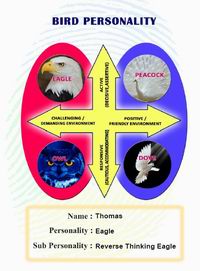
People raised across two cultural contexts frequently describe code-switching not just in language but in personality expression itself, speaking up more in one setting and holding back in another, without feeling like either version is fake. This is a well-documented pattern in bicultural identity research, and it complicates any personality test, including a bird personality test or DISC assessment, that assumes one stable behavioral style per person.
Before assuming a friend, partner, or coworker has a fixed personality, it is worth asking which cultural context shaped the behavior you are seeing, and whether they would describe themselves differently in a different setting. I grew up assuming my own culture's version of confidence was just what confidence looked like, full stop, and it took living somewhere else to notice how much of that was local custom rather than trait.
This reflection is meant as a general psychology overview, not a substitute for guidance from a cross-cultural counselor or psychologist for deeper identity or adjustment concerns.
Frequently Asked Questions
Does personality vary by culture, or is it the same everywhere?
The underlying trait structure appears broadly similar across cultures, but how each trait gets expressed, valued, and labeled varies a great deal, which is why the same behavior can read as confident in one setting and rude in another.
Can living in a new culture change your personality?
It can change how you express existing traits and, over time, shift some trait levels modestly, especially through sustained exposure to different social norms and expectations.
Why do personality tests sometimes feel inaccurate across cultures?
Many widely used tests were developed and validated in specific cultural contexts, so questions and behavioral examples do not always translate cleanly, which can skew results for people outside that original context.
Is code-switching a sign of an inconsistent personality?
No. Adjusting expression style across cultural contexts is a documented and often healthy adaptation, not evidence of an unstable or fake personality.
How can I recognize my own cultural bias when judging someone's personality?
Notice whether you are judging a behavior itself or comparing it to an unstated local norm. Asking how someone would describe their own behavior, rather than assuming your framework applies, usually reveals the difference.
- Why Serotonin Is Important for Your Well-Being
- Best Careers for Your Personality Type (Full Guide)
- Emotional Freedom Technique (EFT)
- Overcoming Perfectionism: Tips and Strategies for a Healthier Mindset
- Bird Personality : Genius Eagle
- Setting Specific and Achievable Goals
- The Impact of Alexithymia on Mental Health and Relationships