Toxic Relationship Signs With Parents: What to Watch For
A toxic relationship with a parent is a pattern, not a single bad argument: repeated criticism, guilt, control, or disrespect for your boundaries that leaves you drained or anxious after most contact. Every parent loses their temper sometimes. The warning sign is a relationship where your feelings are regularly dismissed, your independence is punished, and affection depends on your compliance.
Many adults find this hard to name because the person involved raised them, may have sacrificed for them, and may be loved in return. Both things can be true. A parent can be generous in some ways and harmful in others, and recognizing the harm does not require pretending the good never happened.
What makes a parent-child relationship toxic?
A relationship is toxic when it causes ongoing emotional harm and the parent does not respond to feedback. The key difference from ordinary conflict is repetition without repair. In a healthy relationship, a parent who hurts you eventually acknowledges it, even clumsily. In a toxic one, the hurt is denied, turned around on you, or punished.
The term is not a clinical diagnosis. Therapists usually talk about specific behaviors, such as emotional abuse, enmeshment, or psychological control, and the research on those is more precise than the popular label. Felitti and colleagues' 1998 Adverse Childhood Experiences study in the American Journal of Preventive Medicine surveyed more than 9,500 adults and found that childhood experiences such as emotional abuse and household dysfunction were linked to depressed mood, substance use, and heart disease in adulthood. The risk rose with the number of such experiences.
What are the most common signs of a toxic parent?
The signs below show up across many families, though no single one proves a relationship is toxic. A cluster of several that continue over years is a stronger signal than any one of them.
- Constant criticism that feels personal. A parent who comments on your weight, your job, your partner, and your parenting in every conversation is not offering feedback. Feedback has a purpose and an end. This kind of commentary runs until you stop visiting.
- Guilt used as a tool. Phrases like "after everything I've done for you" or "I guess I'll just be alone" turn a normal request into a debt. You find yourself agreeing to things you do not want in order to stop the pressure.
- Ignoring your boundaries. Showing up unannounced after being asked not to, reading your messages, or sharing your private information with relatives all signal that your limits do not count.
- Love that depends on obedience. The warmth arrives when you do what they want and disappears when you disagree. Children learn quickly which version of themselves earns affection, and some spend decades performing it.
- Playing favorites or pitting siblings against each other. A parent who repeats what one child said about another, or compares them constantly, creates rivalry that outlasts childhood.
- Rewriting history. You describe an event, and the parent insists it never happened or that you exaggerate. Repeated denial of your memory makes many adults doubt their own perception.
- Treating you as a confidant or a caretaker as a child. A parent who shares adult problems with a ten-year-old, or relies on a teenager to manage their emotions, has reversed the roles. Psychologists call this parentification, and it often leads to adults who cannot stop taking care of others.
- Punishing independence. Moving away, choosing a partner they dislike, or making a decision they did not approve results in silence, anger, or threats. Normal adult choices become acts of betrayal.
How is a toxic pattern different from normal parent conflict?
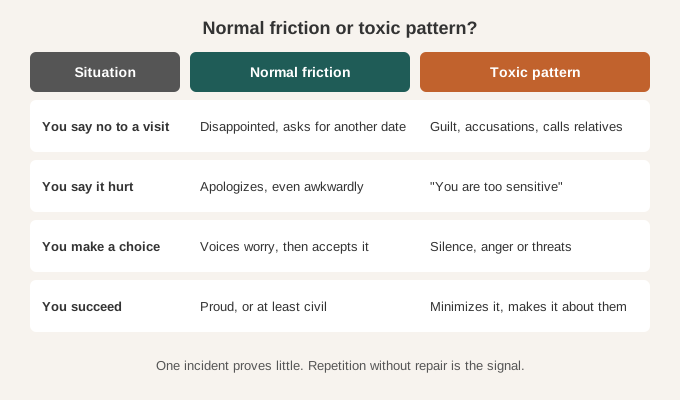
The difference comes down to frequency, repair, and respect for you as a separate person. The table below places common situations side by side.
| Situation | Normal friction | Toxic pattern |
|---|---|---|
| You disagree about a career choice | Parent voices worry, then accepts your decision | Parent brings it up at every meal and withholds support for years |
| You say no to a visit | Parent is disappointed and asks for another date | Parent cries, accuses you of abandonment, and calls other relatives |
| You point out that something hurt you | Parent apologizes, even awkwardly | Parent says you are too sensitive, or lists what you did wrong |
| You make a mistake | Parent helps and does not mention it again | Parent brings it up in arguments for decades |
| You set a boundary about money | Parent grumbles but respects it | Parent keeps asking, escalates, or goes around you |
| You succeed at something | Parent is proud, or at least civil | Parent minimizes the achievement or turns it into a story about themselves |
If you recognize the right-hand column more than the left, the relationship deserves a closer look, even if your parent is also kind in other moments. Intermittent kindness is one reason these patterns last so long: the good days make the bad ones easier to excuse.
How does this show up in adult life?
Adults with toxic parents often notice the effects in other relationships before they connect them to home. Common ones include difficulty saying no, a strong fear of disappointing people, a harsh inner critic that sounds like a parent, and attraction to partners who are controlling or critical in familiar ways.
Personality plays a part in how the harm lands. A Dove, the patient and harmony-seeking type in the DOPE model, may absorb the criticism and keep trying to please. An Eagle may fight back openly and end up in a cycle of loud conflict. An Owl may withdraw into analysis and distance, and a Peacock may keep the relationship cheerful on the surface while the pain builds underneath. You can see where you fall with the DOPE personality test, though a quiz result is a starting point for reflection, not an explanation of your family.
Physical symptoms are common too. Dreading a phone call, getting a stomachache before a visit, or needing a full day to recover afterward are your body reporting what you may be reluctant to say aloud.
Is it your fault if your parent treats you this way?
No. Children do not cause their parents' behavior, and adults are not responsible for another adult's refusal to respect them. People who grew up with a critical parent often assume they must have been difficult, and that belief keeps them trying to earn something that was never conditional on their performance.
It is also possible that your parent has their own history. Many toxic parents were treated the same way, or live with untreated depression, addiction, or a personality disorder. That explanation can help you feel less angry. It does not oblige you to absorb the harm.
What can you do about it?
You have several options, and they sit on a range from small adjustments to full separation. Most people start with the smallest one that works and move up only if it does not.
- Limit the length and frequency of contact. A one-hour lunch every month can be easier to manage than a weekend.
- Set one specific boundary and state it calmly, such as "I won't discuss my weight. If you bring it up, I'll leave." Then follow through the first time it is tested.
- Move contact to a medium you control. A text thread or a short call can be paused, whereas a house visit cannot.
- Bring a third person to difficult events, such as a sibling or partner who will not join in the criticism.
- Work with a therapist who has experience with family patterns. Two or three sessions are often enough to figure out which boundaries are realistic for your situation.
Boundaries rarely go smoothly the first time. Expect a surge of guilt trips, anger, or silent treatment as your parent tests whether you mean it, a response therapists call an extinction burst. If you hold the line through that stretch, the pressure usually drops.
When is it time to step back or cut contact?
Consider distance when the relationship involves ongoing abuse, threats, or violence, when boundaries are ignored after repeated clear requests, or when contact leaves you unable to function for days. Some adults choose low contact, where they exchange holiday messages and little else. Others choose no contact, which is a serious decision that is easier with support from a therapist or a trusted friend.
The choice is not a measure of how much you love your parent. Many people who step back report grief that continues for years, and that is a normal response to losing the relationship you wished for. If safety is at risk, contact a local domestic violence or child protection service, or your emergency number.
Parents with the best chance of changing are the ones who can hear "that hurt me" without defending themselves. If your parent can, a family therapy session may help. If not, you can still build a life in which their opinion carries less weight than it did at fifteen.
Frequently asked questions
What are the signs of a toxic parent?
Common signs include constant criticism, guilt used to control you, ignoring boundaries, withdrawing affection when you disagree, and denying events you remember. One sign alone does not prove a relationship is toxic. A cluster that continues for years, with no acknowledgment or repair, is the stronger indicator.
Can a toxic parent change?
Some do, but only if they recognize the problem and want to change. A parent who can listen to feedback, apologize, and adjust their behavior has a good chance of improving the relationship. A parent who blames you for the problem rarely changes without outside pressure.
Is it okay to cut off a toxic parent?
Yes, when the relationship harms your health or safety and other approaches have failed. It is a serious decision with emotional costs, including grief and pressure from relatives. A therapist can help you weigh low contact against a full break.
Why do I feel guilty setting boundaries with my parents?
Guilt is common because many children are taught that obedience equals love. Feeling guilty does not mean the boundary is wrong. It means you are changing a pattern that you learned early, and the discomfort usually fades with practice.
How do I know if I am being oversensitive or my parent is being toxic?
Look at the pattern, not one incident. Ask whether the behavior repeats, whether your parent apologizes when they hurt you, and whether other people see it as well. A trusted friend or therapist can offer an outside view when you doubt your own judgment.
What kind of therapy helps with toxic parents?
Individual therapy that focuses on family patterns, such as cognitive behavioral therapy or schema therapy, is a common choice. Group therapy and support groups for adult children of difficult parents can also help. Choose a therapist who has worked with family relationships and ask about their approach in the first session.

- Bird Personality : Dove
- Bird Personality : Mild Dove
- Bird Personality : Smart Dove
- Bird Personality : Brave Dove
- Bird Personality : Genius Dove
- Bird Personality : Wizard Dove
- Bird Personality : Reverse Thinking Dove
- Bird Personality : Changeable Dove
- Dove Personality in Relationships: How They Show Love