4 Ways to Deal With Rejection
Rejection activates the exact neural circuits responsible for physical agony. An employer choosing a rival candidate, an agent passing on a manuscript, or a partner ending a commitment all register identically in the central nervous system. The human brain perceives exclusion as an immediate threat to survival. Primitive hominid survival depended on tribal inclusion; being expelled from the group meant starvation or predator attacks on the Pleistocene savanna. Your modern nervous system retains this ancient architecture, treating every social dismissal as a biological emergency.
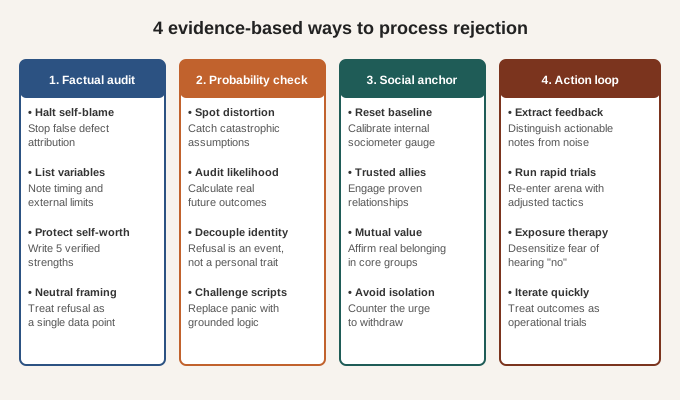
Most people react to this physiological alarm by compounding the damage. They insult their own intelligence, withdraw into isolation, and assume a single refusal defines their entire future trajectory. You can bypass this destructive downward spiral through four concrete, research-backed practices: running an objective factual audit to halt reflexive self-blame, calculating the mathematical odds of catastrophic narratives, recalibrating the internal sociometer through stable bonds, and converting future attempts into structured behavioral trials.
The neurological mechanics of social exclusion
Social exclusion creates measurable neurological trauma rather than mere psychological discomfort. In a landmark 2003 neuroimaging study at the University of California, Los Angeles, researchers Naomi Eisenberger, Matthew Lieberman, and Kipling Williams placed participants inside fMRI scanners while playing a virtual ball-tossing game called Cyberball. Without warning, the computerized avatars stopped tossing the ball to the participant, excluding them from the group. The brain scans revealed immediate activation in the dorsal anterior cingulate cortex and anterior insula. These exact regions process the affective distress of physical pain, such as burning a hand on a stovetop.
Subsequent research led by Ethan Kross at the University of Michigan in 2011 demonstrated that intense social heartbreak recruits the secondary somatosensory cortex and dorsal posterior insula. These sensory systems encode the somatic sting of physical burns and lacerations. Social rejection hurts because the human nervous system uses a single alarm system for both broken bones and fractured bonds. Dismissing this pain as an imaginary mental weakness ignores basic mammalian neurology.
Psychologist Mark Leary at Wake Forest University introduced the sociometer theory in 1995, explaining that self-esteem is an internal gauge monitoring social acceptance. Self-esteem does not exist as an independent fountain of confidence; it monitors social belonging. A rejection drops the needle on this gauge toward zero, triggering acute panic, elevated cortisol, and depressive symptoms. Rebuilding stability requires manual intervention to recalibrate that gauge before emotional exhaustion sets in.
Strategy 1: interrupt the self-flagellation reflex with a factual audit
The immediate impulse following a rejection is reflexive self-criticism. Clinical psychologist Guy Winch documented in his clinical research on emotional first aid that people routinely respond to rejection by listing their personal inadequacies. A rejected job applicant concludes they lack intelligence; a spurned romantic partner decides their appearance is repellent. This reaction resembles sustaining a deep physical laceration and deliberately rubbing dirt into the open wound.
Halting this destructive habit requires an immediate factual audit within two hours of receiving the refusal. Sit down with a blank sheet of paper and divide it into two columns: external variables and controllable execution factors. Under external variables, write down the environmental constraints that had zero relation to your personal worth. In corporate hiring, these include internal candidate promotions, budget freezes, organizational restructuring, or subjective executive bias. In dating, these include mismatched life timelines, unresolved trauma from the other party, or incompatible geographic goals.
Under controllable execution factors, identify concrete technical adjustments for future attempts. Perhaps an interview answer lacked clear metric data, or a business proposal needed a more concise pricing breakdown. Separating external chaos from technical mechanics stops the ego from absorbing unearned blame. Complete the audit by listing five documented strengths with verifiable historical evidence, such as projects delivered ahead of schedule or past peer endorsements. This restores cognitive equilibrium and protects self-esteem from arbitrary degradation.
Strategy 2: run an objective probability check on catastrophic scripts
Rejection rapidly distorts cognitive appraisal, transforming a single isolated refusal into a sweeping declaration of permanent failure. Cognitive behavioral therapy pioneers Aaron Beck and Albert Ellis identified this distortion as overgeneralization and catastrophizing. The mind takes the premise that company X declined an offer and leaps to the irrational conclusion that you will remain permanently unemployed, face financial ruin, and end up destitute. This runaway narrative generates severe physiological distress.
Neutralizing catastrophic thinking demands a rigorous mathematical probability audit. Write down the apocalyptic narrative dominating your thoughts, then calculate the statistical baseline for the environment in which you operate. A top-tier venture capital fund reviews roughly 1,000 pitch decks to fund two companies, establishing a baseline rejection rate of 99.8 percent. Academic journals reject between 80 and 90 percent of submitted manuscripts. Competitive corporate job openings attract 250 resumes for a single desk.
A single refusal in a high-volume statistical environment carries almost zero predictive power regarding your overall competence. The outcome is a mathematical consequence of selection ratios rather than an indictment of your talent. Challenge your catastrophic script by asking three grounded questions: Does this outcome permanently eliminate my existing technical skills? Have other professionals succeeded in this field after absorbing identical refusals? Specific evidence indicating that future opportunities must copy this isolated outcome rarely exists. Documenting these answers terminates the catastrophic cycle and re-establishes rational perspective.
Strategy 3: recalibrate your sociometer through reliable social anchors
The instinct to withdraw into seclusion following social exclusion exacerbates neurological pain. Solitary rumination traps the brain in an echo chamber of threat detection, prolonging the release of cortisol and adrenaline. Because the sociometer relies on external social data to measure personal safety, isolation leaves the gauge permanently pegged in the danger zone. Healing requires intentional contact with stable social anchors.
Identify two or three individuals in your personal or professional life whose respect and loyalty are already established through years of consistent interaction. Schedule an in-person conversation or a telephone call within twenty-four hours of a major setback. The objective of this conversation is not to rehearse grievances or fish for superficial flattery. State plainly that you received an unwelcome outcome and desire connection in a neutral, supportive environment.
Engage in collaborative activities that affirm mutual competence and shared history. Discuss an unrelated intellectual project, prepare a meal, or assist them with an operational challenge in their own life. Participating in reciprocal social exchange triggers oxytocin release, which directly suppresses amygdala hyperactivity and dampens pain signals in the anterior insula. Your internal sociometer registers that your core tribe remains intact, reducing the perceived existential threat of the external refusal.
Strategy 4: convert rejection data into low-stakes behavioral experiments
Treating every social or commercial initiative as an all-or-nothing referendum on personal worth guarantees chronic performance anxiety. Stanford University psychologist Carol Dweck demonstrated across three decades of research that a fixed mindset interprets failure as an indictment of innate capability, whereas a growth mindset treats failure as diagnostic feedback. Shifting from an ego-defensive posture to an experimental posture neutralizes the emotional cost of hearing "no."
Entrepreneur Jia Jiang popularized this operational shift through a structured series of daily rejection challenges, demonstrating that voluntary exposure to refusal systematically desensitizes the autonomic nervous system. You can implement this principle by framing professional pitches, creative submissions, and networking requests as empirical split tests rather than personal pleas for validation. Break your primary objective into twenty small, distinct inquiries distributed over several weeks.
Alter a single variable across each batch of inquiries. In a sales context, test two contrasting email subject lines or pitch structures. In creative writing, submit short drafts to diverse publications simultaneously rather than obsessing over a single prestigious outlet. Log incoming refusals into a spreadsheet alongside the specific variables tested. The refusal ceases to be a personal wound; it becomes an informative data point indicating which approaches fail to resonate with a specific audience. This systematic habituation builds high psychological endurance.
How different DOPE personality archetypes experience social rejection
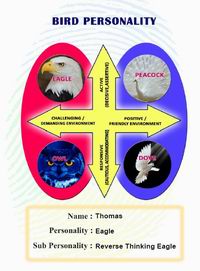
Individual temperaments process social friction differently. The DOPE framework categorizes behavioral styles into four distinct archetypes: Eagle, Peacock, Dove, and Owl. Recognizing your baseline personality pattern clarifies your reflexive vulnerabilities and reveals targeted counter-measures.
Eagle personalities respond to rejection with intense anger, indignation, and aggressive counter-attacks. They blame bureaucratic incompetence or perceived weakness in the decision-maker. To recover constructively, an Eagle must channel that aggressive energy into rigorous operational improvements rather than hostile confrontations that burn professional relationships.
Peacock personalities derive energy from enthusiasm, social validation, and public recognition. Rejection strikes at their core vulnerability, generating profound embarrassment, deflation, and public shame. Peacocks often feel invisible or unloved after a refusal. Their recovery requires decoupling personal self-esteem from external applause and grounding self-worth in private craft mastery rather than public adulation.
Dove personalities prioritize relational harmony, emotional security, and steady loyalty. Rejection shatters their sense of interpersonal peace, causing them to absorb excessive guilt and retreat into silent accommodation. Doves often assume the other party dislikes them personally. Doves must practice assertive boundary setting, recognizing that differing operational needs between parties do not indicate personal animosity.
Rejected Owls descend into obsessive analysis, searching endlessly for technical flaws in their work or accusing the selection process of irrational bias. Owls easily become paralyzed by perfectionism, refusing to submit future work until every variable is flawless. Owls must accept that human decisions contain irreducible subjective variance that no mathematical formula can eliminate.
| Rejection category | Immediate psychological risk | High-impact intervention | Measured behavioral outcome |
|---|---|---|---|
| Professional job application | Imposter syndrome and catastrophic career paralysis | Objective separation of market supply ratios from personal skill inventory | Resumption of targeted job submissions within forty-eight hours |
| Romantic dating ending | Acute drop in sociometer score and compulsive rumination | Immediate activation of trusted friendships and structured somatic exercise | Reduction in obsessive social media checking and panic spikes |
| Creative or commercial pitch | Creative block, perfectionist paralysis, and abandonment of projects | Batch experimentation testing multiple pitches across varied audiences | Generation of actionable market feedback and iterative refinement |
| Social group exclusion | Intense activation of physical pain circuits and defensive hostility | Re-engagement with historical core allies and explicit values inventory | Preservation of interpersonal trust without cynical withdrawal |
Building long-term psychological callus through calibrated exposure
Absorbing rejection without emotional collapse does not mean becoming callous, indifferent, or cynical. Psychological callus resembles the physical friction skin that develops on the fingertips of a classical guitarist. The skin remains sensitive to pressure and musical nuance, but the raw blistering ceases. You can build this durable layer by deliberately increasing your frequency of low-stakes exposure to potential refusals.
Make a conscious decision to request small accommodations in daily interactions where a refusal carries zero real consequence. Ask for a table upgrade at a crowded restaurant, request a modest discount on a retail purchase, or pitch an ambitious guest column to an established publication. Experiencing polite refusals in mundane settings recalibrates your threat detection system. The autonomic spike in heart rate and adrenaline flattens as your subconscious learns that hearing a simple "no" leaves your physical safety, financial security, and personal integrity entirely intact.
Action cures the lingering paralysis that follows a major disappointment. While passive rumination preserves the memory of failure, decisive physical movement and structured routine demand prefrontal engagement. Commit to completing a tangible, measurable task within three hours of any major setback: clear an administrative backlog, execute a heavy weightlifting session, or outline a new strategic proposal. Moving your body and directing your attention toward constructive output breaks the cycle of helpless passivity.
Frequently asked questions
Can physical pain relievers reduce the emotional sting of rejection?
Research led by C. Nathan DeWall at the University of Kentucky showed that daily doses of acetaminophen reduced self-reported social distress and blunted neural responses in the dorsal anterior cingulate cortex during social exclusion. While over-the-counter painkillers offer temporary dampening, cognitive restructuring and social connection remain the only sustainable long-term solutions for processing rejection.
How long does the acute pain of a major rejection typically last?
The acute neurochemical surge of adrenaline and cortisol following a severe rejection peaks within the first twenty-four to forty-eight hours. Emotional processing gradually stabilizes over two to six weeks as the prefrontal cortex integrates the event into long-term memory. Lingering distress beyond that window indicates persistent cognitive rumination or unaddressed self-criticism that requires deliberate behavioral intervention.
Should you ask for direct feedback after being rejected for a role?
Requesting feedback is worthwhile if you frame the inquiry around specific operational skills rather than asking for general opinions. Send a concise note thanking the decision-maker and asking for one concrete technical area to strengthen for future consideration. Recognize that many corporate policies restrict hiring managers from providing candid details due to legal constraints.
What is the difference between healthy processing and unproductive rumination?
Healthy processing identifies factual causes, separates controllable actions from uncontrollable environmental variables, and leads directly to adjusted behavioral plans. Unproductive rumination repeats the emotional shock in a closed loop, questions personal worth, and produces paralysis. If your internal dialogue focuses on assigning blame rather than executing the next step, you are ruminating.
Why do some individuals experience rejection far more intensely than others?
Genetic variations in mu-opioid receptor genes, early childhood attachment stability, and baseline neurochemical sensitivity influence individual reactions to social exclusion. Individuals with high rejection sensitivity perceive neutral social cues as intentional snubs and experience heightened amygdala reactivity. Cognitive behavioral strategies and systematic desensitization effectively retrain these heightened sensitivities over time.
- Leading with Empathy : The Benefits and Real-Life Examples
- The Best Career Paths for Creative Thinkers
- Why Identity Matters: The Importance of Developing a Strong Sense of Self
- Signs Of Emotionally Abusive Parents
- What Are Temperaments? Understanding the Human Psyche
- 8 Tips To Help You Stop Rushing
- Toxic Relationship Signs Backed by Psychology
- Bird Personality : Dove
- Bird Personality : Mild Dove
- Bird Personality : Smart Dove
- Bird Personality : Brave Dove
- Bird Personality : Genius Dove
- Bird Personality : Wizard Dove
- Bird Personality : Reverse Thinking Dove
- Bird Personality : Changeable Dove
- Dove Personality in Relationships: How They Show Love