Peacock Personality Type: Traits, Strengths, and Weaknesses
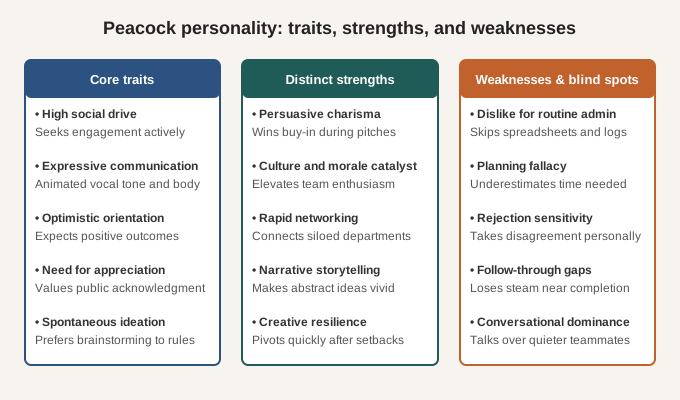
The Peacock personality archetype represents the expressive, socially driven quadrant within the DOPE four-bird model and William Moulton Marston's DISC framework. Propelled by an appetite for social engagement, public acknowledgment, and spontaneous collaboration, Peacocks inject enthusiasm into workplace cultures and rally consensus around novel initiatives. Their natural exuberance introduces distinct operational liabilities: chronic administrative avoidance, optimistic overpromising, and acute sensitivity to interpersonal criticism. Mastering this behavioral profile requires anchoring charismatic persuasion to rigid accountability habits.
Psychologists evaluate the DOPE framework as an accessible translation of Marston's High Influence behavioral archetype. While the decisive Eagle commands authority and the analytical Owl audits data, the Peacock builds emotional bridges across disparate human networks. Understanding the psychological mechanics of the Peacock profile reveals how to harness their creative output while neutralizing their organizational blind spots.
Theoretical foundations: from Marston's DISC to the DOPE framework
Modern bird personality testing traces its lineage to the work of American psychologist William Moulton Marston. In his 1928 treatise Emotions of Normal People, Marston identified four primary behavioral styles based on whether an individual perceives their environment as favorable or hostile, and whether they respond actively or passively. The Influence dimension corresponds directly to the Peacock archetype: an individual who perceives their surroundings as favorable and actively exercises verbal and emotional persuasion to shape social outcomes.
Contemporary psychometrics maps the Peacock profile closely to the Five-Factor Model developed by Paul Costa and Robert McCrae. Peacocks score exceptionally high in Extraversion, particularly across the facets of Gregariousness, Assertiveness, and Positive Emotionality. Their scores in Conscientiousness show a pronounced split: they demonstrate high achievement striving during public campaigns but register low scores in the orderliness and deliberation sub-facets. This neurobehavioral combination produces high communicative drive paired with low tolerance for repetitive administrative routines.
Dopaminergic pathways play a documented role in driving the Peacock's extraverted behavior. Research by neuroscientist Michael Cohen demonstrates that individuals with high extraversion show heightened reactivity in the brain's ventral striatum when anticipating social rewards and verbal praise. A Peacock does not socialize out of casual preference; their brain chemistry actively seeks the neurochemical reinforcement derived from social approval, audience engagement, and shared excitement.
Core behavioral traits of the Peacock archetype
Peacock personalities exhibit identifiable communicative and behavioral habits across personal and professional settings. Their expressive verbal style relies heavily on animated gestures, varied vocal pitch, and descriptive anecdotes rather than dry numerical recitations. In group discussions, a Peacock naturally commands center stage, reading the room's emotional climate and adjusting their storytelling to maintain audience interest.
Spontaneous ideation characterizes their cognitive processing. Rather than advancing along linear, step-by-step analytical progressions, Peacocks connect disparate ideas through intuitive leaps. They thrive during open-ended brainstorming sessions where traditional procedural constraints are temporarily lifted. Unorthodox connections emerge easily from their expansive conversational exploration.
A deep emotional requirement for external validation underpins their daily motivation. While an Owl feels satisfied by private technical perfection and an Eagle measures success through bottom-line victories, a Peacock requires visible acknowledgment from peers and supervisors. Public praise, team applause, and celebratory awards replenish their psychological reserves. Depriving a Peacock of relational feedback produces rapid disengagement and demoralization.
Distinct workplace strengths
Organizations benefit immensely from deploying Peacocks in outward-facing, collaborative roles. Their primary corporate asset is persuasive storytelling. A Peacock translates complex, jargon-heavy product specifications into compelling value narratives that resonate with prospective clients, board members, and cross-functional teams. They bridge the gap between technical developers and non-technical stakeholders with natural charm.
Team morale defense is another major Peacock strength. During organizational restructuring, prolonged market downturns, or exhausting product cycles, collective cynicism frequently infects project teams. The Peacock's infectious optimism counters despair, reframing difficult hurdles as thrilling creative challenges. Their presence preserves social cohesion and prevents teams from fracturing into defensive silos.
Rapid networking and diplomatic goodwill generation round out their core competencies. In a 2013 study published in Psychological Science, organizational psychologist Adam Grant examined the relationship between extroversion levels and commercial performance. Grant observed that while extreme extroverts sometimes struggle with active listening, their willingness to initiate conversations and establish immediate personal rapport generates immense initial deal volume and expands organizational reach into new markets.
Operational vulnerabilities and blind spots
The very traits that make Peacocks charismatic communicators generate severe operational friction when mismanaged. Their most prominent liability is administrative and detail fatigue. Compiling detailed spreadsheets, updating customer relationship management databases, and filing compliance documentation feels physically draining to a Peacock. They routinely postpone routine record-keeping, creating data blind spots for their colleagues.
Chronic optimistic bias frequently leads Peacocks into the planning fallacy, a cognitive distortion identified by Daniel Kahneman and Amos Tversky in 1979. Peacocks consistently underestimate the time, budget, and labor required to complete complex projects. In their eagerness to please leadership and win approval, they commit to unrealistic deadlines. The resulting production scrambles impose immense stress on analytical colleagues tasked with executing the technical details.
Rejection sensitivity represents another acute vulnerability. Because their self-worth links closely to social validation, constructive feedback delivered with blunt directness feels like a personal betrayal. A Peacock facing criticism may react with defensive rationalizations, emotional withdrawal, or theatrical indignation. In team settings, they also risk monopolizing conversations, inadvertently talking over introverted colleagues who hold vital operational insights.
The Peacock in professional environments
Professional success for a Peacock depends on strategic role positioning. Placing a Peacock in an isolated, highly regimented position guarantees mutual misery and operational failure. Roles in enterprise sales, brand ambassadorship, corporate communications, executive recruiting, and public speaking maximize their innate talents for persuasion and relationship cultivation.
Conversely, assigning a Peacock to solitary auditing, regulatory compliance, quality assurance, or long-form legal drafting triggers rapid burnout. In these roles, their tendency to skim details, bypass procedural checklists, and seek social stimulation undermines operational accuracy. Assigning Peacocks to administrative tasks requires smart leadership to pair them with methodical partners who provide structured oversight.
Remote work environments present distinct challenges for this archetype. Deprived of the spontaneous energy of an open office, hallway conversations, and physical social cues, Peacocks experience feelings of professional isolation. Remote managers must institute regular video check-ins, collaborative virtual whiteboarding sessions, and explicit verbal praise to keep remote Peacock employees engaged and productive.
| DOPE bird archetype | Primary emotional motivator | Core operational strength | Dominant friction point |
|---|---|---|---|
| Peacock (High Influence) | Social appreciation, public recognition, and shared excitement | Charismatic persuasion, storytelling, and rapid team rapport building | Administrative follow-through, detail fatigue, and planning fallacy |
| Eagle (High Dominance) | Autonomy, tangible authority, and aggressive target achievement | Decisive crisis management, velocity, and direct accountability | Impatience, blunt interpersonal friction, and steamrolling peers |
| Dove (High Steadiness) | Relational harmony, security, and consistent team loyalty | Empathetic mediation, patient execution, and collaborative stability | Conflict avoidance, resistance to sudden change, and passive resistance |
| Owl (High Conscientiousness) | Accuracy, systematic logic, and procedural integrity | Rigorous quality control, empirical analysis, and risk mitigation | Analysis paralysis, perfectionist delays, and skepticism of optimism |
Interpersonal dynamics: how Peacocks interact with other bird types
Workplace collaboration requires understanding how the Peacock's expressive energy collides with the other three archetypes. Pairings between Peacocks and Eagles create dynamic, high-velocity initiatives, but they frequently spark power struggles. The Eagle focuses exclusively on raw results and speed, viewing the Peacock's elaborate storytelling as frivolous time wasting. To collaborate effectively, the Peacock must present bottom-line conclusions to the Eagle before indulging in narrative flourishes.
Peacock-Dove partnerships generate warm, empathetic team environments. Doves appreciate the Peacock's humor and social initiative, while Peacocks rely on the Dove's steady loyalty and listening ear. Friction arises when the Peacock's sudden shifts in direction overwhelm the Dove's preference for stable routines. Peacocks must give Doves advance notice before altering project scopes or schedules.
The sharpest organizational tension occurs between Peacocks and Owls. The Owl demands empirical data, citations, spreadsheets, and verifiable proof, whereas the Peacock relies on intuitive enthusiasm and broad vision. An Owl interrogating a Peacock's proposal with skeptical line-item questions causes the Peacock to interpret the audit as a hostile personal attack. Successful teams bridge this divide by establishing clear division of labor: the Peacock pitches the vision and secures stakeholder buy-in, while the Owl architects the technical infrastructure and verifies the numbers.
Actionable growth protocols for Peacock personalities
Peacocks can elevate their professional effectiveness by adopting three structured behavioral guardrails. First, implement an externalized daily constraint system. Because Peacocks suffer from working memory overload when juggling multiple administrative items, they should select no more than three concrete execution deliverables each morning. Writing these three items on an index card and refusing to open social channels until all three are crossed off anchors their wandering attention.
Second, establish a mandatory forty-eight-hour commitment buffer. Invitations to join a new committee, launch an untested side initiative, or accept an aggressive deadline require the Peacock to institute a policy of saying: "Let me check my delivery schedule and confirm with you on Thursday." This artificial delay interrupts the dopamine-driven urge to say "yes" to immediate flattery, allowing the prefrontal cortex to calculate the real time costs involved.
Third, cultivate deliberate listening pauses during collaborative meetings. Peacocks frequently mistake silence for disinterest, rushing to fill conversational voids with additional talk. Practicing a three-second pause after another team member finishes speaking allows introverted Owls and Doves to voice their thoughts. This practice elevates team intelligence and ensures the Peacock gathers vital operational facts that would otherwise be drowned out by their own enthusiasm.
Frequently asked questions
Can a Peacock personality succeed in technical or analytical careers?
Peacocks succeed in technical fields when positioned in bridge roles like technical sales engineering, developer relations, product management, or agile coaching. These positions demand deep conceptual comprehension combined with high emotional intelligence and storytelling skills. Pure programming or quality-assurance roles without collaborative outlets produce severe dissatisfaction for this archetype.
How should a manager deliver critical feedback to a Peacock employee?
Managers should deliver feedback privately, opening with sincere recognition of the Peacock's recent contributions before outlining the specific operational deficiency. Frame the correction around observable metrics rather than character traits, and collaborate on a concrete roadmap for improvement. Closing the conversation with an explicit affirmation of their value to the team prevents defensive emotional withdrawal.
What causes a Peacock personality to experience sudden workplace burnout?
Stripping away collaborative projects and confining a Peacock to isolated spreadsheet maintenance causes their dopamine baseline to crash. Workplace burnout in Peacocks stems from prolonged social isolation, repetitive administrative monotony, and a lack of public appreciation. Restoring energy requires reintroducing team collaboration, client interactions, or creative presentation responsibilities.
Are Peacock personalities naturally extroverted in all areas of life?
Most Peacocks demonstrate high extroversion, but their social energy remains dependent on context. A Peacock requires private downtime to recover from prolonged high-stakes performances, especially after major public presentations or intense negotiations. Understanding that their outward showmanship demands subsequent periods of quiet recuperation prevents chronic physical exhaustion.
How does a Peacock handle interpersonal conflict with a dominant Eagle?
Peacocks handle conflict with Eagles most effectively by presenting concise, metric-backed facts and avoiding emotional defensiveness. Eagles interpret emotional appeals and long theatrical explanations as weakness or manipulation. Stating the operational challenge plainly, proposing two direct options, and letting the Eagle select the path forward preserves mutual respect and resolves disputes quickly.
- 16 Personalities of Myers-Briggs Type Indicator (MBTI)
- Bad Habits in the Workplace: Breaking the Cycle for Success
- Bird Personality : Smart Peacock
- How To Make a Difference in the World
- Psychopath Personality Disorder
- Introduction to Positive Psychology: Theory and Examples
- Main Principles of Humanistic Psychology : Understanding Humans as Complete Individuals
- Bird Personality : Dove
- Bird Personality : Mild Dove
- Bird Personality : Smart Dove
- Bird Personality : Brave Dove
- Bird Personality : Genius Dove
- Bird Personality : Wizard Dove
- Bird Personality : Reverse Thinking Dove
- Bird Personality : Changeable Dove
- Dove Personality in Relationships: How They Show Love