Owl Personality in Relationships: How They Love and Communicate
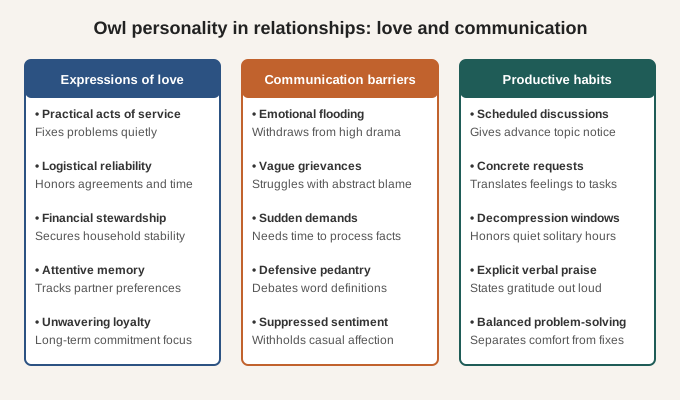
Owl personalities express love through practical reliability, deliberate problem-solving, and predictable daily routines. In the DOPE bird framework and William Moulton Marston's DISC assessment, the Owl reflects High Conscientiousness (C), prioritizing logic, empirical facts, and structural consistency over spontaneous drama or public demonstrations of affection. Partners who understand this temperament find a steady companion who demonstrates devotion by fixing tangible problems, organizing household logistics, and honoring agreements without fail.
Romantic relationships between an Owl and more emotive or impulsive personality types can suffer from mismatched expectations. Emotive partners frequently interpret an Owl's emotional reserve as coldness, indifference, or passive rejection. An Owl observing emotional turbulence rarely reacts with spontaneous soothing words; their mind immediately begins diagnosing root causes and designing structural remedies. This disconnect creates tension unless both partners understand the cognitive mechanics driving the Owl's romantic behavior.
The analytical foundation of Owl romance
Dating an Owl means interacting with someone who views romantic commitment through a lens of long-term sustainability. Dr. John Gottman's longitudinal relationship research shows that emotional stability and predictable mutual trust form the strongest predictors of marital endurance. Owls embody this finding naturally. They rarely rush into commitments based on fleeting chemistry. Instead, they evaluate compatibility across core values, financial habits, life goals, and personal ethics before opening their emotional perimeter.
This deliberate vetting process can make early courtship feel slow or overly formal. An Owl partner might spend the first three months of dating analyzing conversation patterns, assessing emotional maturity, and testing consistency. I have watched many potential partners assume an Owl was uninterested, only to discover later that the Owl was quietly determining whether the relationship had the structural integrity to last twenty years. Once an Owl commits, their loyalty is exceptionally sturdy because they made the decision through careful rational deduction.
Vulnerability remains a complex territory for an analytical mind. Emotional exposure carries an inherent risk of disorder, which clashes with the Owl's baseline desire for predictability. Opening up emotionally requires an Owl to lower their intellectual defenses, an act they perform only in environments of established safety and zero manipulation. Demanding immediate emotional transparency from an Owl produces the opposite outcome: they retreat behind a wall of silence or polite deflection.
Practical acts of service as romantic currency
Gary Chapman identified Acts of Service and Quality Time as distinct love languages, and Owls rely on these channels almost exclusively. You will rarely catch an Owl writing sprawling love sonnets on sticky notes or making grand public gestures on social media. Their affection appears in the maintenance of daily existence: checking tire pressure before a rainy road trip, auditing the household insurance policy to save eight hundred dollars annually, or updating computer software to spare their partner technical frustration.
These practical contributions often go unnoticed because modern romance culture celebrates effusive verbal affection. If a partner complains about work exhaustion, an Owl will not instinctively offer a twenty-minute hug and murmured affirmations. Instead, the Owl will offer to prepare dinner, take over the evening chores, or sketch out a plan to resolve the workplace bottleneck. The Owl considers problem-solving to be the highest form of care; dismissive partners dismiss the gesture as cold efficiency.
Affection from an Owl shows up in remarkable attention to detail. An Owl partner remembers the exact brand of oat milk you prefer, the specific side effects you experience from antihistamines, and the precise temperature you prefer in the bedroom. They store these observations systematically. Their mind treats your preferences as operational data designed to keep the relationship running smoothly.
Communication habits under calm conditions
Clear, direct language defines the Owl's conversational style during peaceful periods. They choose words carefully, aiming for precision rather than dramatic flair. If you ask an Owl for their opinion on a home purchase or vacation destination, expect an itemized breakdown with pros, cons, and budgetary implications. They respect conversations that trade in specific facts, dates, and actionable outcomes.
Ambiguity creates cognitive friction for an analytical partner. Statements like "our vibe feels off" or "I feel disconnected" leave an Owl disoriented because the phrases lack clear definitions or measurable benchmarks. An Owl wants to know the exact moment the disconnect began, which specific behavior caused the feeling, and what concrete actions would remedy the situation. Framing concerns with measurable specificity allows the Owl to engage constructively without feeling blindsided.
Owls also require significant processing pauses during routine discussions. An Owl often pauses for four or five seconds before responding to an important question. Unfamiliar partners misinterpret this silence as stubbornness or disengagement. In truth, the Owl's cognitive processing requires internal editing to ensure their reply is accurate, honest, and measured. Interrupting that pause with demands for faster answers causes the Owl to shut down entirely.
Conflict de-escalation and emotional flooding
Gottman defined physiological flooding as a state where a person's heart rate exceeds one hundred beats per minute during an argument, triggering primitive fight-or-flight reactions. In high-conflict arguments, Owls experience cognitive flooding rather than explosive rage. In moments where a partner shouts, uses exaggerated accusations like "you fail to listen," or unleashes tearful hostility, the Owl's logical circuits overload. Their immediate self-defense mechanism is emotional detachment.
The Owl will retreat behind flat facial expressions, low vocal pitch, and clinical debate tactics. They may correct their partner's grammar, dispute specific timestamps, or pick apart logical fallacies in the middle of a crying spell. This defense mechanism infuriates expressive partners, who see the behavior as cruel condescension. Yet the Owl relies on intellectual pedantry because raw emotional displays feel dangerous, unpredictable, and impossible to compute.
Repairing arguments with an Owl requires lowering the ambient volume and stepping back from emotional intensity. Proposing a twenty-minute intermission is the fastest way to restore connection. During this break, the Owl can calm their nervous system, organize their thoughts on paper, and return to the discussion with reasoned solutions rather than defensive walls. Respecting this processing window transforms volatile fights into productive problem-solving sessions.
Comparing Owl relationship dynamics across bird types
Examining how the Owl interacts with all four DOPE personality profiles reveals distinct behavioral patterns in domestic life. The table below details how each bird personality operates across critical relationship dimensions:
| Personality Type | Primary Love Language | Response to Conflict | Communication Priority | Greatest Intimacy Vulnerability |
|---|---|---|---|---|
| Owl (C - Conscientiousness) | Acts of service and practical support | Analytical withdrawal and logical debate | Factual accuracy and clarity | Fear of chaotic emotional exposure |
| Eagle (D - Dominance) | Quality time focused on shared goals | Direct confrontation and swift resolution | Brevity and bottom-line outcomes | Discomfort with admitting fault |
| Peacock (I - Influence) | Words of affirmation and shared excitement | Emotional expressiveness and rapid venting | Enthusiastic storytelling and validation | Sensitivity to rejection or coldness |
| Dove (S - Steadiness) | Physical touch and consistent companionship | Passive accommodation and peace-seeking | Gentle listening and harmony | Suppression of genuine needs |
Navigating romantic compatibility with other personalities
Pairing an Owl with an Eagle creates a highly capable partnership centered on competence. Both types respect productivity, factual reality, and disciplined execution. Financial management, career goals, and home maintenance in this household operate like clockwork. Friction arises when the Eagle's aggressive impatience collides with the Owl's deliberate caution. An Eagle wants instant decisions; an Owl demands five days to study the data. If the Eagle treats the Owl's thoroughness as incompetence, bitter power struggles emerge.
An Owl paired with a Peacock experiences the classic "opposites attract" phenomenon. The Peacock brings social color, spontaneity, and warmth into the Owl's orderly life, while the Owl provides the grounding, financial prudence, and stability the Peacock frequently lacks. Over time, however, this pairing faces severe communication friction. The Peacock views the Owl's meticulous budget as a joyless cage; the Owl views the Peacock's impulsive spending as existential recklessness. Success here requires total acceptance that both approaches have merit.
The Owl and Dove combination forms the calmest domestic environment. Both personalities value tranquility, quiet evenings, low sensory overload, and mutual consideration. Neither partner resorts to yelling or manufactured drama. The primary danger in this relationship is emotional stagnation. The Dove avoids confrontation to keep the peace, while the Owl buries unresolved interpersonal tension under work or hobbies. Unspoken resentments can accumulate for years without a single raised voice.
Marriages between two Owls operate with astonishing precision. Calendars are synced, chores are equitably distributed according to clear criteria, and financial investments follow rigorous economic models. The danger in an Owl-Owl pairing is a lack of emotional warmth. Conversations can easily slide into technical exchanges about home improvements, grocery budgets, and career trajectories, leaving little room for tender vulnerability or playful intimacy.
Constructive steps for partners of Owl personalities
Living harmoniously with an Owl partner requires adjusting how you present information and express emotional needs. Implementing five specific practices will prevent unnecessary domestic friction:
- Give advance notice before serious discussions. Blindsiding an Owl with sudden demands to talk sparks defensive panic. Give them thirty minutes or suggest talking after dinner, stating the topic plainly so they can assemble their thoughts.
- Translate emotional complaints into concrete actions. Replace vague critiques like "you are emotionally unavailable" with actionable requests such as "I want thirty minutes of dedicated phone-free conversation each Tuesday night."
- Acknowledge their acts of service openly. Recognizing when the Owl repairs your car or balances the household checkbook helps validate their love language.
- Respect their decompression rituals. Owls expend tremendous energy processing external stimuli throughout the workday. Allow them thirty minutes of solitary quiet when they arrive home before expecting detailed conversation.
- Avoid sweeping accusations during arguments. Strip absolute accusations from your vocabulary during disputes, as the Owl will immediately challenge the factual inaccuracy rather than hearing your pain.
Constructive habits for Owls in relationships
Owl individuals must also recognize that human intimacy cannot be managed solely through engineering principles. Emotional connection requires tolerance for messiness, ambiguity, and non-rational experiences. Practicing deliberate vulnerability strengthens an Owl's romantic bond significantly.
Owls should practice verbalizing emotional appreciation out loud, even when it feels awkward or redundant. If you admire your partner's kindness, tell them directly rather than assuming your practical help conveys the sentiment. Words of affirmation cost nothing, yet they provide vital psychological reassurance to expressive partners.
Learning to offer comfort before offering solutions represents another essential growth area. If your partner arrives home weeping about a difficult coworker, suppress the immediate urge to draft an email to Human Resources. Sit quietly, offer physical presence, and ask: "Do you want me to listen and comfort you right now, or do you want me to help solve the problem?" This single question eliminates seventy percent of relationship misunderstandings.
Frequently asked questions
How do Owl personalities show affection without saying it?
Owls show affection through dependable acts of service, meticulous household stewardship, and quiet loyalty. They express devotion by handling complex logistics, fixing household items, remembering exact personal preferences, and ensuring long-term financial security for their partner.
Why do Owls withdraw during emotional arguments?
Shouting or dramatic generalizations trigger analytical overload in Owls, prompting them to retreat into silence to regain composure and evaluate the facts rationally. They disengage to protect themselves from cognitive flooding rather than out of apathy.
Which bird personality is the best romantic match for an Owl?
Doves and Owls often share the smoothest day-to-day compatibility due to their mutual desire for calm environments, low conflict, and respectful communication. However, an Owl can thrive with a Peacock or Eagle when both individuals respect their differing operational paces and emotional expressions.
Can an Owl personality learn to be spontaneous in romance?
Owls can embrace spontaneity if it exists within defined parameters. Scheduling an open weekend with zero fixed obligations allows an Owl to enjoy impulsive activities without experiencing the acute anxiety caused by sudden, unplanned disruptions to their commitments.
What is the biggest mistake partners make when communicating with an Owl?
Demanding immediate emotional responses during high-stress conflicts is the most destructive error. Forcing an Owl to speak before they have processed the facts produces defensive pedantry, emotional shutdown, or total physical withdrawal from the interaction.
- 8 Ways to Be More Optimistic
- Famous People With a Dove Personality Type
- The Importance of Musical Intelligence in Human Development
- Personality Traits Based on Favorite Color
- How to Build a Culture of Kindness
- The 9 Enneagram Personality Types
- 3 Ways to Change Yourself: Embrace Growth and Transformation
- Bird Personality : Dove
- Bird Personality : Mild Dove
- Bird Personality : Smart Dove
- Bird Personality : Brave Dove
- Bird Personality : Genius Dove
- Bird Personality : Wizard Dove
- Bird Personality : Reverse Thinking Dove
- Bird Personality : Changeable Dove
- Dove Personality in Relationships: How They Show Love