Personality Traits Employers Look for in Every Interview
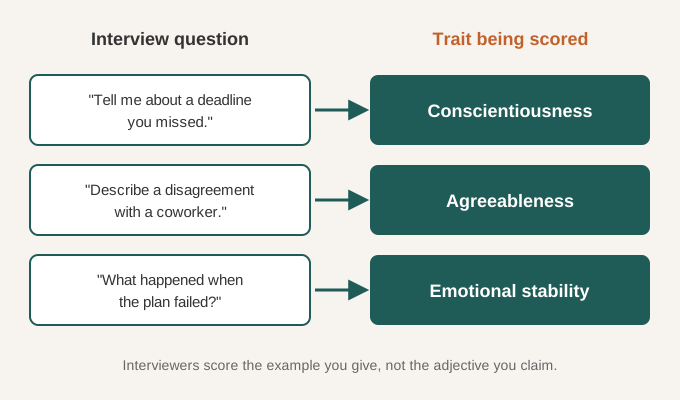
Employers look for conscientiousness, emotional stability, agreeableness, curiosity, and clear communication, and they judge these traits by the examples you give, not by the adjectives you claim. A candidate who says "I'm organized" earns nothing. A candidate who describes how they rebuilt a shared tracking sheet after three missed deadlines earns a check mark in the interviewer's notes.
Most interviewers will never use the word "personality" in the room. They ask about a deadline you missed, a coworker you disagreed with, a plan that fell apart, and they score the answers against a list of traits that predict how you will behave in the job. Knowing the list ahead of time lets you pick stories that fit it honestly.
Which personality traits do employers want most?
Conscientiousness is the trait with the strongest track record. In 1991, Murray Barrick and Michael Mount published a meta-analysis of 117 studies in Personnel Psychology and found that conscientiousness predicted job performance in all five occupational groups they examined: professionals, police officers, managers, salespeople, and skilled or semiskilled workers. No other Big Five trait did that.
The other traits matter more in specific jobs. Extraversion predicted success in sales and management. Emotional stability helps in roles with constant pressure, and agreeableness helps anywhere the work depends on other people. The table below shows what an interviewer listens for with each trait and how the same story can land well or badly.
| Trait | What the interviewer listens for | Weak answer | Stronger answer |
|---|---|---|---|
| Conscientiousness | Follow-through, preparation, attention to detail | "I always meet my deadlines." | "I kept a weekly checklist, and when a vendor slipped by four days I moved two tasks forward so the launch date held." |
| Emotional stability | Calm recovery after setbacks, no blame spiral | "That project was a disaster because of my manager." | "The release failed on a Friday. I wrote down what broke, fixed it Monday, and added a test so it could not repeat." |
| Agreeableness | Cooperation, giving credit, handling disagreement | "I get along with everyone." | "My colleague and I disagreed about the pricing page. We tested both versions for two weeks, and hers won." |
| Openness | Learning speed, interest in new methods | "I'm a fast learner." | "I taught myself SQL over a month because our reports took two days to request." |
| Communication | Answers the question asked, stops at a sensible length | A four-minute answer that never reaches a result | A 90-second answer with a situation, an action, and a number |
| Initiative | Starts work without being told | "I do what my manager asks." | "Nobody owned onboarding documents, so I wrote them, and new hires started two days faster." |
How do interviewers actually measure personality?
Most do it through structured interviews, where every candidate gets the same questions and the answers are scored against a rubric. Frank Schmidt and John Hunter's 1998 review in Psychological Bulletin put the validity of structured interviews at about .51, against about .38 for unstructured ones. Employers who have read this research use behavioral questions that begin "Tell me about a time when..." because past behavior is the best available forecast.
Some employers add a short personality questionnaire, usually built on the Big Five. These assessments rarely decide a hire alone. They give the interviewer follow-up questions, such as "Your profile suggests you prefer to work alone. Tell me about a team project that went well."
The interviewer also reads you in real time. Whether you interrupt, how you handle a question you can't answer, and whether you ask anything about the team all count as evidence, even if nobody writes it down.
Seven ways to show these traits in an interview
- Prepare five stories before you walk in. Choose one about a setback, one about a disagreement, one about a result you are proud of, one about learning something fast, and one about a mistake. Five stories cover most behavioral questions, because the same story can answer several of them.
- Use the situation, action, result structure. Spend one sentence on the situation, most of the time on what you did, and finish with an outcome. Numbers help: hours saved, error rate, revenue, headcount.
- Say "I" for your actions and "we" for team outcomes. Interviewers want to know what you personally did. A story told entirely in "we" leaves them guessing.
- Admit a real mistake and name the repair. A mistake story shows emotional stability when it ends with a specific change in how you work. "I now confirm requirements in writing" beats "I learned a lot."
- Research the company and mention one specific thing. A recent product launch or a line from the job posting shows preparation, which is conscientiousness in action.
- Ask two questions that show curiosity. "What does a strong first 90 days look like?" tells them you plan ahead. Asking about vacation days in the first interview does not.
- Stop talking when you reach the result. Candidates who keep going after the point is made dilute it. Silence for two seconds is fine.
How does your bird type shape the way you interview?
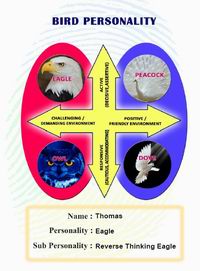
The DOPE framework, which sorts people into Dove, Owl, Peacock, and Eagle styles, predicts the mistakes people make more than the traits they have. It describes tendencies, not fixed boxes, but it helps to know which way you lean before you practice.
Eagles tend to answer fast and take control of the conversation. That reads as confidence until they interrupt the interviewer or describe coworkers as obstacles. An Eagle should practice finishing the question before answering and should include one story where someone else's idea won.
Owls prepare thoroughly and sometimes deliver all of it. Ten minutes on a database migration loses the room. An Owl benefits from a hard cap of two minutes per answer and from ending each one with the result, then offering more detail only if the interviewer asks.
Doves undersell. They credit the team for work they led and say "it was nothing special" about results other candidates would put in bold. A Dove should write down the actual numbers beforehand, because the number is easier to say aloud than a compliment about yourself.
Peacocks are warm and memorable and sometimes thin on specifics. The interviewer remembers the conversation and cannot write down a single measurable result. A Peacock should attach one figure to every story and say it plainly before moving on to the next anecdote.
If you do not know your lean, the DOPE personality test takes a few minutes and gives you a starting point. Treat the result as a prompt for practice, not a verdict.
Which behaviors make employers doubt your personality fit?
Interviewers write down patterns that suggest low conscientiousness or low emotional stability, and a handful of them come up again and again:
- Blaming a former manager or company for every problem in the story, which suggests you will blame this one later.
- Answers with no specifics, such as "I handled it well," where the interviewer cannot tell what you did.
- Arriving without knowing what the company sells.
- Contradicting yourself, for example claiming to love working alone and then calling yourself a natural collaborator.
- Speaking about earlier coworkers with contempt, even when the story is funny.
I think the last one gets underestimated. Interviewers are people, and a candidate who mocks a former colleague in minute ten has told the interviewer how they will talk about the interviewer's team in a year.
Can you fake the traits employers want?
You can perform them for forty-five minutes, but you cannot hold the performance through reference checks, a trial period, and a first hard week. Candidates who invent a calm, organized version of themselves also tend to get hired into jobs that require it daily, which is a poor trade if the real version of you is a better fit for a different role.
The honest approach is more modest. Pick true stories that favor the traits you have, and prepare for the traits you are weaker on by choosing one example where you worked at it. An Owl who admits "I used to over-prepare and I now cap my research at two hours" sounds more credible than an Owl who claims to be spontaneous.
Employers also hire for team balance. A group of five Eagles needs a Dove and an Owl, and a good interviewer knows this. Your job is to show your actual strengths clearly enough that a fair comparison is possible.
What should you do the week before an interview?
Write the five stories, time yourself saying each one aloud, and cut them to ninety seconds. Record one on your phone and listen for filler, blame, and missing numbers. Then ask a friend to throw a question you did not prepare for, since the follow-up question is where unrehearsed candidates drift.
Do this three evenings in a row and the answers stop sounding like recitation. The interviewer will hear the traits in the structure of the story, which is where they were looking all along.
Frequently asked questions
What personality traits do employers value most?
Conscientiousness ranks first, because Barrick and Mount's 1991 meta-analysis found it predicted job performance across all five occupational groups they studied. Emotional stability, agreeableness, and communication skills follow, with their importance changing by role. Sales and management roles weigh extraversion more heavily.
Should you mention your personality type in an interview?
Mention it only if the interviewer asks or the company uses a framework you know well. Describing your behavior with specific stories is more persuasive than naming a type. If you do mention a type, follow it with an example of how you work.
How do you answer "Describe your personality" in an interview?
Pick two or three traits that fit the job and give one short example for each. A strong answer takes under 90 seconds, for instance: "I'm organized and calm under deadlines. Last quarter I ran a launch with four dependencies and shipped on the planned date."
Do employers use personality tests when hiring?
Some do, mostly for larger employers and roles with many applicants. The tests are usually based on the Big Five and are paired with interviews instead of replacing them. Answering honestly matters, since a profile that contradicts your interview stories raises questions.
Is it a problem to be introverted in a job interview?
No. Introverts often score well on preparation and listening, which interviewers read as conscientiousness. The risk is giving answers that are too short, so prepare stories with concrete results and practice saying them at a normal volume.
How many stories should you prepare for a behavioral interview?
Five is enough for most interviews. Cover a setback, a disagreement, an achievement, a fast learning curve, and a mistake. Each story can be reshaped to answer several questions by emphasizing a different part of what happened.
- 10 Ways to Build a Mindset for Success
- Shameful Feelings: A Guide to Understanding and Coping with Shame
- Overcoming Abandonment : Tips and Strategies for Healing
- About Intrapersonal Intelligence
- Understanding the Dangers of Love Bombing
- Recognizing Relationship Red Flags
- What Does It Mean To Be Introverted?