Toxic Relationship Signs in the Early Stages of Dating
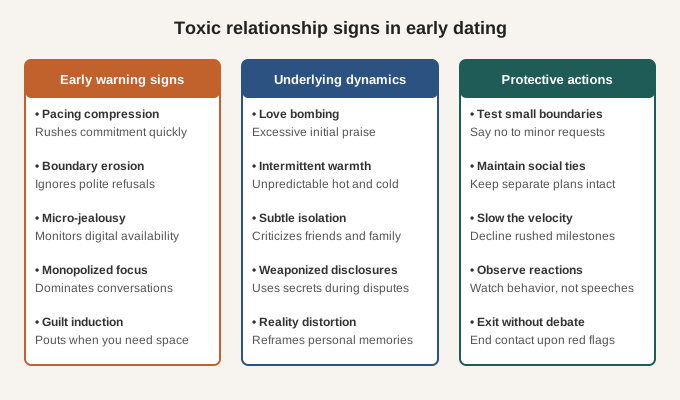
Toxic relationship patterns rarely begin with overt hostility; they start with accelerated emotional intimacy, subtle boundary testing, and disproportionate demands for attention presented as intense romance. The first ninety days of dating reveal how a prospective partner handles personal autonomy, differing opinions, and small refusals. In clinical psychology, early relational manipulation relies on intermittent reinforcement, an operant conditioning schedule identified by B.F. Skinner where unpredictable shifts between affection and cold withdrawal generate strong emotional dependency.
People often dismiss early discomfort as personal paranoia or date jitters. Trusting physiological intuition and objective behavioral observations protects individuals from sinking months or years into destructive partnerships. Examining specific relational patterns during the opening weeks provides the clearest forecast of long-term psychological safety.
Accelerated pacing and manufactured intimacy
Accelerated pacing occurs when a date pushes for rapid relationship milestones, declaring exclusive devotion or proposing shared travel within days of meeting. Manipulative individuals use intensity to bypass natural emotional defenses. In psychology, researchers refer to this overwhelming display of affection, constant communication, and premature flattery as love bombing, a tactic documented by Margaret Singer in studies on coercive social influence.
Rapid pacing feels intoxicating because it triggers massive dopamine release. The manipulator insists that the connection is unprecedented, calling you their soulmate before learning your basic life history or personal flaws. This manufactured urgency serves an operational purpose: it locks down commitment before the person's true temperament, emotional volatility, or controlling habits surface.
I have counseled people who felt flattered by daily flower deliveries and endless morning-to-night texting during week two, only to find themselves completely isolated by month three. Healthy relationships build deliberate foundation stones over months. Sustainable affection allows space to breathe, reflects realistic knowledge of a partner, and does not demand instant declarations of lifelong exclusivity.
Reaction to small boundaries and polite refusals
Testing minor boundaries provides the clearest early indicator of a date's emotional maturity and respect for your autonomy. The simplest way to evaluate a new acquaintance is to decline a non-critical request politely. Say no to an inconvenient restaurant choice, postpone a date by twenty-four hours due to work deadlines, or state that you prefer not to discuss a private family detail.
Healthy individuals receive a simple refusal with composure and easy accommodation. They offer alternative times, respect conversational limits, and carry on without awkward tension. Manipulative individuals react to boundaries with sulking, passive-aggressive remarks, or relentless debate designed to wear down your resolve. They might frame your refusal as a lack of affection or accuse you of being cold and withholding.
Boundary erosion proceeds in tiny increments. An individual who ignores your stated bedtime by texting repeatedly until two in the morning will not respect larger financial, physical, or emotional limits later. Pay close attention to the micro-reaction immediately following your refusal; that split second reveals whether they view you as an independent person or as an instrument for their comfort.
Digital monitoring and manufactured urgency
Digital monitoring involves tracking response times, demanding immediate replies during work hours, and questioning routine social media activity. In contemporary dating, controlling partners weaponize smartphones to maintain constant surveillance under the guise of sweet concern. They send multiple messages asking where you are, who you are meeting, and why your status shows online if you have not responded to their text.
This behavior introduces subtle panic into your daily schedule. You find yourself checking your phone during team meetings or driving hurriedly to respond to messages out of fear that a delay will trigger an emotional cross-examination. Manipulative partners justify this pressure by citing past trauma or claiming that unanswered messages cause them terrible anxiety, effectively transferring responsibility for their internal emotional regulation onto you.
Surveillance rarely decreases as a relationship progresses; it usually expands. A partner who demands an immediate audit of your afternoon during week four will demand location-tracking apps and passwords by month six. High-trust dating respects that both adults have professional obligations, friendships, and solitary hours that do not require constant digital check-ins.
Conversational asymmetry and weaponized vulnerability
Conversational asymmetry describes an interaction where one person monopolizes dialogue, directs topics toward their personal achievements or grievances, and displays indifference toward your experiences. During early dates, a self-absorbed partner treats the conversation like an audience engagement. They talk about their career, their past triumphs, and their misunderstandings with former partners without asking substantive follow-up questions about your life.
A darker variation involves weaponized vulnerability. In this pattern, the dating partner reveals heavy personal secrets, family traumas, or emotional wounds on the first or second date. This calculated disclosure creates false intimacy, prompting you to share reciprocal private vulnerabilities to maintain emotional balance. Weeks later, during the first disagreement, those shared vulnerabilities resurface as targeted insults or leverage to invalidate your concerns.
Observing conversational reciprocity reveals how much empathy a person possesses. Healthy dialogue resembles a balanced tennis rally with equal time on both sides of the net. If you leave a three-hour dinner realizing that your date did not ask about your profession, your hobbies, or your background, you are dealing with relational self-absorption.
Early dating behaviors: healthy contrast versus toxic patterns
Discerning healthy romantic interest from manipulative behavior requires observing consistent behavioral actions across predictable scenarios. The following comparison table outlines the contrast between sustainable courting habits, toxic warning signs, and recommended personal actions.
| Dating scenario | Healthy behavioral pattern | Toxic warning sign | Recommended protective action |
|---|---|---|---|
| Communicating between dates | Texts at reasonable intervals; respects work hours and personal sleep routines. | Sends dozens of messages; demands instant responses and accuses you of neglect. | Establish clear focus hours; do not answer messages during designated work periods. |
| Hearing a scheduling refusal | Accepts the schedule conflict gracefully; proposes a convenient alternative date. | Pouts, questions your priorities, or launches an argumentative guilt trip. | Maintain your original schedule; do not cancel existing plans to appease them. |
| Discussing previous partners | Speaks with balanced maturity; acknowledges shared responsibility for the breakup. | Labels previous partners crazy, abusive, or dishonest without self-critique. | Take their descriptions as a preview of how they will eventually describe you. |
| Introducing social circles | Shows interest in meeting your friends; encourages you to maintain social hobbies. | Criticizes your close friends; acts sullen or creates scenes during group gatherings. | Protect social independence; refuse demands to drop long-standing friendships. |
| Resolving minor differences | Listens to differing perspectives; seeks practical compromise without hostility. | Refuses to concede points; uses silent treatment or twists facts to force capitulation. | End the argument calmly; exit the connection if reality distortion persists. |
Subtle isolation and criticism of existing support systems
Early isolation begins through discreet negative commentary about your friends, siblings, or hobbies rather than overt ultimatums. An abusive partner understands that a strong social circle provides external reality checks that expose manipulative behavior. To weaken those checks, they plant seeds of doubt about the people closest to you.
They might claim that your best friend acts jealous of your happiness, or suggest that your family members take financial advantage of your generosity. These observations often contain a tiny grain of plausibility, making them difficult to dismiss immediately. Over time, the partner creates subtle discomfort around joint social events until you choose to attend alone or skip gatherings to avoid tension.
I regularly remind people that an emotionally safe partner rejoices when you have fulfilling connections outside the relationship. They encourage your personal sports leagues, your creative pursuits, and your family dinners. A new romantic interest who consistently casts your existing community in a negative light aims to become your sole source of validation.
Vulnerability patterns across the DOPE bird archetypes
The DOPE personality framework divides behavioral tendencies into four bird types: Dove, Eagle, Peacock, and Owl. Each archetype possesses distinct relational strengths along with specific vulnerabilities that predatory or emotionally immature partners exploit during early dating stages.
Dove personalities emphasize interpersonal peace, empathy, and loyalty. Because Doves dislike direct conflict and strive to accommodate others, they represent the most common targets for early boundary testing. A Dove often rationalizes a partner's aggressive outbursts as stress, working overtime to soothe the individual while abandoning personal comfort. Doves must practice stating direct refusals without offering lengthy apologies.
Eagle personalities value control, autonomy, and direct results. Eagles rarely fall for overt helplessness, but they can be blindsided by covert competition and passive-aggressive power struggles. A toxic partner might challenge an Eagle's intelligence or competence under the guise of playful banter, baiting the Eagle into endless arguments to prove superiority. Eagles must learn that walking away from bait demonstrates greater power than winning a pointless domestic debate.
Peacock personalities thrive on social excitement, verbal praise, and public attention. They are susceptible to grand romantic gestures, lavish compliments, and dramatic declarations of admiration. A manipulator can easily disarm a Peacock through excessive flattery, blinding them to serious character deficiencies beneath the charming surface. Peacocks must demand consistent follow-through and quiet dependability rather than being swayed by charismatic performances.
Owl personalities rely on logic, methodical analysis, and clear rules. An Owl handles early red flags by attempting to analyze them intellectually, searching for explanations in psychological literature or trying to fix the partner's broken systems. Manipulators exploit this by dragging Owls into exhausting debates where the rules of logic are constantly altered. Owls need to recognize that emotional toxicity cannot be solved like an engineering puzzle; walking away is the only logical remedy.
Concrete behavioral tests to evaluate a new romantic interest
Dating requires proactive discernment rather than passive hope. Implementing small, deliberate behavioral tests during the first month clarifies a partner's character without manufacturing artificial drama. These checks preserve your agency and reveal genuine personality patterns before significant emotional attachment develops.
First, implement a planned communication delay. Put your phone away during a three-hour gym session, a dinner with friends, or a busy workday. Observe the partner's reaction upon your return. A secure adult might send a casual follow-up or wait patiently for your reply; a volatile individual will leave irritated voicemails, accusatory texts, or multiple question marks that indicate an anxious need for control.
Second, express a calm difference of opinion on a low-stakes topic. Disagree about a movie ending, an architectural style, or a musical artist. Notice whether the person can sustain a playful, engaging conversation about contrasting tastes, or whether they become condescending, defensive, or visibly irritated that you hold an independent perspective.
Third, decline an invitation without providing an elaborate justification. State directly that you cannot make it that evening and look forward to catching up later in the week. A mature partner respects your schedule; a manipulative person presses for details, demands to know what could possibly be more important than seeing them, and tries to negotiate your availability.
Frequently asked questions
How can someone distinguish passionate romantic interest from love bombing?
Passionate interest respects personal pacing, welcomes existing friendships, and grows gradually as partners discover real details about each other. Love bombing feels overwhelming, demands instant emotional exclusivity, and reacts with anger or distress when boundaries are asserted. Authentic passion values your autonomy; love bombing seeks to secure compliance.
What is the safest way to break off contact with an early-stage manipulator?
The safest approach is to deliver a brief, polite, and unambiguous statement ending the connection without offering room for negotiation. Avoid long explanations or emotional debates that give the individual material to contest. Block the phone number and social media profiles immediately if the person responds with hostility or harassment.
Why do self-aware people overlook obvious warning signs during early dating?
Chemical surges of dopamine and oxytocin during early courtship suppress activity in brain regions responsible for critical assessment and risk detection. People also project their personal integrity onto new dates, assuming that charming words reflect honest intentions. Loneliness and past relationship fatigue further induce individuals to rationalize problematic behaviors.
Can an early toxic behavioral pattern improve through calm communication?
Minor misunderstandings regarding texting habits or scheduling preferences resolve easily through candid discussion. Fundamental traits like boundary violations, micro-jealousy, and reality distortion reflect entrenched psychological coping mechanisms that rarely alter in dating contexts. Attempting to reform an emotionally volatile partner creates long-term codependency.
Which DOPE personality type faces the greatest difficulty ending toxic connections?
Dove personalities struggle the most because their core motivations center on maintaining peace and helping others heal. Doves often assume personal responsibility for a partner's emotional volatility, believing that additional patience will resolve the conflict. Developing assertive boundary habits is essential for Doves to protect their emotional well-being.
- How and Why to Identify Your Life Aspirations
- Six Reasons to Study Psychology
- Bird Personality : Peacock
- The Importance of Logical-Mathematical Intelligence in Problem-Solving and Decision-Making
- The Science Behind Why Your Personality Changes in Your 20s and 30s
- Peacock Personality at Work: Managing the Team's Energizer
- How to Bond With a Child Whose Personality Is Different From Yours
- Bird Personality : Dove
- Bird Personality : Mild Dove
- Bird Personality : Smart Dove
- Bird Personality : Brave Dove
- Bird Personality : Genius Dove
- Bird Personality : Wizard Dove
- Bird Personality : Reverse Thinking Dove
- Bird Personality : Changeable Dove
- Dove Personality in Relationships: How They Show Love