Personality Traits for Effective Team Leadership

The personality traits that best predict effective team leadership are conscientiousness, emotional stability, openness to experience, and extraversion, according to a 2002 meta-analysis by Timothy Judge and colleagues. No single trait guarantees good leadership, and the same trait can help or hurt depending on the team and the task.
I have worked under a charismatic manager who could fill a room and lose a project in the same week, and under a quiet one whose teams shipped on time year after year. Charisma was never the variable that separated them. Reliability and attention to people were.
Which personality traits predict effective leadership
Judge, Bono, Ilies, and Gerhardt pooled data from 73 samples for a 2002 paper in the Journal of Applied Psychology and compared leadership outcomes against the Big Five personality traits. Extraversion had the strongest link to leadership (a correlation of about .31), followed by conscientiousness (.28), openness (.24), and low neuroticism (-.24). Agreeableness was the weakest of the five (.08).
The numbers are moderate, not dramatic. A correlation of .30 means personality explains roughly 9 percent of the variation in who becomes a leader or performs well as one. The rest comes from skills, experience, the team, and luck.
| Big Five trait | Link to leadership (2002 meta-analysis) | What it adds for a team |
|---|---|---|
| Extraversion | .31, strongest | Visibility, willingness to speak first, energy in meetings |
| Conscientiousness | .28 | Follow-through, clear deadlines, dependable planning |
| Openness | .24 | Comfort with new methods and with being corrected |
| Low neuroticism (emotional stability) | -.24 for neuroticism | Steady reactions when a project goes wrong |
| Agreeableness | .08, weakest | Warmth, but also a risk of avoiding hard decisions |
Do you need to be an extrovert to lead a team
No. Extraversion predicts who gets picked as a leader more reliably than it predicts who leads well. People who talk the most in a group are often seen as leaders, a pattern researchers call the emergence effect, even when their ideas are no better than anyone else's.
Adam Grant, Francesca Gino, and David Hofmann published a 2011 study in the Academy of Management Journal that complicates the extrovert assumption. In a pizza company with 57 stores, extraverted leaders produced higher profits when employees were passive. When employees were proactive, introverted leaders did better, because they listened to suggestions instead of overriding them.
Gallup's 2015 report on managers adds a related number: managers account for at least 70 percent of the variance in team engagement scores. Whether that manager is loud or quiet matters less than whether they pay attention.
Where more of a good trait stops helping
Assertiveness shows a curve rather than a line. Daniel Ames and Francis Flynn found in 2007 that ratings of leader effectiveness rose with assertiveness up to a point and then fell. Leaders who were either too passive or too forceful got lower marks from their teams than those in the middle.
Confidence follows the same pattern. A leader who admits "I was wrong about that vendor" earns more trust than one who defends a failing plan for three months. Overconfidence also tends to shut down the people most likely to catch a mistake early.
How the four bird types lead a team
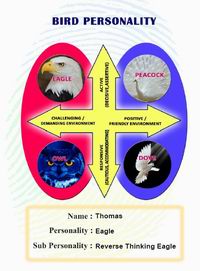
The DOPE bird model, a bird-themed take on DISC, sorts people into dove, owl, peacock, and eagle. It is a simpler map than the Big Five, but it gives a team a shared vocabulary for working differences. Each type brings a strength to the leader's chair and a habit that needs watching.
- Eagle leaders decide quickly and push for results. They set a direction in one meeting and expect movement by the next. The cost shows up in people who needed one more day to think, and who stopped offering ideas after being cut off twice.
- Peacock leaders build energy and relationships. They are good at recruiting, pitching, and making a stalled project feel worth finishing. The risk is a calendar full of enthusiasm and a to-do list that no one owns.
- Dove leaders keep the team stable. They notice when someone is struggling and tend to resolve conflict privately before it spreads. Their weak point is delay: a hard conversation with an underperformer can wait for six months.
- Owl leaders get the details right. They write the plan, check the numbers, and catch the error before the client does. Under pressure they can hold back a decision until the data feels complete, which on most projects it never will.
Most leaders are a blend, usually one dominant type and one secondary. If you want to see where you land, the bird personality test takes about ten minutes.
Which skills and habits matter as much as personality
Google's internal Project Aristotle, which studied 180 teams between 2012 and 2015, found that psychological safety was the strongest factor in team effectiveness. Psychological safety, a concept Harvard professor Amy Edmondson introduced in 1999, means team members believe they can raise a concern or admit a mistake without being punished or ridiculed.
That finding moves attention from who the leader is to what the leader does. A few behaviors show up repeatedly in the research and in team surveys:
- The leader asks for disagreement in meetings, by name, and thanks the person who gives it.
- Decisions come with a stated reason and an owner, so the team knows who to ask.
- One-on-one meetings happen on a fixed schedule and are not canceled when work gets busy.
- The leader reports their own mistakes first, in front of the group.
Every item on that list can be learned. A conscientious owl and a spontaneous peacock can both do it, which is the best argument against treating personality as destiny.
How to build leadership strengths you do not naturally have
Pick the weakest link between your type and the job, and practice against it in small, repeatable ways. Personality traits shift slowly, but a 2006 meta-analysis of 92 longitudinal studies by Brent Roberts and colleagues found that people on average become more emotionally stable and conscientious from their twenties into middle age. Roberts has linked part of that change to taking on responsibility at work and in relationships.
A few specific starting points by type:
- An eagle can set a rule to ask two questions before giving any instruction in a meeting.
- A peacock can end every meeting by writing down who does what by which date, in the meeting notes.
- A dove can schedule the difficult conversation as a calendar event within 48 hours, so avoidance has a harder time winning.
- An owl can set a deadline for decisions, such as "we choose Friday with whatever we know."
Ask three people who work for you what you do that makes their job harder. Their answers will be more accurate than any test, including the one on this site, and the willingness to ask is itself a trait that predicts how well you will lead.
What to look for when choosing a team leader
A promotion committee should look at track record before personality. Ask what the candidate did the last time a project went badly, and whether their previous team members would choose to work for them again.
Personality assessments can inform a conversation but should not decide a hire. The Big Five has reasonable evidence behind it, and vendor-built bird or color tests have much less, so treat the results as a prompt for questions, not a score.
Frequently asked questions
What is the best personality type for a team leader?
No type is best in every situation. The 2002 Judge meta-analysis found extraversion and conscientiousness correlate most with leadership, but effective leaders appear in all types. Fit between the leader's style and the team's needs predicts success better than the type label.
Can an introvert be a good team leader?
Yes. Grant, Gino, and Hofmann's 2011 study found introverted leaders produced higher profits than extraverted ones when employees were proactive, because they listened and implemented suggestions. Introverts tend to struggle more with visibility than with the work of leading.
Which Big Five trait matters least for leadership?
Agreeableness showed the weakest link in the 2002 meta-analysis, at about .08. Warmth helps with morale, but leaders who avoid conflict to stay liked often delay decisions that the team needs.
Can you change your personality to become a better leader?
Traits shift slowly, but behaviors change fast. A 2006 meta-analysis by Roberts and colleagues found that people grow more conscientious and emotionally stable over adulthood, partly through taking on responsibility. In practice, you can build specific habits such as listening first or setting decision deadlines within a few months.
How do the dove, owl, peacock, and eagle types differ as leaders?
Eagles decide fast and push results, peacocks build energy and relationships, doves keep teams stable and avoid conflict, and owls focus on accuracy and planning. Each has a typical blind spot: eagles overrule, peacocks overcommit, doves delay hard conversations, and owls wait for perfect data.
How does psychological safety relate to leadership?
Psychological safety is the belief that you can speak up without being punished. Google's Project Aristotle found it was the strongest factor in team effectiveness across 180 teams. Leaders create it by inviting disagreement, admitting their own errors, and responding to bad news calmly.
- Bird Personality : Dove
- Bird Personality : Mild Dove
- Bird Personality : Smart Dove
- Bird Personality : Brave Dove
- Bird Personality : Genius Dove
- Bird Personality : Wizard Dove
- Bird Personality : Reverse Thinking Dove
- Bird Personality : Changeable Dove
- Dove Personality in Relationships: How They Show Love