Signs Your Personality Type Isn't Suited for Your Current Job
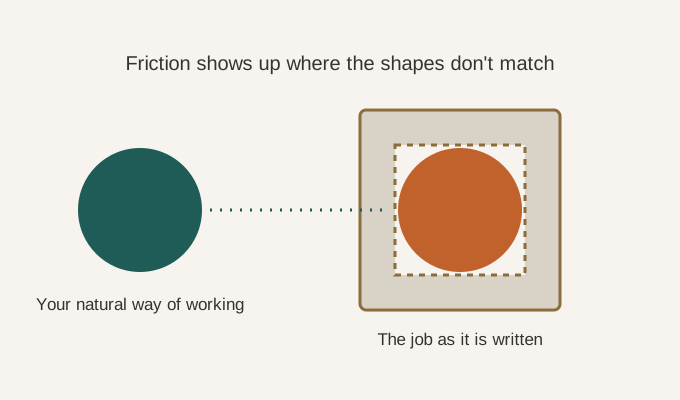
Your personality type is probably a poor fit for your job if the work drains you even when you are good at it, if you spend most of the day acting like someone else, and if the same feedback keeps coming back no matter how hard you adjust. A mismatch shows up as chronic fatigue and a loss of interest long before it shows up as bad performance.
I once spent two years in a role that looked perfect on a resume. It paid well, my manager was decent, and my reviews were good. I dreaded Monday mornings anyway, and for a long time I blamed myself for being ungrateful. The role needed me to be on calls eight hours a day, and I do my best thinking alone. Nobody was wrong. The job and I were shaped differently.
How do you know your personality does not fit your job?
The clearest test is how you feel at the end of a workday compared with what you did that day. If you finish work you are skilled at and still feel emptied out, the problem is usually the way the job asks you to behave, not the tasks. Skill and fit are separate questions.
Research supports the link between fit and wellbeing. Amy Kristof-Brown, Ryan Zimmerman, and Erin Johnson reviewed the literature in a 2005 meta-analysis in Personnel Psychology and found a correlation of about .56 between person-job fit and job satisfaction. That is a strong relationship by the standards of workplace research. Gallup's 2025 State of the Global Workplace report found that only 21 percent of employees worldwide were engaged at work in 2024, and mismatch is one of several reasons people disengage.
What are the signs your personality type is wrong for your job?
The signs below cluster around energy, behavior, and feedback. Having one or two does not mean you are in the wrong job. A person with five or six, lasting for six months or more, has good reason to look harder.
- You are exhausted after work you are good at. A highly capable person can still be depleted by a role that demands constant networking or constant solitude. Tiredness that sleep does not fix points to a fit problem.
- You feel like you are acting. Arlie Hochschild named this "emotional labor" in her 1983 book The Managed Heart. Alicia Grandey's 2003 study in the Academy of Management Journal found that surface acting, where you fake a displayed emotion without feeling it, was associated with higher emotional exhaustion.
- The same feedback keeps returning. If three managers in a row say you are "too blunt," "too quiet," or "too detail-focused," that points to a style clash with how the culture works.
- Sunday evening turns heavy. A weekly dread that arrives on schedule says more than a bad week. Notice whether the dread is about specific people or about the type of work itself.
- You envy other people's tasks. If you keep eyeing a coworker's project, or the job of a colleague in another department, pay attention. Envy points at what you want to be doing.
- Your best hours happen outside work. If the hobby or side project is where you feel most competent, your core strengths may not be used at your job.
- You avoid the central part of the role. A salesperson who dreads calls or a manager who dreads one-on-ones is avoiding the thing the job is built on.
- Success feels flat. You hit a target and feel nothing, or relief only. Praise for work that does not interest you lands badly.
- Your body is complaining. Headaches before meetings, trouble sleeping on Sunday, and stomach problems at work can have medical causes, so see a doctor first. If the doctor finds nothing, the job becomes a reasonable suspect.
- You are quietly interviewing, mentally. Drafting resignation emails in your head or browsing job listings during the workday is a sign you have already started to leave.
How do the bird personality types clash with jobs?
Each bird type has a kind of work that drains it and a kind that energizes it. The table gives a rough guide; people vary a lot, and a job description rarely describes the daily reality.
| Bird type | Roles that tend to drain it | What the mismatch feels like |
|---|---|---|
| Eagle | Approval-heavy bureaucracies, roles with little authority, long consensus processes | Constant frustration at slow decisions, and a sense of being held back |
| Peacock | Solitary data entry, back-office roles, jobs with no audience or collaboration | Restlessness and a drop in motivation without people to talk to |
| Dove | Aggressive sales targets, confrontational management, high-conflict teams | Dread before meetings, difficulty saying no, and a feeling of walking on eggshells |
| Owl | Fast-moving startups, ambiguous roles, jobs where "good enough" is the standard | Anxiety about errors, and frustration at being asked to decide without full information |
Take your own result with some caution. The bird personality test describes tendencies, not limits, and plenty of owls thrive in startups. The table is a way to ask whether the daily demands of your job match how you naturally work.
Is it a personality mismatch or just burnout?
The two overlap, and they have different fixes. Burnout, as the World Health Organization defined it in ICD-11 in 2019, is a syndrome resulting from chronic workplace stress that has not been managed, marked by exhaustion, mental distance from the job, and reduced effectiveness. A mismatch can cause burnout, but burnout also happens to people in well-fitting jobs with unmanageable workloads.
One practical test is to ask whether a long vacation would help. If a two-week break leaves you refreshed for the first week back, workload is a likely cause. If you feel the dread returning on the flight home, the nature of the work is more likely the issue. Depression can also look like both, and persistent low mood, loss of interest in everything (not only work), or changes in sleep and appetite are worth bringing to a doctor or therapist.
Can you fix a mismatch without quitting?
Often, in part. Amy Wrzesniewski and Jane Dutton described "job crafting" in a 2001 paper in the Academy of Management Review, meaning small changes to the tasks, relationships, and meaning of your work. Their best-known example is hospital cleaners who treated patients and visitors as part of the job and so redefined what the work was.
Brian Little, a personality psychologist, has argued that people can act out of character for work they care about, and then need what he calls a restorative niche, a place to be themselves afterward. A quiet person who gives a keynote speech, for instance, may need an hour alone in a hotel room. Building that kind of recovery time into your day is practical, and it costs nothing.
- Ask your manager to shift one or two tasks toward work that suits you, with a specific proposal and a trial period of 30 days.
- Protect blocks of the day for the kind of work you do best, such as deep work for owls or collaboration for peacocks.
- Move your hardest social or analytical tasks to the time of day when you have the most energy.
- Ask for a transfer within the company before looking outside. Internal moves keep your seniority and benefits.
When is it time to leave?
Leave when you have tried to change the role, given it a fair chance, and the core demands of the job still conflict with how you work. Six months of honest attempts is a reasonable limit. You do not have to quit immediately, and you should not quit on a bad Tuesday.
Before you resign, write down what specifically drains you and what specifically energizes you in your current job. The list tells you what to look for next. People who leave a role for "something different" often end up in a similar role at a new company, because they never identified what they were running from.
Use a short experiment first. Take on a small project, a volunteer role, or a course in the area you think fits better. Three months of that tells you more than a year of imagining it.
Frequently asked questions
Can your personality be wrong for your job?
Yes, in the sense that a job's daily demands can conflict with how you naturally work. A 2005 meta-analysis by Kristof-Brown, Zimmerman, and Johnson found a correlation of about .56 between person-job fit and job satisfaction. A mismatch does not mean you are unskilled; it means the work costs you more energy than it costs others.
What are the signs of being in the wrong career?
Common signs include exhaustion after work you do well, repeated feedback about the same trait, Sunday dread, and envy of other people's roles. Having a few of these for a month is normal. Having several for six months or more suggests a fit problem worth acting on.
Is it normal to hate your job even if you are good at it?
It is common. Being skilled does not mean the work suits your temperament, and strong performers are often the people most likely to be handed more of the work that drains them. Competence and enjoyment are separate things.
Should introverts avoid sales or management jobs?
No. Introverts succeed in both, but they usually need recovery time and a different style, such as one-on-one conversations instead of large groups. The better question is whether the specific job demands more social contact than you can sustain, and what you could change about it.
How long should you stay in a job that does not fit?
Six months of honest effort to adjust the role is a reasonable test. If the main problem is a workload or a bad manager, fixing it may help. If the core tasks conflict with how you work, staying longer rarely changes that.
Can a personality test tell me what job to take?
It can point to the kinds of work and environments that fit your tendencies, but it cannot choose a job for you. Use the result to generate questions about pace, autonomy, and social contact. Then test those against real roles by talking to people who do them.
- Signs Your Parenting Style May Be Too Controlling
- What Happens to Your Body When You Read Every Day?
- Bird Personality : Mild Dove
- How to Center Yourself and Find Peace
- How to Support a Loved One With a Personality Disorder
- Emotional Regulation Tips for Each Personality Type
- Tips to Improve Mood and Mental Health
- Bird Personality : Dove
- Bird Personality : Mild Dove
- Bird Personality : Smart Dove
- Bird Personality : Brave Dove
- Bird Personality : Genius Dove
- Bird Personality : Wizard Dove
- Bird Personality : Reverse Thinking Dove
- Bird Personality : Changeable Dove
- Dove Personality in Relationships: How They Show Love