Parenting an Owl Personality Child: What They Need From You
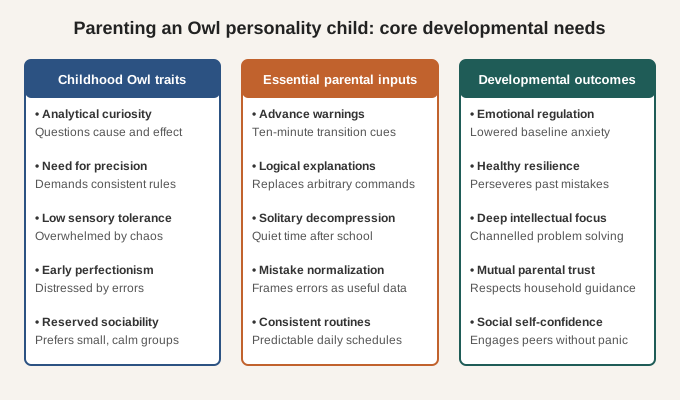
Owl personality children process the world through observation, logical deduction, and structured order. In personality frameworks based on William Moulton Marston's DISC model, the Owl represents High Conscientiousness (C), matching children with high conscientiousness and introverted temperaments in developmental psychology. These children do not respond well to arbitrary authority or chaotic environments. Parenting an Owl child successfully requires patience, predictable routines, and transparent explanations that respect their analytical intellect.
Many parents misread an Owl child's hesitation as shyness, stubbornness, or disrespect. An Owl child interrogating house rules is not seeking to rebel against parental boundaries. They are attempting to understand the underlying mechanics of their environment. Providing the correct structural support prevents chronic childhood anxiety and transforms rigid perfectionism into confident intellectual mastery.
Distinct cognitive traits of the Owl child
Developmental psychologist Jerome Kagan conducted extensive longitudinal research on childhood temperament, identifying high-reactive children who examine unfamiliar environments thoroughly before participating. Owl children fall squarely into this profile. They observe social gatherings from the periphery, inspect new toys for structural integrity, and retain detailed memories of household schedules.
Four primary behaviors characterize Owl children across early and middle childhood:
- Insistence on consistency and rule enforcement. Owl children possess an acute sense of procedural justice. Board games played with shifting house rules cause immediate distress. They frequently correct parents or teachers who deviate from stated schedules.
- Persistent cause-and-effect questioning. Surface-level answers fail to satisfy an Owl child. Hearing that it is time for bed prompts questions regarding circadian rhythms or sleep benefits. Dismissing these questions produces anxiety rather than compliance.
- Heightened sensitivity to environmental disorder. Cluttered rooms, noisy gatherings, and sudden sensory overstimulation exhaust an Owl child's nervous system. They require visual predictability and organized physical surroundings to maintain emotional equilibrium.
- Early-onset perfectionism. An accidental tear in a drawing or a minor spelling mistake can trigger tears or total disengagement. The child associates personal competence with flawlessness, viewing errors as catastrophic failures.
Five core needs of an Owl child
Meeting an Owl child's emotional and intellectual needs requires deliberate adjustments to standard parenting techniques. Parents must shift away from spontaneous, emotion-driven commands toward predictable, collaborative systems.
Logical rationale instead of arbitrary commands
Authoritarian demands like "because I said so" alienate an Owl child. Their brains crave structural cause and effect. Explaining the reasoning behind a request enlists their natural cooperation: "Putting your boots by the door keeps melted snow off the wooden floorboards, preventing wood rot." Once the child understands the mechanical necessity of a rule, compliance becomes an intellectual principle rather than a struggle for dominance.
Advance warnings for schedule transitions
Sudden disruptions shatter an Owl child's internal planning process. Telling an Owl child to stop an activity instantly causes severe cognitive friction. Implementing a standardized countdown system gives them time to reach a logical stopping point. Announcing fifteen-minute, ten-minute, and two-minute warnings before dinner or departures allows the child to conclude their task smoothly without emotional resistance.
Dedicated solitary decompression after school
School environments bombard children with fluorescent lights, noisy hallways, and unpredictable peer interactions. An Owl child expends enormous cognitive energy managing this sensory load. Demanding immediate homework completion or interrogating them about their school day the moment they walk through the door triggers defensive shutdowns. Granting forty-five minutes of quiet, unscheduled solitude restores their depleted reserves.
Deliberate normalization of human error
Perfectionistic tendencies threaten to paralyze Owl children as academic and social expectations rise. Parents must actively dismantle the belief that mistakes deserve shame. Demonstrating personal errors openly teaches resilience: "I mismeasured this recipe and added too much salt. The stew tastes bitter, but now we know how to adjust the ratio next time." Reframing mistakes as diagnostic data rather than character defects frees the child to attempt difficult tasks.
Emotional validation alongside analytical problem-solving
Confronted with uncomfortable emotions, Owl children instinctively retreat into intellectualization. They analyze sadness or frustration as problems to solve rather than sensations to feel. Parents should acknowledge physical feelings before shifting into logic: "It makes sense that you felt angry when the group ignored your idea. Let us sit with that feeling for a minute before we brainstorm how to present it tomorrow."
Everyday parenting approaches for Owl children
| Parenting scenario | Counterproductive parental reaction | Constructive Owl-friendly approach | Developmental impact |
|---|---|---|---|
| The child refuses to leave the playground immediately. | Threatens to leave them behind or drags them by the arm. | Gives a five-minute warning: "Take two more turns on the slide, then we walk to the car." | Child anticipates departure calmly; avoids public emotional meltdowns. |
| The child crumples homework after making an erasure smudge. | Tells the child they are overreacting and demands they finish the page. | Validates frustration, takes a brief walking break, and supplies clean scratch paper. | De-escalates panic; teaches emotional recovery tools during frustration. |
| The child asks ten questions before agreeing to a doctor visit. | Snaps that questions take too long and orders them into the car. | Explains the checkup steps sequentially: waiting room, blood pressure cuff, ear check. | Reduces fear of the unknown; builds medical confidence through facts. |
| The child isolates themselves during a bustling family reunion. | Forces the child to perform, hug distant relatives, and join games. | Assigns a specific quiet task, like arranging dessert plates or operating the camera. | Honors social capacity; keeps the child connected without sensory overload. |
| The child rigidly polices a younger sibling's toy usage. | Punishes the Owl for bossiness and demands immediate sharing. | Clarifies separate toy ownership rules and sets designated sharing bins. | Prevents boundary friction; acknowledges child's desire for order fairly. |
| The child rejects dinner items due to texture or ingredient touching. | Demands clean plates and scolds the child for picky eating. | Serves components separated on partitioned plates with predictable seasonings. | Eliminates mealtime power struggles; respects sensory processing limits. |
| The child freezes when faced with a large multi-step school project. | Lectures on procrastination and sets arbitrary immediate deadlines. | Breaks the assignment into dated phases: research, outline, draft, review. | Dismantles cognitive paralysis; replaces panic with sequential progress. |
Communication strategies during acute meltdowns
Owl meltdowns look distinct from standard tantrums. Rather than screaming to manipulate a desired outcome, an Owl child melts down when cognitive or sensory overload collapses their processing capacity. Their nervous system experiences a system overload caused by unexpected changes, noise, or perceived failure.
During an active episode, parents must dramatically reduce spoken language. Firing questions like "What is wrong with you?" forces an overloaded brain to process additional auditory data, worsening the spiral. Speaking in low, monotone sentences while offering a quiet physical sanctuary creates safety. Save logical debriefing sessions for several hours later, after the child's nervous system returns to baseline regulation.
Managing perfectionism and anxiety spirals
Perfectionism represents the most significant psychological vulnerability for high-conscientiousness children. Dr. Thomas Greenspon, author of "Moving Past Perfect," distinguishes between healthy strivings for excellence and toxic perfectionism. Healthy achievement focuses on curiosity and skill acquisition. Perfectionism focuses on shielding an insecure ego from perceived inadequacy.
Parents can counteract perfectionistic spirals by introducing deliberate imperfection exercises. Drawing pictures with non-dominant hands or setting a timer for quick, rough drafts teaches children that imperfect outcomes do not threaten their safety. Praising effort, strategy refinement, and perseverance rather than pristine grades or flawless scores redirects the child's focus toward growth.
Structuring the home environment for success
An Owl child thrives when physical surroundings mirror their internal desire for logic. Simple organizational adjustments inside the household reduce daily friction dramatically.
Visual schedules and routine boards
Abstract verbal reminders often cause confusion. Placing a laminated checklist near the child's desk showing morning and evening routines eliminates recurring arguments. Checking off visual boxes satisfies the Owl child's desire for task completion and grants them autonomy over their daily responsibilities.
Clearly defined private space
Shared bedrooms often present difficulties for Owl children if siblings have chaotic habits. If separate rooms are impossible, designating a specific bookshelf, desk, or partitioned corner that remains under the Owl child's exclusive control gives them a sanctuary of physical order.
Predictable household calendar
Posting a family calendar on the refrigerator detailing weekend plans, doctor appointments, and visiting relatives prevents sudden shocks. Reviewing upcoming weekly schedules together on Sunday evenings satisfies the child's need for forward visibility.
Supporting the Owl child in school and peer groups
Classrooms favor extroverted, fast-responding children during open class discussions. Owl children process information thoroughly before speaking, often remaining silent while louder peers dominate conversation. Parents should partner with teachers to ensure the child receives structured participation opportunities, such as written reflections or assigned presentation roles.
Social circles develop best around shared intellectual interests rather than chaotic playground athletics. Enrolling an Owl child in robotics clubs, chess leagues, coding workshops, or botanical groups connects them with peers who share their deliberate pacing and focused communication style.
Frequently asked questions
Can an Owl personality child learn to handle spontaneous schedule changes?
Gradual exposure to minor variations builds cognitive flexibility over time. Parents can introduce occasional small adjustments with advance explanation, celebrating the child's ability to adapt without distress.
How should parents handle an Owl child who constantly corrects adults?
Acknowledge the accuracy of their observation privately, then teach social discretion regarding timing and audience. Explain that correcting peers or authority figures in public settings often provokes defensiveness rather than gratitude.
Why does an Owl child melt down over minor homework errors?
Perfectionistic children view mistakes as evidence of personal inadequacy rather than ordinary learning steps. Their intense emotional reaction reflects acute shame rather than intentional defiance.
What extracurricular activities suit an Owl personality child best?
Activities with clear rules, measurable progression, and focused environments suit them best. Individual sports like swimming or archery, alongside STEM clubs, instrumental music, and strategy games, match their temperamental strengths.
Do Owl children outgrow their cautious, analytical nature?
Core personality traits remain relatively stable across the lifespan. With supportive parenting, cautious children mature into exceptionally thorough, reliable, and thoughtful adults who manage complex problems with precision.
- How to Identify Your Personality Type and Use It to Grow Faster
- Friendship Tips : How to Attract New Friends
- Asperger Syndrome: Symptoms, Causes and Treatment
- What Are Cognitive Distortions
- 9 Multiple Intelligences by Howard Gardner
- How to Feel Good About Yourself?
- The Science Behind Why Your Personality Changes in Your 20s and 30s
- Bird Personality : Dove
- Bird Personality : Mild Dove
- Bird Personality : Smart Dove
- Bird Personality : Brave Dove
- Bird Personality : Genius Dove
- Bird Personality : Wizard Dove
- Bird Personality : Reverse Thinking Dove
- Bird Personality : Changeable Dove
- Dove Personality in Relationships: How They Show Love