Famous People With a Dove Personality Type
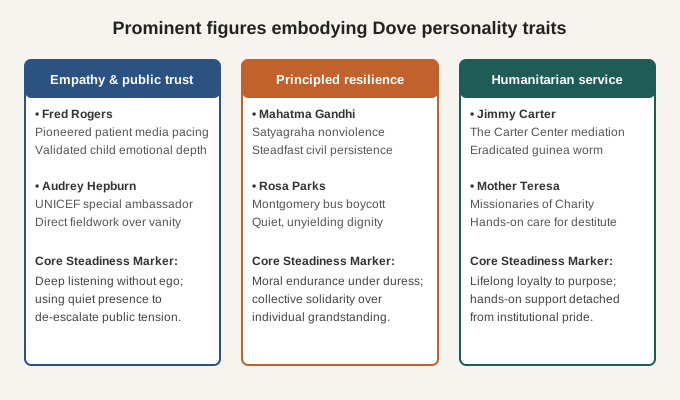
Dove personality types lead through patience, empathy, consensus-building, and moral endurance rather than theatrical dominance. In personality typology, including the DOPE bird model and William Moulton Marston's DISC framework, the Dove aligns with High Steadiness (S). Modern celebrity culture disproportionately celebrates aggressive Eagle executives or charismatic Peacock performers. History demonstrates that Doves provide the organizational glue and quiet resolve behind durable social movements, diplomacy, and humanitarian institutions.
Examining famous figures who embody Dove characteristics illuminates how high-steadiness individuals influence the world. These leaders did not rely on intimidation or flashy self-promotion. They achieved monumental outcomes through active listening, loyalty to vulnerable communities, and a refusal to escalate hostility during acute crises.
Defining Dove leadership traits in public life
Public figures with Dove personalities exhibit distinct operational habits that set them apart from other archetypes. Sociologist Robert K. Greenleaf described this orientation as servant leadership in his foundational 1970 essay. Rather than commanding followers from above, servant leaders anchor institutions by supporting the people carrying out the daily work.
Four consistent behavioral markers distinguish public figures with Dove profiles:
- De-escalation over confrontation. Confronted with hostility, Doves lower the emotional temperature of the room. They respond with deliberate pauses, calm vocal tones, and questions designed to locate common ground.
- Long-term relational loyalty. Doves maintain relationships across decades. They rarely discard allies for short-term political convenience, earning intense reciprocal loyalty from their inner circles.
- Unassuming personal demeanor. Grandiose displays of wealth or status alienate Dove personalities. They favor simple dress, accessible language, and unpretentious public interactions.
- Quiet persistence under sustained pressure. The gentleness of a Dove is frequently mistaken for frailty. In reality, high-steadiness individuals possess immense stamina, outlasting more erratic opponents through disciplined, daily consistency.
Fred Rogers: Radical empathy in mass media
Fred Rogers, creator and host of "Mister Rogers' Neighborhood," exemplified the Dove personality throughout his thirty-three-year broadcasting career on American public television. Broadcasting from Pittsburgh station WQED between 1968 and 2001, Rogers rejected the rapid-fire edits, slapstick violence, and commercial sales pitches common in children's entertainment.
His production philosophy centered on emotional presence and unhurried pacing. Rogers addressed viewers directly at eye level, speaking slowly and leaving deliberate silences for children to process complex themes such as death, divorce, and racial integration. In 1969, during a legendary Senate testimony before John Pastore, Rogers secured six million dollars in federal funding for public broadcasting not through aggressive political threats, but by reciting the gentle lyrics of his song "What Do You Do with the Mad That You Feel?" Pastore openly conceded that Rogers' calm sincerity had persuaded him within six minutes.
Audrey Hepburn: Humanitarian field diplomacy
Audrey Hepburn transitioned from Hollywood stardom to full-time humanitarian work, demonstrating the Dove's instinct to redirect public attention toward communal needs. Appointed as a UNICEF Goodwill Ambassador in 1988, Hepburn spent the final five years of her life traveling across Ethiopia, Sudan, Somalia, and El Salvador.
Colleagues noted that Hepburn refused VIP accommodations during field missions. She spent hours sitting directly with malnourished children and local healthcare workers in sweltering conditions, listening to their immediate logistical requirements. Her congressional testimonies and international press conferences avoided self-congratulatory rhetoric. Instead, she used her cultural platform to present concrete data regarding water purification, vaccination supplies, and famine relief logistics.
Mahatma Gandhi: The power of nonviolent endurance
Mohandas Karamchand Gandhi mobilized hundreds of millions of Indian citizens against British colonial rule through Satyagraha, a philosophy rooted in nonviolent non-cooperation and steady moral resistance. Gandhi's methods matched the Dove archetype by eliminating aggression while maintaining unyielding ethical boundaries.
His 1930 Salt March, covering two hundred and forty miles from Sabarmati Ashram to Dandi, demonstrated the strategic power of patient, collective action. Rather than launching armed skirmishes, Gandhi invited peaceful arrest, exposing the moral bankruptcy of imperial oppression. His daily routine emphasized communal self-reliance, spinning khadi cloth, and resolving internal disputes within the Indian National Congress through patient mediation.
Rosa Parks: Quiet conviction that catalyzed change
Rosa Parks became a recognized figure of the American civil rights movement through an act of quiet, dignified refusal. On December 1, 1955, in Montgomery, Alabama, Parks declined to vacate her seat on a segregated bus for a white passenger, leading to her arrest and igniting the Montgomery Bus Boycott.
Media narratives frequently framed Parks as a tired seamstress who acted on an impulse. Historical records, including her work as secretary for the Montgomery NAACP chapter since 1943, reveal a deliberate, disciplined activist who believed in collective solidarity over individual heroics. Her calm demeanor in the courtroom and her steadfast endurance through death threats exemplified the Dove's capacity to anchor an entire movement without raising her voice.
Jimmy Carter: Post-presidential conciliation
Jimmy Carter, thirty-ninth President of the United States, established the gold standard for high-steadiness diplomacy during his post-presidency. After leaving the White House in 1981, Carter co-founded The Carter Center in Atlanta, dedicating four decades to international conflict mediation, election monitoring, and disease eradication.
His mediation style avoided coercive geopolitical pressure. In 1994, Carter traveled to North Korea and Haiti, defusing imminent military confrontations through face-to-face dialogue with hostile dictators whom Western leaders refused to contact. His personal devotion to Habitat for Humanity, swinging hammers on construction sites well into his nineties, embodied the Dove's belief that direct, practical service matters far more than ceremonial status.
Mother Teresa: Hands-on dedication to the marginalized
Anjezë Gonxhe Bojaxhiu, known globally as Mother Teresa, founded the Missionaries of Charity in Kolkata in 1950. Her operational focus remained intensely local and personal, providing palliative care, hospice shelter, and basic medical support to people abandoned on city streets.
Her approach reflected the classic Dove preference for individual connection over bureaucratic administration. Rather than lobbying governments for theoretical welfare reforms, she washed wounds and held the hands of dying individuals each morning. Her daily discipline created an international network operating across more than one hundred and thirty countries at the time of her death in 1997.
Comparison of prominent Dove figures
| Prominent figure | Primary field | Active era | Signature Dove behavioral trait | Historical impact |
|---|---|---|---|---|
| Fred Rogers | Public broadcasting | 1953–2001 | Radical patience, unhurried conversational cadence, emotional validation. | Transformed standards for compassionate early childhood media education. |
| Audrey Hepburn | Humanitarian diplomacy | 1988–1993 | Personal humility, direct field immersion, deflecting praise to local staff. | Elevated global awareness and funding for UNICEF emergency response. |
| Mahatma Gandhi | Political independence | 1893–1948 | Principled nonviolence, collective perseverance, consensus building. | Established nonviolent civil resistance as a primary tool for liberation. |
| Rosa Parks | Civil rights activism | 1943–2005 | Quiet courage, unshakeable dignity, communal movement orientation. | Catalyzed the Montgomery Bus Boycott and legal desegregation victories. |
| Jimmy Carter | International mediation | 1977–2023 | Impartial diplomacy, direct personal mediation, hands-on philanthropy. | Eradicated guinea worm disease; mediated international peace pacts. |
| Mother Teresa | Hospice and charitable care | 1948–1997 | Daily physical service to the destitute, rejection of personal luxury. | Built global healthcare and palliative relief networks for the poor. |
Common misconceptions regarding famous Dove personalities
Western culture frequently equates assertiveness with loud volume, leading critics to misjudge Dove personalities as weak, indecisive, or easily intimidated. Detailed examination of historical archives disproves these assumptions.
The first myth claims that Doves lack ambition. In truth, their ambition directs itself outward toward communal welfare rather than inward toward personal glorification. Jimmy Carter survived hostile congressional battles and negotiated the historic 1978 Camp David Accords between Anwar Sadat and Menachem Begin by refusing to let both leaders leave the negotiating table for thirteen days.
The second myth assumes Doves collapse under conflict. In reality, their nervous systems tolerate prolonged, grueling negotiations far better than short-tempered personalities who burn out after initial confrontations. A Dove's willingness to stay seated, listen through hours of venting, and maintain composure breaks through diplomatic gridlock that aggressive tactics cannot resolve.
Lessons modern professionals can adopt from Dove leaders
Emulating Dove traits can elevate modern workplace cultures that suffer from high turnover, toxic competition, and burnout. Adopting these habits improves team cohesion and institutional longevity.
Practicing active listening without interruption
Most corporate discussions turn into competitions where individuals wait for their turn to speak. Fred Rogers modeled the power of active listening by remaining entirely focused on the speaker, acknowledging emotions before offering solutions. Managers who adopt this technique report immediate reductions in departmental friction.
Building sustainable collaborative coalitions
Aggressive leaders push through short-term policy changes by decree, creating passive-aggressive resistance among subordinates. Dove leaders like Gandhi built coalitions by consulting local representatives, addressing specific concerns, and allowing consensus to mature naturally. Decisions made through consensus require longer lead times but encounter virtually no implementation sabotage.
Maintaining personal humility during public triumphs
Crediting team members for collective successes shields organizations from toxic jealousy. Audrey Hepburn consistently used her press conferences to list the names of field doctors, nurses, and logistics drivers working behind the scenes. This habit builds profound organizational loyalty and protects leaders from isolation.
Frequently asked questions
Can someone with a Dove personality succeed in competitive corporate environments?
High-steadiness professionals thrive in corporate roles that require client retention, human resources oversight, project coordination, and cross-functional mediation. Their calm reliability makes them indispensable partners to executive teams.
How do famous Doves handle high-stakes public pressure?
Prominent Doves manage stress by relying on structured daily routines, strong personal values, and close confidants. They focus on their immediate ethical duty rather than fixating on volatile public opinion polls.
Are Dove leaders capable of making difficult termination decisions?
Dove leaders make tough personnel cuts when necessary to protect the collective health of the organization. They execute these decisions with dignity, clear severance terms, and personal empathy rather than abrupt cruelty.
What personality bird pairs best with a Dove leader?
Doves collaborate effectively with Owls, who provide rigorous analytical data to support the Dove's empathetic intuition. They also balance Eagles by softening the harsh edges of rapid top-down organizational mandates.
Did famous Doves ever struggle with burnout?
Historical biographies show that many famous Doves experienced severe physical and emotional exhaustion. Their tendency to absorb communal suffering required intentional periods of solitude and rest to restore depleted energy.
- How Different Personality Types Handle Conflict in Relationships
- How to Feel Good About Yourself?
- Personality Disorders Explained: A Beginner's Guide
- How to Tackle a Bully?
- 32 Words of Kindness for the Important People in Your Life
- The Impact of AI on Career Opportunities : What You Need to Know
- What Happens to Your Body When You Read Every Day?
- Bird Personality : Dove
- Bird Personality : Mild Dove
- Bird Personality : Smart Dove
- Bird Personality : Brave Dove
- Bird Personality : Genius Dove
- Bird Personality : Wizard Dove
- Bird Personality : Reverse Thinking Dove
- Bird Personality : Changeable Dove
- Dove Personality in Relationships: How They Show Love