Are You an Owl Personality? 12 Signs of a Natural Analyst
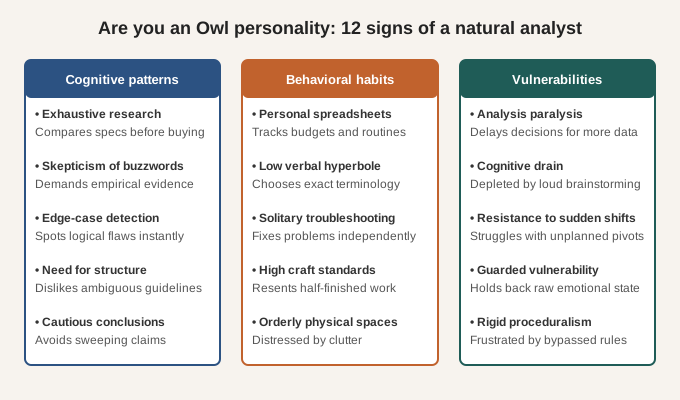
You are an Owl personality if you make decisions based on empirical evidence rather than emotional intuition, value technical precision over speed, and feel mentally exhausted by chaotic environments lacking clear rules. In the DOPE bird model and William Moulton Marston's DISC assessment, the Owl represents High Conscientiousness (C). Natural analysts belonging to this profile process life through structured observation, rigorous risk mitigation, and systematic problem-solving.
Society often mislabels Owls as aloof, overly skeptical, or stubborn. These traits are cognitive defense mechanisms designed to protect operational integrity. Extroverted or impulsive personalities jump headfirst into novel projects based on enthusiasm, but the Owl looks beneath the surface to calculate failure rates, test structural tolerances, and evaluate contingency plans. Without Owls, organizations launch untested software, households drown in debt, and careless oversights compound into structural crises.
The cognitive psychology of the natural analyst
Carl Jung's psychological frameworks identified Introverted Thinking (Ti) and Introverted Sensing (Si) as cognitive functions that organize internal reality through logic and verifiable history. In historical typology dating back to Galen's four humors, this disposition aligned with the melancholic temperament, characterized by thoughtful rumination, deep focus, and an uncompromising quest for truth. Owls operate largely within these contemplative mental models. Psychologist Arie Kruglanski researched the cognitive need for closure, finding that individuals with high conscientiousness feel acute mental distress in ambiguous, unpredictable environments. An Owl craves definite answers, clear guidelines, and verifiable data to resolve that internal tension.
This psychological disposition creates exceptional competence alongside distinct operational constraints. An Owl will spot an accounting error or a flaw in a legal contract that four other professionals overlooked. Conversely, that same analytical drive can spiral into analysis paralysis, where fear of making a suboptimal choice prevents the individual from acting. Recognizing where your analytical instincts help and where they hinder represents the central journey of the Owl personality.
Modern workplaces place an enormous premium on rapid iteration and charismatic pitching, creating quiet strain for high-conscientiousness thinkers. While corporate culture celebrates moving fast and breaking things, the Owl recognizes that broken things cost money, waste hours, and demoralize staff. Natural analysts take quiet pride in building durable systems that function without emergency interventions.
Twelve unmistakable signs of an Owl personality
Identifying whether you possess an Owl temperament involves examining your spontaneous habits, communication patterns, and emotional stress triggers. The twelve behaviors detailed below distinguish the true analytical mind from casual pragmatism:
- Researching purchases until the decision window nearly closes. Buying a four-hundred-dollar espresso machine or a thirty-dollar bicycle pump requires opening fourteen browser tabs. You read forum discussions, compare technical specifications, check warranty return policies, and track price history graphs. Impulse buying feels irresponsible; you require empirical proof that you selected the optimal product on the market.
- Demanding explicit parameters before starting work. Vague project directives like "look into our marketing strategy" paralyze you with frustration. You demand clear acceptance criteria, defined deadlines, budget constraints, and concrete benchmarks of success before writing a line of code or drafting a proposal.
- Experiencing sensory irritation from disordered environments. Cluttered desks, disorganized desktop folders, unsorted spice racks, and mislabeled tools create genuine psychological fatigue. You cannot focus on complex intellectual work until your immediate workspace reflects structural order and cleanliness.
- Deconstructing emotional crises into mechanical problems. If a friend or family member begins crying about an interpersonal dispute, your brain immediately starts diagnosing procedural causes. You suggest timelines, review message transcripts, and recommend tactical fixes. Emotional venting without actionable remedies feels hollow to you.
- Instinctively cross-referencing claims and statistics. Hearing a podcast host or colleague cite a dramatic statistic prompts an immediate search on Google Scholar or government databases. You check sample sizes, identify funding sources, and scrutinize methodology before accepting any claim as factual truth. Buzzwords and trendy corporate jargon trigger instant skepticism.
- Draining rapidly in synchronous brainstorming sessions. Loud, unstructured group whiteboard sessions deplete your energy within forty-five minutes. You detest shouting over colleagues to pitch half-formed concepts. You prefer asynchronous collaboration, where participants submit written proposals with supporting data for thoughtful individual review.
- Resisting the urge to ship unfinished or unverified work. Submitting a report with formatting inconsistencies, unverified calculations, or missing citations makes your skin crawl. You would rather request a forty-eight-hour extension to polish details than release an imperfect draft that exposes you to technical critique.
- Building personal spreadsheets for routine life logistics. Your personal computer contains multiple spreadsheets tracking household utility expenses, personal fitness metrics, vehicle maintenance intervals, and travel itineraries with built-in buffer windows. Structuring daily life through spreadsheets brings you a sense of calm control.
- Adhering strictly to established rules and protocols. You respect standard operating procedures because they prevent catastrophic human error. Watching colleagues bypass security protocols, cheat compliance rules, or ignore safety guidelines to save ten minutes generates intense internal indignation.
- Pausing deliberately before answering complex questions. You rarely blurt out immediate reactions in meetings. You pause for several seconds to organize your thoughts, verify facts internally, and structure your sentence before speaking. You value verbal precision and hate retracting careless statements later.
- Exhausting independent troubleshooting before requesting assistance. Asking someone for help is your absolute last resort. If a piece of software crashes or an appliance breaks, you read the instruction manual, study diagnostic forums, and run three independent tests before calling customer support or asking a coworker.
- Tying personal self-esteem to technical competence and accuracy. Being praised for being nice or popular feels hollow compared to being recognized as an expert who avoids mistakes. Making an obvious factual error or mathematical blunder in public causes you lasting embarrassment that lingers for days.
Managing the communication gap with non-analytical colleagues
Working alongside fast-moving or emotive personalities often generates friction for an Owl. Impulsive managers mistake your thorough questions for passive resistance or insubordination. Asking seven detailed questions about a proposed initiative does not indicate an attempt to derail the project; you are uncovering the technical specifications required to execute it successfully.
Analytical professionals must bridge this gap by contextualizing their thoroughness. Stating your positive intent explicitly alters how colleagues receive your critiques. Saying, "I support this objective fully, and I am asking these technical questions to ensure we avoid costly deployment bugs," reframes your skepticism as protective stewardship rather than obstructionist pedantry.
Written communication remains the Owl's strongest medium. Drafting clear executive memos, itemized technical documentation, and structured changelogs allows you to express your analytical rigor without suffering the social friction of live verbal sparring. Colleagues quickly learn that while you may speak quietly in meetings, your written documentation provides the definitive blueprint for team execution.
Comparing the Owl analyst to Eagle, Peacock, and Dove profiles
Understanding where the Owl fits within the broader behavioral ecosystem clarifies why you clash with certain coworkers or family members. The table below compares the Owl's analytical traits against the other three bird types:
| Behavioral Metric | Owl (Conscientiousness) | Eagle (Dominance) | Peacock (Influence) | Dove (Steadiness) |
|---|---|---|---|---|
| Decision-making speed | Deliberate, slow, data-dependent | Immediate, decisive, outcome-driven | Spontaneous, intuitive, emotional | Cautious, consensus-driven, patient |
| Information processing | Exhaustive analysis of raw data | High-level summaries and bottom lines | Visual concepts and human narratives | Step-by-step practical realities |
| Primary stress trigger | Disorganization and sudden chaos | Loss of control and stalled progress | Social isolation and blunt disapproval | Aggressive conflict and hostility |
| Core life motivation | Mastery, accuracy, and competence | Achievement, power, and results | Recognition, connection, and fun | Stability, peace, and mutual support |
Actionable growth areas for high-conscientiousness thinkers
Recognizing your Owl tendencies allows you to correct cognitive liabilities before they damage your career or personal relationships. Embracing three deliberate practices expands your effectiveness without compromising your analytical integrity:
Adopting the eighty percent rule prevents crippling analysis paralysis. Former United States Secretary of State Colin Powell popularized the forty-to-seventy rule: if you have less than forty percent of the information, do not make the decision; once you have seventy percent of the information, make the call. Waiting for ninety-nine percent certainty guarantees missed opportunities. Learn to ship work that is robust and functional rather than mathematically flawless.
Practicing emotional validation before intellectual critique strengthens personal connections. If a family member expresses anxiety or frustration, your instinctive urge to correct their flawed logic will alienate them. Acknowledge the emotional validity of their experience first. Expressing that you hear how frustrating the situation feels opens the door to constructive problem-solving later.
Allowing buffer zones for unplanned disruptions reduces daily stress. Owls experience acute anxiety when schedules slip or unexpected emergencies derail carefully planned weekends. Building sixty-minute unscheduled blocks into your calendar provides psychological elasticity, preventing sudden changes from triggering cognitive irritation.
Frequently asked questions
What careers are best suited for an Owl personality?
Software engineering, financial auditing, forensic accounting, data science, scientific research, and quality assurance represent ideal environments for Owls. These fields reward deep technical mastery, methodical documentation, and relentless precision.
Are Owl personalities introverted?
Owls lean heavily toward introversion in the vast majority of cases. They recharge their cognitive batteries through solitary focus and quiet reflection, finding large group gatherings and prolonged small talk socially draining.
How does an Owl personality handle high stress?
Under acute stress, Owls withdraw emotionally and immerse themselves in micro-details or procedural busywork. If chaos persists, they become pedantic, hypercritical of others, and paralyzed by decision anxiety.
Can an Owl personality succeed in leadership roles?
Owls excel as operational, technical, and strategic leaders where precision, compliance, and systems architecture determine success. They often struggle in purely inspirational or public-facing leadership roles unless they partner with high-influence teammates.
What is the main difference between an Owl and a Dove?
Owls prioritize task accuracy and empirical logic above interpersonal feelings, whereas Doves prioritize relational harmony and emotional stability above technical perfection. Doves yield to keep peace; Owls defend facts regardless of social discomfort.
- Bird Personality : Dove
- Bird Personality : Mild Dove
- Bird Personality : Smart Dove
- Bird Personality : Brave Dove
- Bird Personality : Genius Dove
- Bird Personality : Wizard Dove
- Bird Personality : Reverse Thinking Dove
- Bird Personality : Changeable Dove
- Dove Personality in Relationships: How They Show Love