The Link Between Personality Type and Burnout
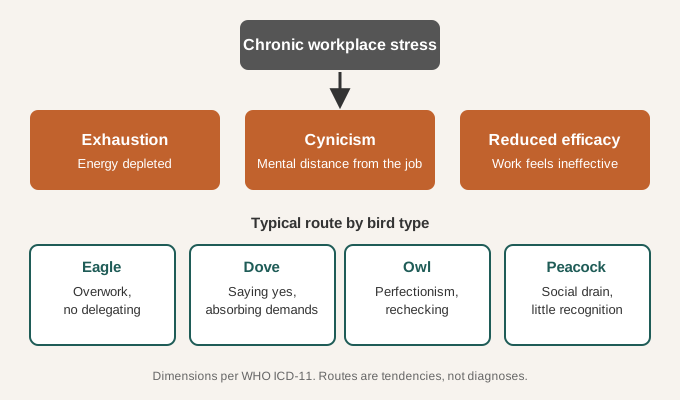
Personality does not cause burnout, but it shapes the route you take to it. Meta-analytic research finds that people with lower emotional stability report more burnout, and the bird types in the DOPE framework each reach exhaustion through a different habit: Eagles overwork, Doves absorb other people's demands, Owls chase perfection, and Peacocks run on social energy until it runs out.
Burnout itself has a formal definition. The World Health Organization's ICD-11, which took effect in January 2022, describes burn-out as an occupational phenomenon resulting from chronic workplace stress that has not been successfully managed, and lists three dimensions: feelings of energy depletion or exhaustion, increased mental distance or cynicism toward one's job, and reduced professional efficacy. It is not classified as a medical condition.
What does research say about personality and burnout?
The strongest link is with emotional stability, the Big Five trait opposite of neuroticism. In a 2009 meta-analysis in the journal Work and Stress, Gene Alarcon, Kevin Eschleman, and Nathan Bowling combined studies of personality and burnout and found that neuroticism related most strongly to burnout, with extraversion and conscientiousness also linked to lower burnout. People who are more anxious and easily upset tend to report exhaustion and cynicism at higher rates.
Two cautions apply. First, correlation is not destiny: a high-neuroticism employee in a supportive team can do better than a calm one in a toxic job. Second, workplace conditions explain a large share of burnout. Christina Maslach, who developed the Maslach Burnout Inventory with Susan Jackson in 1981, has long argued that workload, lack of control, insufficient reward, a breakdown of community, unfairness, and conflicting values matter more than individual traits.
I find the second point easy to forget when reading personality articles, this one included. If your job has three people's workload and no authority over it, a personality tweak will not fix it. The framework is useful for spotting your own habits, not for blaming yourself for a bad job.
How common is burnout?
A 2018 Gallup study of about 7,500 full-time US employees found that 23 percent reported feeling burned out at work very often or always, and another 44 percent reported feeling burned out sometimes. The study named five factors most strongly associated with burnout: unfair treatment, an unmanageable workload, lack of role clarity, lack of communication and support from the manager, and unreasonable time pressure.
None of those five is a personality trait. All of them describe the job and the manager, which fits Maslach's view.
How does each bird type reach burnout?
The DOPE types describe tendencies, not fixed categories. The paths below are the patterns I would expect, given each type's strengths taken too far.
| Bird type | Typical path to burnout | Early warning sign | First change to try |
|---|---|---|---|
| Eagle | Takes on more targets, treats rest as lost time, rarely delegates | Irritability and short temper with the team | Hand off one full responsibility per month |
| Dove | Says yes to avoid conflict, absorbs colleagues' problems | Resentment and dread on Sunday evenings | Decline one request per week using a prepared sentence |
| Owl | Sets impossible quality standards, rechecks everything | Procrastination from fear of imperfect work | Define "done" before starting and stop at that line |
| Peacock | Spends energy on people and visibility, lacks recognition or variety | Loss of enthusiasm, withdrawal from usual social contact | Block recovery time between meetings and ask for feedback |
Why do Eagles burn out?
Eagles burn out because they treat their own energy as unlimited. They set demanding goals, raise the target when they hit it, and read tiredness as weakness. Their usual early sign is not exhaustion they notice but a short fuse with colleagues, which others see before they do.
The fix is structural. An Eagle will not listen to "take it easy," but will respond to a target: two protected evenings a week, a delegated project, a fixed finish time. Treat rest as a performance requirement, which for most Eagles is accurate.
Why do Doves burn out?
Doves burn out through accommodation. They agree to the extra project, cover for the colleague, and listen to the team's problems, and they do this without complaint, so colleagues do not know the load has become too heavy. The Dove's cynicism, when it arrives, often appears as quiet withdrawal.
The fix is saying no in advance. Write a sentence you can use: "I can't take that on this week, but I could look at it Thursday." It sounds minor, and for a Dove, saying it aloud is the hard part. Start with requests that carry little risk.
Why do Owls burn out?
Owls burn out through perfectionism. They set standards that no schedule can meet, reread their own work repeatedly, and feel each error as a verdict on themselves. Their inefficacy dimension, the sense that nothing they do is good enough, tends to arrive early.
A practical change is defining "good enough" before starting. For a report, that could be "three sources, two charts, one page of conclusions." When the list is done, stop. It feels uncomfortable the first few times and then becomes routine.
Why do Peacocks burn out?
Peacocks burn out when energy runs on social contact and recognition, and the job offers neither. A remote role with little feedback, or one with constant meetings and no creative work, drains them differently than it would an Owl. They often continue to look cheerful, which hides the problem from managers.
The fix is variety and feedback. Ask for a regular check-in, work on a project with another person, and schedule recovery time after high-contact days. A Peacock who says "I'm fine" in a bright voice may not be.
What are the warning signs of burnout?
The earliest signs are usually physical and behavioral, not emotional. Look for several of these lasting more than a few weeks:
- Sleep problems. You wake at 3 a.m. thinking about work or sleep ten hours and still feel tired.
- Dread before work starts. The feeling hits on Sunday afternoon or in the car park, not only when something specific is wrong.
- Cynicism. You start mocking the company, the clients, or colleagues in ways that are out of character.
- Lower output on tasks you used to finish quickly. A report that once took an hour now takes three.
- Physical complaints. Headaches, stomach trouble, and frequent colds with no clear medical cause.
- Emotional numbness. Good news and bad news produce the same flat response.
- Escape fantasies. You daydream about quitting, moving, or a long illness that would excuse you from work.
The burnout test on this site scores these areas in a few minutes. It is a screening tool, not a diagnosis, so use the result to decide whether to talk to a professional.
How is burnout different from depression?
Burnout is tied to work and usually eases when the work situation changes, while depression affects mood across all areas of life and does not lift on vacation. The two can overlap, and chronic burnout may raise the risk of depression. Symptoms such as persistent hopelessness, loss of pleasure in everything, or thoughts of self-harm call for a doctor or therapist, not a schedule change.
If you are in crisis in the United States, you can call or text 988 to reach the Suicide and Crisis Lifeline. In other countries, contact local emergency services or a crisis line.
What helps recovery?
Recovery needs a change in the conditions that produced the burnout, plus rest, plus support. Rest alone often fails: people take a week off, return to the same workload, and the exhaustion comes back within a month.
- Reduce or reshape the workload, with your manager if possible. Bring specifics: hours, tasks, and what you propose to drop.
- Protect sleep for several weeks, since poor sleep keeps the stress response running.
- Restore one non-work activity you gave up, such as a sport, a class, or regular dinner with friends.
- Talk to a therapist, particularly one with experience in work stress, if symptoms last beyond a month or two.
- Consider a role or employer change when the conditions will not move. Some jobs cannot be fixed by the person doing them.
Expect slow progress. Recovery usually takes months, not days, and the energy returns unevenly.
Can you prevent burnout if your personality puts you at risk?
Yes, partly. Knowing your pattern lets you set up guards before the pattern costs you: an Eagle fixes a finish time, a Dove prepares refusal sentences, an Owl defines done, a Peacock books recovery time. None of this removes the need for a reasonable workload, and none replaces a manager who notices.
My own view is that employers should carry more of this than they do. Telling an overloaded Dove to "set boundaries" while handing them a fourth project is advice that ignores who controls the work. Use your type to understand your habits, and use the job conditions to decide whether the job is workable.
Frequently asked questions
Does personality affect burnout risk?
Yes, to a degree. A 2009 meta-analysis by Alarcon, Eschleman, and Bowling found that neuroticism had the strongest relationship with burnout, while extraversion and conscientiousness were associated with lower burnout. Job conditions such as workload and lack of control still explain a large part of the picture.
Which personality type is most likely to burn out?
No bird type is most likely, since the path differs by type. Eagles burn out through overwork, Doves through taking on others' demands, Owls through perfectionism, and Peacocks through low recognition and social drain. Emotional stability and job conditions predict risk better than type alone.
What is the difference between stress and burnout?
Stress usually involves too much pressure, and relief arrives when the pressure eases. Burnout involves exhaustion, cynicism, and a drop in effectiveness that continue after the pressure has eased. The WHO classifies burn-out as a result of chronic workplace stress that has not been managed successfully.
How long does it take to recover from burnout?
Recovery commonly takes several months, though the range varies with severity and with whether the job changes. A week of vacation helps briefly but rarely resolves it. Recovery usually requires a lower workload, better sleep, and support from a therapist or manager.
Can introverts get burned out more easily?
Introverts burn out when the job requires heavy social contact without recovery time, and extraverts burn out when the job is isolating. The Alarcon meta-analysis found extraversion was linked to lower burnout on average, but an individual introvert in a quiet role may do well. Fit between person and job matters more than the label.
When should you see a doctor about burnout?
See a doctor or therapist if symptoms last longer than a few weeks, if you cannot sleep or function at work, or if you feel hopeless or have thoughts of self-harm. Burnout and depression can look alike, and a professional can tell them apart. In a crisis, call or text 988 in the United States.
- Leading with Empathy : The Benefits and Real-Life Examples
- About Personality Disorders
- What Are Cognitive Distortions
- Discover the Cognitive Effects of Depression on the Brain
- The Impact of Alexithymia on Mental Health and Relationships
- Overcoming Perfectionism: Tips and Strategies for a Healthier Mindset
- Understanding the Dangers of Love Bombing