Personality Traits for Entrepreneurs: Do You Have What It Takes?
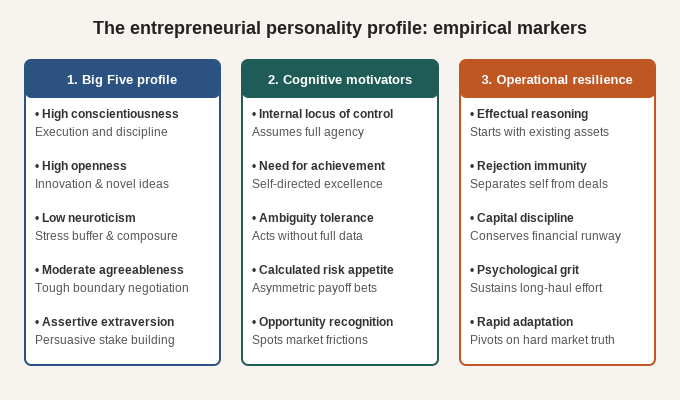
Successful entrepreneurs display a measurable psychological profile defined by high conscientiousness, high openness to experience, low neuroticism, and moderate to low agreeableness within the Five-Factor Model of personality. Decades of industrial-organizational psychology confirm that individuals who launch and sustain commercial ventures differ systematically from salaried corporate managers in their appetite for calculated risk, internal locus of control, and tolerance for chronic ambiguity.
Popular media often depicts startup founders as reckless gamblers driven by ungrounded charismatic bravado. Empirical research tells a different story. Resilient business owners operate as disciplined risk mitigators who convert uncertainty into structured experiments, demonstrating relentless execution stamina while staying emotionally composed under financial pressure.
Founding an enterprise tests emotional resilience far more than raw intellectual ability. Understanding your baseline personality strengths and blind spots allows you to build complementary co-founding teams and avoid predictable operational traps.
Empirical research on the entrepreneurial personality
Psychologists spent decades debating whether an identifiable entrepreneurial personality exists or whether business outcomes depend entirely on external market timing. Rigorous statistical meta-analyses have resolved this question in favor of personality differences.
A definitive meta-analysis conducted by Hao Zhao and Scott Seibert, published in 2006 in the Journal of Applied Psychology, examined twenty-three empirical studies comprising 4,923 participants to compare entrepreneurs against corporate managers. Zhao and Seibert demonstrated statistically significant divergences across four of the Big Five personality dimensions. Entrepreneurs scored significantly higher on Conscientiousness and Openness to Experience, while scoring significantly lower on Neuroticism and Agreeableness compared to managerial counterparts.
Harvard psychologist David McClelland laid the theoretical groundwork for this field in 1961 through his seminal book The Achieving Society. McClelland identified the Need for Achievement (nAch) as the single primary psychological engine of venture creation. High-nAch individuals prefer personal responsibility for solving problems, set challenging but calculated performance targets, and demand unambiguous feedback on concrete performance metrics.
Julian Rotter's 1966 research on Locus of Control adds another foundational pillar. Individuals possessing an internal locus of control believe their own decisions and discipline determine life outcomes, whereas external-locus individuals attribute success or failure to luck, regulatory barriers, or economic fate. Research confirms that founders with strong internal loci recover significantly faster from commercial insolvency, treating market rejections as actionable diagnostic data rather than fatal personal verdicts.
Big Five personality traits in entrepreneurial ventures
The Five-Factor Model provides an objective diagnostic lens for evaluating entrepreneurial fitness. The table below details how each trait manifests in startup environments compared to traditional corporate roles.
| Big Five trait | Typical founder profile | Corporate manager baseline | Behavioral impact on startups | Operational danger at extremes |
|---|---|---|---|---|
| Conscientiousness | Exceptionally high | High | Maintains relentless execution discipline, work standards, and operational follow-through | Workaholic burnout, micromanagement of early hires |
| Openness to experience | High to very high | Moderate | Generates novel business models, identifies market inefficiencies, and adapts to technology | Shiny object syndrome, constant strategy pivots without execution |
| Neuroticism | Low to very low | Moderate | Maintains emotional composure during cash flow crunches and customer churn | Complacent neglect of legitimate systemic risks |
| Agreeableness | Moderate to low | Moderate to high | Negotiates aggressive terms, cuts unprofitable product lines, and fires poor performers | Destructive abrasiveness, alienation of key staff members |
| Extraversion | Moderate to high | Moderate | Persuades investors, recruits talent, and closes complex business development deals | Excessive networking at the expense of internal product work |
Cognitive mechanisms: ambiguity tolerance and effectuation
Operating a startup differs qualitatively from managing an established enterprise because the startup environment lacks historic performance data, predictable client demand, and clear rules. Surviving this environment requires specific cognitive adaptations.
Tolerance for ambiguity, first operationalized by Stanley Budner in 1962, measures how an individual perceives ambiguous, contradictory, or unpredictable situations. Low-ambiguity individuals experience acute cognitive anxiety when instructions are vague, seeking refuge in clear corporate hierarchies. Founders perceive ambiguity as a competitive opening, making decisions with only 60% of necessary information and testing assumptions in production.
Darden School of Business professor Saras Sarasvathy introduced Effectuation Theory in 2001, observing how expert serial entrepreneurs make decisions. Corporate executives use causal reasoning: they define a predetermined target and assemble resources to hit that target. Expert entrepreneurs use effectual reasoning: they take inventory of who they are, what they know, and whom they know, then imagine multiple possible effects. Sarasvathy demonstrated that resilient founders operate on the Affordable Loss Principle, risking only what they can afford to lose rather than calculating phantom projections of expected return.
Bird personality types in startup founding teams
Rarely does a single individual embody all necessary entrepreneurial virtues. Evaluating founding teams through the four-bird personality framework demonstrates why complementary co-founders build more durable enterprises than solo operators.
Eagle entrepreneurs provide decisive momentum, competitive hunger, and fierce executive authority. An Eagle founder drives product launches, pushes for early revenue, and makes painful decisions without emotional hesitation. Solo Eagles run the risk of alienating team members and making impulsive strategic gambles without verifying unit economics.
Owl entrepreneurs deliver structural rigor, financial conservatism, and technological depth. An Owl co-founder builds scalable systems, tracks gross margin variations, and ensures legal and technical compliance. Without an Eagle or Peacock partner, Owl-dominated startups often suffer from analysis paralysis, endlessly polishing features without ever releasing them to the open market.
Peacock entrepreneurs represent the public voice, charismatic storytelling, and customer evangelism of the venture. A Peacock founder secures media coverage, excites angel investors, and attracts early early-adopter customers through personal magnetism. Peacocks require Owl and Eagle discipline to ensure promises made during sales presentations match actual technical capabilities.
Dove entrepreneurs safeguard internal culture, client retention, and collaborative morale. A Dove co-founder establishes customer support excellence, listens intently to user feedback, and resolves interpersonal friction among technical talent. Early startups without Dove empathy often suffer catastrophic staff turnover as founder pressure burns out engineering staff.
Psychological capital and the biology of founder stamina
Management theorist Fred Luthans introduced the concept of Psychological Capital (PsyCap) in 2007, categorizing four measurable cognitive resources: Hope, Self-Efficacy, Resilience, and Optimism. Academic assessments demonstrate that high PsyCap correlates directly with entrepreneurial persistence, revenue growth, and reduced founder burnout.
Angela Duckworth's research on Grit at the University of Pennsylvania, published in 2007, defines grit as perseverance and passion for long-term goals. Duckworth proved that grit predicts success more reliably than raw IQ in demanding competitive fields. In entrepreneurship, grit manifests as the capacity to sustain deliberate effort across five to ten years when early commercial traction stalls.
Physical stamina underpins psychological grit. A clinical study by Michael Freeman at the University of California San Francisco in 2018 surveyed 242 entrepreneurs, finding that 49% reported one or more lifetime mental health conditions, including higher rates of depression and ADHD than the general population. Founders who survive long-term maintain strict somatic habits: mandatory cardiovascular exercise, consistent sleep schedules, and deliberate social activities unrelated to their business balance out the extreme neurochemical strain of running a high-stakes enterprise.
Actionable audit: testing your entrepreneurial readiness
Assessing your readiness to launch a commercial venture requires objective self-examination rather than inspirational self-affirmation. Review these four diagnostic questions before committing capital.
- Evaluate your psychological tolerance for income volatility. Can you endure twelve consecutive months of unpredictable compensation without succumbing to paralyzing anxiety that impairs your strategic judgment?
- Audit your response to personal rejection. Facing skeptical prospective clients or venture partners requires treating rejection as neutral market data rather than a personal wound.
- Measure your self-directed execution discipline. Maintaining forty hours of focused, proactive work per week demands rigorous inner boundaries when no supervisor monitors your daily output.
- Test your willingness to enforce unpopular boundaries. Protecting enterprise solvency requires terminating friendly underperformers and renegotiating unprofitable commercial agreements without lingering guilt.
Frequently asked questions
Can you learn to be an entrepreneur if you lack natural traits?
Personality traits represent baseline behavioral tendencies rather than rigid behavioral prisons. While traits like low neuroticism provide a natural buffer against stress, specific entrepreneurial skills such as financial modeling, sales negotiation, and customer interviewing can be mastered through deliberate practice. Developing situational self-awareness allows founders to consciously adopt required behaviors even when those actions run counter to natural preferences.
Which personality trait is most damaging to a new startup founder?
High neuroticism combined with low conscientiousness represents the most destructive trait pairing for a business founder. High neuroticism causes founders to overreact emotionally to ordinary operational setbacks, while low conscientiousness leads to missed operational deadlines, disorganization, and failure to track financial burn rates.
Are introverts or extroverts more successful as startup founders?
Empirical studies show comparable success rates between introverted and extroverted founders, though they lead through different operational styles. Extroverts excel at early fundraising, team recruitment, and public presentations, while introverts excel at deep product development, analytical listening, and empowering autonomous engineering teams.
Why is low agreeableness common among successful business owners?
Moderate to low agreeableness allows a founder to defend firm boundaries, decline unprofitable partnership requests, and hold personnel accountable without fear of social disapproval. Highly agreeable individuals frequently struggle with founder duties because their desire to maintain harmony prevents them from confronting underperformance.
How should a solo founder compensate for missing personality strengths?
A solo founder must conduct an objective personality audit and deliberately recruit co-founders, advisory board members, or executive assistants who possess opposing traits. An impulsive Eagle founder should partner with an analytical Owl operations lead to balance speed with financial accuracy.
- Toxic Relationship Signs at Work: Dealing With a Difficult Colleague
- Personality Disorders Explained: A Beginner's Guide
- 6 Signs You Are Hypervigilant
- The Ultimate Guide to Understanding the DISC Personality Test
- Bird Personality : Reverse Thinking Peacock
- Borderline Personality Disorder: Signs, Traits, and Support Options
- How To Make a Difference in the World
- Bird Personality : Dove
- Bird Personality : Mild Dove
- Bird Personality : Smart Dove
- Bird Personality : Brave Dove
- Bird Personality : Genius Dove
- Bird Personality : Wizard Dove
- Bird Personality : Reverse Thinking Dove
- Bird Personality : Changeable Dove
- Dove Personality in Relationships: How They Show Love