How to Organize Your Thoughts Using Mind Mapping
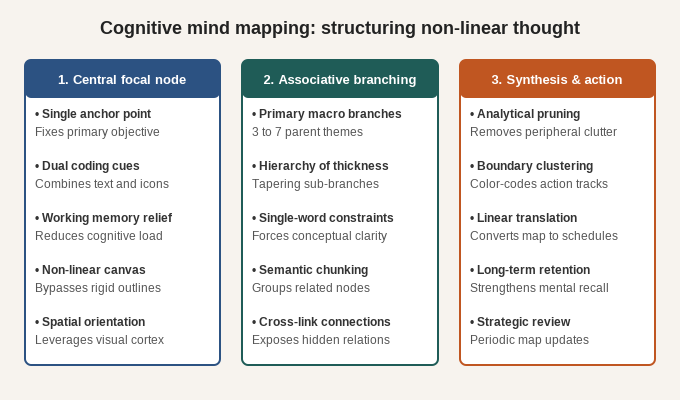
Mind mapping is a visual thinking method that arranges concepts hierarchically around a central focal subject using radiant branches, concise keywords, and spatial groupings. Popularized by British researcher Tony Buzan during the 1970s, this technique mirrors the brain's associative memory networks rather than forcing complex ideas into the rigid vertical sequence of standard text outlines.
Linear note-taking forces you to prioritize grammar, syntax, and chronological order before you understand how different concepts interact. Mind mapping separates idea generation from structural editing, allowing your visual cortex to track relationships between disparate ideas simultaneously. The result is faster problem resolution, lower mental fatigue, and measurable improvements in information recall.
Researchers in cognitive psychology recognize mind mapping as an external working memory buffer. Transferring mental associations onto a two-dimensional visual surface bypasses the severe processing bottlenecks of conscious short-term memory.
Cognitive science behind visual and radiant thinking
The human brain does not process complex problems in sequential bullet points. Memory storage operates through semantic networks, vast webs of interconnected neurons where activating one concept triggers associated memories across multiple cortical regions. Linear text suppresses these natural connections by demanding a strict top-to-bottom reading sequence.
Cognitive psychologist Allan Paivio established the empirical foundation for visual thinking through Dual Coding Theory in 1971. Paivio demonstrated that human memory utilizes two separate cognitive subsystems: one dedicated to processing linguistic information and another specialized for non-verbal spatial imagery. Standard note-taking relies exclusively on the verbal channel, creating cognitive congestion. Mind maps activate both channels simultaneously, pairing spatial positions and visual shapes with linguistic labels to double the pathways available for memory retrieval.
John Sweller's Cognitive Load Theory, published in 1988, explains why unorganized thoughts feel paralyzing. Working memory can hold only four to seven discrete items at one time, a constraint documented by Nelson Cowan in 2001. Attempting to organize a project mentally overloads prefrontal executive bandwidth. A physical mind map acts as an external cognitive prosthesis, offloading storage demands to paper so your prefrontal cortex can focus on analysis, evaluation, and synthesis.
Neuroimaging research published by Eleanor Maguire in 2000 regarding hippocampal spatial mapping demonstrates that the brain processes physical space and abstract concepts using overlapping neural structures. Placing an idea in the upper right quadrant of a large sheet attaches a spatial coordinate to the thought. Weeks after drawing a map, students frequently recall the exact visual location of an argument even when raw textual details have faded.
Empirical research on retention and comprehension
Controlled academic studies confirm the cognitive advantages of diagrammatic thought organization over passive reading and text transcription.
A landmark clinical trial conducted by Paul Farrand, Fearzana Hussain, and Enid Hennessy at Queen Mary University of London, published in 2002 in the journal Medical Education, tested the efficacy of the mind map technique on fifty-second-year medical students. The researchers evaluated factual retention across a 600-word passage of complex text. Students utilizing mind maps demonstrated a 10% to 15% increase in long-term factual recall over a seven-day interval compared to the control group practicing self-selected study methods.
Further research by Martin Eppler at the University of St. Gallen in 2006 evaluated knowledge visualization methods within organizational management. Eppler found that visual concept structures reduced cognitive overhead during team strategy sessions, enabling executives to identify systemic dependencies and planning gaps 23% faster than teams working with conventional slide decks and linear briefs.
Educational researchers Joseph Novak and Bob Gowin, pioneering concept mapping frameworks at Cornell University throughout the 1980s, established that external graphic organizers promote meaningful learning over rote memorization. Students required to connect concepts visually demonstrated superior problem-solving agility on unfamiliar examinations because their internal mental models possessed richer associative links.
Comparing mental organization frameworks
Different cognitive tasks require distinct structural frameworks. The table below contrasts four primary organizational tools across operational dimensions.
| Method | Structural format | Primary cognitive strength | Working memory load | Best practical application |
|---|---|---|---|---|
| Mind mapping | Radiant hierarchy around single central node | Rapid associative exploration and cross-linking | Low (externalized spatial canvas) | Brainstorming, complex project planning, book summaries |
| Linear outline | Vertical nested Roman numerals or bullets | Logical order and sequential presentation | Moderate (requires continuous vertical parsing) | Final report writing, legal briefs, public speech drafts |
| Concept mapping | Network graphs with labeled relational verbs | Detailed causal and ontological mapping | Moderate to high (dense relationship definitions) | Scientific modeling, systems engineering, software architecture |
| Bullet journaling | Rapid chronological daily logging with task signifiers | Task accountability and time tracking | Low to moderate (sequential entry style) | Daily operational routines, personal habit maintenance |
Step-by-step protocol to build a functional mind map
Effective mind maps avoid decorative art in favor of cognitive efficiency. Follow these five procedural steps to construct a working thinking canvas.
- Establish an unambiguous central anchor node. Write the core topic in the exact center of a blank horizontal sheet, using a three-word noun phrase paired with a distinctive box or circle to fix visual orientation.
- Radiate between three and seven major parent branches. Draw thick curved lines originating directly from the central hub, dedicating each branch to a distinct macro-dimension of the subject, such as budget, personnel, technical architecture, or timeline.
- Enforce strict single-word or short-phrase constraints on child branches. Resist the temptation to write complete sentences on nodes; single keywords preserve mental flexibility and invite rapid associative sub-branching.
- Differentiate conceptual clusters using distinct color tracks. Assign one consistent ink or marker color to each major branch family to trigger immediate visual chunking across your peripheral field of view.
- Draw lateral dotted connector arrows between distant branches. Linking a technical constraint node on one branch to a budgetary risk node on another captures systemic cross-dependencies that linear documents conceal.
Adapting mind mapping to bird personality styles
Individual personality profiles process visual information through distinct cognitive lenses. Aligning your mapping technique with your natural bird personality archetype produces faster results.
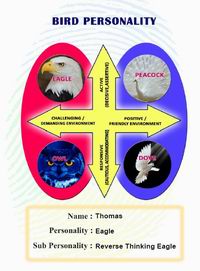
Eagle personalities prioritize speed, macroscopic milestones, and definitive outcomes. Constructing an Eagle mind map requires limiting total branches to three dominant execution tracks and deliberately omitting secondary minutiae. An Eagle map serves as a tactical battle board, displaying revenue targets, primary blockers, and immediate decision gates.
Owl personalities excel in rigorous analysis, precision, and data verification. An Owl thinker thrives by introducing dense sub-hierarchies, numerical metrics, and cross-reference links between distant leaves. Owls should use digital canvas tools that allow infinite zoom levels, letting them document exhaustive technical taxonomies without cluttering high-level views.
Peacock personalities generate expansive enthusiasm, creative metaphors, and social ideas. A Peacock benefits from using varied color palettes, hand-drawn icons, and large unconstrained poster boards. Restricting a Peacock to rigid single-color outlines strangles their creative flow; they need sensory variety to trigger lateral breakthroughs.
Dove personalities emphasize interpersonal harmony, team cohesion, and steady operational consensus. Doves should structure mind maps around stakeholder perspectives, team support roles, and shared cultural values. A Dove map clarifies who owns each responsibility and ensures no team member carries an unbalanced workload.
Mistakes that destroy mind map utility
Many beginners abandon mind mapping after creating cluttered diagrams that resemble chaotic spider webs. Recognizing common structural mistakes preserves clarity.
The most frequent error is writing multi-sentence paragraphs inside node bubbles. Paragraphs force the brain back into linear reading mode, destroying the speed advantage of spatial scanning. Treat nodes as indexing handles rather than narrative essays.
Another error involves symmetrical perfectionism. Spending fifteen minutes selecting digital fonts or drawing elaborate illustrations turns an active cognitive session into decorative distraction. An effective mind map looks utilitarian and evolves rapidly through rough handwritten additions and deletions.
Neglecting hierarchy represents a third operational pitfall. If child branches carry the same line thickness and font size as parent themes, visual priority collapses. Taper line thickness outward from center to edge to reinforce conceptual hierarchy automatically.
Treating the initial draft as a sacred permanent monument guarantees stagnation. Effective thinkers frequently discard an exploratory morning map, extracting only five refined core themes onto a clean sheet for afternoon execution.
Translating visual maps into real execution
A mind map serves as a generative planning tool rather than an immutable permanent archive. Once you complete the divergent phase of exploring connections, initiate the convergent phase of operational execution.
Scan the outer leaf nodes of your map and circle actionable tasks requiring immediate execution. Transfer these terminal action points directly into a linear calendar, Kanban board, or task management software, sequencing them by temporal priority.
Keep your completed physical mind map pinned beside your workstation during project execution. Whenever sudden complications arise, glance at the map to re-anchor your attention to the overarching structural architecture of the project.
Frequently asked questions
Is paper or digital software better for mind mapping?
Physical paper and fine-tipped pens provide superior kinesthetic feedback during early divergent brainstorming, eliminating software interface friction and notification distractions. Digital tools like MindManager or Obsidian Canvas excel during complex project management where teams need to attach hyperlinked files, rearrange branches dynamically, and search extensive text databases.
Can mind mapping assist with clinical anxiety and ADHD?
Clinical psychologists frequently recommend mind mapping for individuals managing attention deficits or anxiety because externalizing mental chaos onto paper calms working memory overload. Seeing all commitments organized spatially in front of you disarms catastrophic feelings of being overwhelmed by unseen responsibilities.
How many branches should an effective mind map contain?
An effective mind map maintains between three and seven primary branches radiating from the central subject. This constraint aligns with human working memory bandwidth, ensuring the overarching structure remains scannable at a single glance without inducing sensory fatigue.
What is the difference between a mind map and a concept map?
A mind map radiates outward from a single central focal concept in a strict tree hierarchy using keywords and visual colors. A concept map connects multiple interconnected concepts in a flexible network web, linking nodes with directional arrows labeled with relational phrases such as "causes," "leads to," or "requires."
Why do single keywords work better than full sentences on branches?
Single keywords allow multiple new associative connections to sprout outward in several conceptual directions. Writing a full sentence fixes a single rigid thought in place, closing off further cognitive exploration and converting the visual canvas back into a conventional paragraph.
- Bird Personality : Dove
- Bird Personality : Mild Dove
- Bird Personality : Smart Dove
- Bird Personality : Brave Dove
- Bird Personality : Genius Dove
- Bird Personality : Wizard Dove
- Bird Personality : Reverse Thinking Dove
- Bird Personality : Changeable Dove
- Dove Personality in Relationships: How They Show Love