Can Mental Illness Change Your Personality? What Research Says
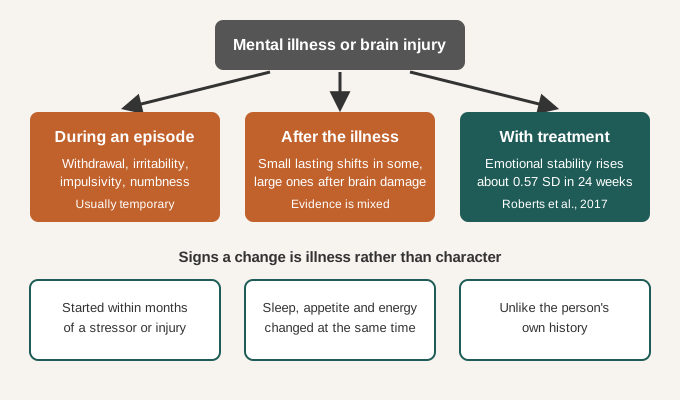
Mental illness can change how you behave and feel, sometimes sharply, and research shows some of those changes outlast the episode. A person in a depressive episode may become withdrawn and irritable, and a person with a severe brain injury or dementia may become someone their family barely recognizes. Most of the time, though, the underlying personality returns or improves when the illness is treated.
The question matters because people on both sides misread it. Patients wonder whether the "real me" is gone. Family members wonder whether the person they love has been replaced. The research gives a more specific answer than either fear.
What is the difference between personality and mental illness?
Personality is the stable pattern in how you think, feel, and act across situations and years. Psychologists usually describe it with the Big Five traits: openness, conscientiousness, extraversion, agreeableness, and neuroticism. Mental illness is a condition with symptoms, such as persistent low mood, panic, or hallucinations, that causes distress or interferes with daily life.
The two overlap, which is why the question is hard. Depression looks like high neuroticism and low extraversion. Mania can look like high extraversion and low conscientiousness. A clinician has to decide whether a trait is a lasting part of you or a symptom that appeared with the illness, and the answer often only becomes clear over time.
What does research say about personality traits and mental illness?
Certain traits predict who develops certain conditions. In 2010, Roman Kotov and colleagues published a meta-analysis in Psychological Bulletin covering 175 studies. They found that high neuroticism and low conscientiousness were associated with nearly all of the anxiety, depressive, and substance use disorders they examined. Low extraversion was linked specifically to depression and social anxiety.
That finding runs in one direction: traits make some illnesses more likely. The harder question is whether the illness then pushes the traits in a new direction. The evidence suggests it can, and the table below summarizes what is known for several conditions.
| Condition | Common change in behavior | Usually temporary? |
|---|---|---|
| Major depression | Withdrawal, irritability, loss of interest, lower energy | Mostly yes, though some people report lasting caution or sensitivity afterward |
| Anxiety disorders | Avoidance, constant checking, difficulty relaxing | Often improves with therapy, such as exposure-based treatment |
| Bipolar disorder | Raised or lowered energy, impulsive spending, shifts in sociability | Changes during episodes, baseline returns between them |
| PTSD | Hypervigilance, emotional numbness, mistrust | Can persist for years without treatment |
| Traumatic brain injury | Impulsivity, flat emotion, poor judgment, anger | Sometimes permanent, depending on the area damaged |
| Frontotemporal dementia | Loss of empathy, odd habits, socially inappropriate behavior | No, it progresses over time |
Does depression change who you are?
During an episode, yes, in behavior and outlook. Someone who was sociable and funny may decline invitations, sleep twelve hours, and stop returning calls. Friends often say "that isn't like her," which is an accurate description of a symptom, not a verdict on her character.
Whether depression leaves a mark afterward is still debated. Some longitudinal studies report that people who recovered from depression score somewhat higher on neuroticism than they did before, an idea researchers call the "scar" hypothesis. Other studies find that the elevated scores are a risk factor that was present all along. The honest summary is that the data point both ways, and the effect where it exists is small.
What people tell their therapists is more consistent. Many say they feel more cautious, more aware of their limits, or less tolerant of small talk after a serious episode. Whether you call that a changed personality or an experience that rearranged priorities is partly a matter of language.
Which conditions change personality most clearly?
The clearest cases involve damage to the brain. The best-known one is Phineas Gage, a railroad foreman who survived an iron rod passing through his frontal lobe in 1848. His doctor, John Harlow, later reported that he became impatient and profane, and that his friends said he was "no longer Gage." Modern accounts debate how much Gage actually changed, but the case is still the standard first example in textbooks on the frontal lobes and behavior.
Frontotemporal dementia is a current example. Family members often report that a mild, considerate person began making crude remarks, hoarding food, or ignoring other people's feelings, sometimes years before memory loss appeared. The DSM-5, the diagnostic manual used by US clinicians, includes a separate diagnosis called "personality change due to another medical condition" for cases like this, where a physical illness produces a lasting shift in behavior.
Severe trauma is another route. People with PTSD often describe becoming guarded and quick to startle, and they may lose trust in people who have given no reason for suspicion. These responses make sense as protection learned in a dangerous environment, which is why trauma-focused therapy, not willpower, tends to work.
Can treatment change your personality for the better?
Yes, and the evidence for this is stronger than most people expect. In 2017, Brent Roberts and colleagues published a systematic review in Psychological Bulletin that pooled 207 studies of therapy and other interventions. They found that traits shifted measurably over an average of about 24 weeks, with the largest change in emotional stability, the opposite pole of neuroticism. For emotional stability the average effect was about 0.57 standard deviations, a moderate to large shift by psychology's standards.
Therapy does not turn an introvert into an extravert. It lowers the volume on distress, and as a result people act and feel differently in daily life.
Medication appears to have a similar effect. In a 2009 trial in Archives of General Psychiatry, Tony Tang and colleagues found that patients treated for depression with either paroxetine or cognitive therapy ended with lower neuroticism and higher extraversion than a placebo group, and the shift was not fully explained by relief of symptoms. A psychiatrist can tell you what to expect from a specific prescription.
How can you tell if a change is the illness or the person?
The most useful comparison is with the person's own history. Ask whether the behavior started recently, whether it appears in all settings or only some, and whether it matches a time when sleep, appetite, or medication changed. Symptoms that arrive within weeks and track those changes are more likely illness than character.
A short checklist for family members and for yourself:
- Write down when it started. A change that began within the last few months, especially after a stressor or a head injury, deserves a medical conversation. Traits that have been present since adolescence are more likely part of the personality.
- Check sleep, appetite, and energy. Large shifts in all three point toward mood or anxiety conditions. They are also easy to describe to a doctor with specifics.
- Notice whether the person is distressed by it. Someone with depression usually feels bad about the change. Someone with frontal lobe damage or mania may not see any problem, and that lack of awareness is itself informative.
- Review medications and substances. Steroids, some anti-seizure drugs, alcohol, and stimulants can all alter mood and behavior. A pharmacist can check the list.
- Ask for a medical exam first. Thyroid problems, vitamin B12 deficiency, and infections can mimic psychiatric illness. A basic blood panel rules out several of them.
What does this mean for how you see yourself?
I think the most useful idea is that you are not a fixed object and neither is your illness. The person you were before a hard year is still in there in most cases, and what has changed is what the illness made loud. If you recover, you are likely to get back most of what you recognize, and sometimes a little more patience or humility than you had.
It also means you should not wait for a personality test to tell you whether to get help. A bird type quiz, including our own DOPE test, measures preferences in a typical state. It cannot tell you whether a recent change in mood is depression, and a result taken during a bad month may differ from one taken during a good month.
When should you talk to a professional?
See a doctor or a licensed mental health professional if a change in mood or behavior lasts more than two weeks, interferes with work or relationships, or follows a head injury or new medication. Seek help sooner for sudden confusion, hallucinations, or any thoughts of harming yourself or others. In an emergency, call your local emergency number or a crisis line in your country.
For families, bring specific examples to the appointment, such as dates, what the person said, and what changed. Clinicians work faster with "she stopped cooking in March and started leaving the stove on" than with "she's different."
Frequently asked questions
Can depression permanently change your personality?
Usually not. Most people return to their previous baseline after treatment, although some report greater caution or sensitivity afterward. Research on a lasting "scar" effect on neuroticism is mixed, and the changes found are small.
Can anxiety change your personality?
Long-term anxiety can make a person look more avoidant and less spontaneous, because they organize their life around reducing fear. These behaviors tend to ease with therapy, especially cognitive behavioral therapy. The underlying traits often remain, but the person acts on them differently.
Is it normal to feel like a different person after trauma?
Yes, it is a common response. People with PTSD often describe numbness, mistrust, and a startled reaction to ordinary events. Trauma-focused therapy and, in some cases, medication reduce these symptoms, and many people recover a sense of who they were.
What is the difference between a personality disorder and a personality change?
A personality disorder is a long-standing pattern of rigid thinking and behavior that begins by early adulthood and causes distress or problems with others. A personality change is a new shift from a person's usual self, often tied to illness, injury, or medication. A clinician diagnoses the two differently.
Can therapy change personality traits?
Yes. A 2017 review of 207 studies by Brent Roberts and colleagues found measurable trait changes within roughly 24 weeks of intervention, with the largest gain in emotional stability. The changes are gradual and depend on the type of therapy.
When does a sudden personality change need urgent attention?
A change that appears over days or weeks, especially with confusion, severe headaches, a recent head injury, or hallucinations, should be evaluated at once. It can signal infection, a tumor, a medication reaction, or a psychiatric emergency. Go to an emergency department or call emergency services.
- Bird Personality : Dove
- Bird Personality : Mild Dove
- Bird Personality : Smart Dove
- Bird Personality : Brave Dove
- Bird Personality : Genius Dove
- Bird Personality : Wizard Dove
- Bird Personality : Reverse Thinking Dove
- Bird Personality : Changeable Dove
- Dove Personality in Relationships: How They Show Love