Dove Personality Growth Areas: Learning to Set Boundaries
Dove personality types excel at listening, mediating interpersonal disputes, and maintaining group harmony. In the DOPE four-bird personality model developed by Richard M. Eyre and Gary Couture, the Dove corresponds to the Steadiness dimension in William Moulton Marston's DISC framework and correlates with high Agreeableness in the Five-Factor Model of personality. These individuals value relational stability above personal recognition. That same desire to preserve peace makes establishing and enforcing personal boundaries their primary developmental hurdle.
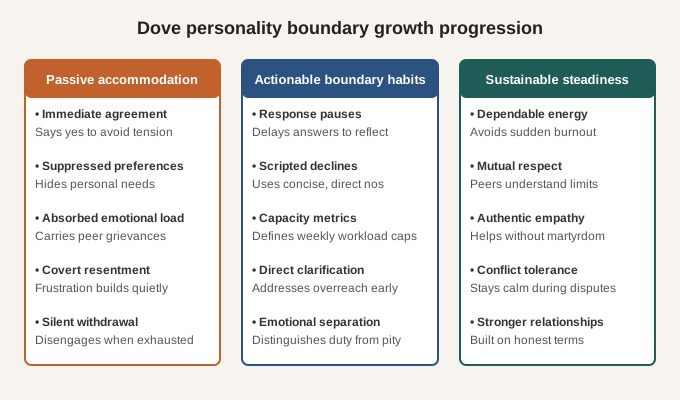
Without conscious boundaries, high-steadiness individuals absorb disproportionate workloads, tolerate disrespectful behavior, and suppress their own valid preferences. Chronic compliance produces physical exhaustion, silent withdrawal, and covert resentment. Learning to set boundaries allows Doves to protect their psychological health while preserving the gentle warmth and loyalty that define their character.
The psychological roots of boundary avoidance in Doves
Doves prioritize relationship preservation over immediate personal comfort. Research in interpersonal psychology, including John Bowlby's attachment theory, demonstrates that individuals with strong communal orientations frequently associate disagreement with relational abandonment. Confronted with an unreasonable request, a Dove's autonomic nervous system treats refusal as an existential threat to social connection.
Conflict avoidance operates as a learned survival strategy rather than a conscious choice. Doves internalize the belief that being agreeable guarantees safety and inclusion. A sudden boundary assertion feels aggressive to someone accustomed to quiet accommodation, even if their response is entirely proportional. Overcoming this instinct requires reframing boundaries from acts of rejection into essential frameworks for long-term relational endurance.
Physiological cues that signal boundary overreach
The human body registers boundary violations before cognitive awareness fully processes the event. Somatic psychology research by Peter Levine indicates that boundary fatigue produces distinct physiological reactions in accommodating personality profiles.
Doves often report tightness across the chest, shallow breathing, or a distinct knot in the upper stomach the moment someone makes an excessive demand. Jaw clenching during phone calls and shoulder tension during one-on-one meetings indicate suppressed objections. Tuning into these somatic indicators allows Doves to recognize boundary breaches in real time rather than discovering their fatigue hours later in isolation.
Core boundary challenges for high-steadiness individuals
Boundary breakdowns among Dove personalities manifest in five distinct operational environments. Each pattern reflects a specific vulnerability inherent to high-agreeableness profiles.
- Automatic agreement during live conversations. Doves frequently say yes before evaluating their calendar, energy levels, or existing commitments. The social pressure of face-to-face interaction triggers their reflex to please the requester, leaving them overwhelmed once the conversation ends.
- Absorbing the emotional distress of peers. High empathy leads Doves to treat other people's crises as personal responsibilities. They spend hours counseling difficult colleagues or relatives, draining their own cognitive reserves while enabling chronic dysfunction in the other person.
- Tolerating chronic deadline and scope creep. Colleagues quickly identify Doves as dependable targets for extra assignments. Because Doves rarely push back publicly, project managers assign them uncredited administrative overflow, assuming the silence indicates spare capacity.
- Substituting silent withdrawal for direct feedback. Rather than expressing frustration when someone crosses an agreed limit, Doves slowly disengage. They stop answering non-critical messages, become emotionally distant, and eventually exit relationships without giving the other party an opportunity to correct the behavior.
- Over-apologizing for legitimate constraints. High-steadiness professionals preface simple logistical refusals with multiple apologies. This habit invites pushback, because aggressive personalities interpret profuse apologies as uncertainty rather than politeness.
Practical boundary frameworks designed for gentle personalities
Standard assertiveness training often instructs participants to use blunt, confrontational phrases. This advice fails for Doves because harsh delivery contradicts their fundamental values and triggers intense anxiety. Effective boundary methods for Doves must preserve their calm demeanour while establishing unambiguous operational limits.
The time-buffer strategy provides immediate relief from conversational pressure. Instead of answering immediate requests on the spot, the Dove implements a standardized response rule: "I need to check my current project commitments before agreeing. I will follow up with an answer by three o'clock." This pause removes immediate social pressure and allows the individual to evaluate their capacity objectively.
The conditional refusal method pairs a limitation with an alternative that protects the relationship. Formulating the decline as "I cannot take on the draft review this week, but I can share the outline template by Friday" establishes the boundary without sounding hostile. The requester receives concrete information about what is possible, eliminating ambiguity while protecting the Dove's schedule.
The broken-record technique proves invaluable against persistent manipulators. Coined in assertiveness literature by Manuel J. Smith, this method involves repeating a calm, neutral phrase without escalation: "I understand this deadline is tight, but I cannot take on this assignment." Refusing to provide elaborate justifications prevents the requester from picking apart excuses or negotiating concessions.
Verbatim boundary scripts for five common workplace situations
Having pre-written responses removes cognitive panic during difficult professional exchanges. Doves can memorize and adapt these specific formulas across standard office dilemmas.
- The sudden end-of-day task dump. "I am wrapping up today's scheduled priorities and cannot begin this tonight. I can review it tomorrow morning at nine."
- The meeting that regularly exceeds its allotted time. "I have a hard stop at two o'clock. I will drop off the call now and catch up on remaining action items via the shared summary document."
- The coworker who tries to offload administrative chores. "My team capacity is fully dedicated to client reports this sprint. You will need to manage the formatting internally or speak with our director about reassigning tasks."
- The intrusive personal inquiry from an office peer. "I prefer to keep my focus strictly on our campaign deliverables during office hours. Let us return to the agenda items."
- The expectation of immediate weekend message responses. "I review project communications during business hours on weekdays. I will address this on Monday morning."
Passive compliance versus assertive boundaries
| Scenario | Typical passive response | Assertive boundary action | Measurable outcome |
|---|---|---|---|
| A teammate requests urgent help on an unassigned project. | Agrees immediately, cancels personal evening plans to finish the task. | States current capacity limits and offers a specific two-hour window tomorrow morning. | Workload remains manageable; teammate respects scheduled time constraints. |
| A family member criticizes personal career or relationship decisions. | Smiles weakly, changes the subject, and stews in frustration for days. | Calmly states that the topic is not open for discussion and redirects the dialogue. | Halts unsolicited commentary; prevents lingering family resentment. |
| A manager adds three administrative tasks during a peak quarter. | Silently absorbs the extra hours without mentioning mounting fatigue. | Requests a priority ranking session to determine which existing tasks must shift back. | Manager recognizes operational bottlenecks; workload stays realistic. |
| A friend calls during work hours to vent personal grievances. | Answers the call out of guilt and struggles to complete assignments. | Sends a brief text explaining focus hours and offers a fifteen-minute call at five. | Protects workday concentration; sets predictable social availability. |
| A neighbor repeatedly borrows household equipment without returning it promptly. | Waits weeks in silence, buying replacement tools out of frustration. | Visits in person, asks for the items directly, and requests return within twenty-four hours. | Retrieves personal property; stops ongoing exploitation. |
| An acquaintance demands an immediate RSVP for an expensive event. | Commits instantly under social pressure, regretting the financial strain later. | Requests forty-eight hours to assess personal budget before providing a firm answer. | Maintains financial sovereignty; avoids impulsive social debt. |
Managing internal guilt after asserting limits
Setting a boundary produces an immediate surge of guilt in high-steadiness individuals. This emotional reaction does not indicate that the boundary was incorrect or selfish. The sensation merely marks the discomfort of breaking an ingrained compliance pattern.
Clinical psychologist Harriet Braiker, author of "The Disease to Please," noted that chronic people-pleasing creates an irrational equation between personal boundaries and moral failure. Recognizing that guilt is a physiological sensation rather than an ethical verdict allows Doves to sit with discomfort without reversing their decision. The intensity of that guilt diminishes noticeably after three to four weeks of consistent boundary enforcement.
Building sustainable boundary habits across key life areas
Progress requires structured, repeatable systems rather than sporadic bursts of willpower. Implementing small, predictable limits in low-stakes environments builds the cognitive resilience needed for high-pressure negotiations.
Workplace capacity management
Doves must establish visible operational parameters before crises occur. Maintaining an updated public task board or calendar signals existing commitments to colleagues without requiring verbal debate. Facing incoming tasks that threaten core deliverables, presenting the conflict to management as a resource allocation problem removes personal emotion: "Taking on Project B means moving the delivery date for Project A to next Tuesday. Please confirm which deliverable takes precedence."
Friendships and social circles
Unbalanced friendships form easily around Doves because self-absorbed individuals gravitate toward patient listeners. Restoring balance requires Doves to monitor conversational reciprocity. An acquaintance who monopolizes discussions without inquiring about the Dove's life should encounter firm time limits, such as a thirty-minute lunch or a scheduled phone call with a predetermined departure time.
Romantic partnerships
In romantic relationships, Doves frequently defer small decisions, including dinner choices, weekend schedules, and budget allocations. Over years, this pattern erodes individual identity and fosters unspoken bitterness. Doves strengthen their partnerships by practicing vocal preference expression in low-stakes situations. Stating clear desires regarding restaurants, leisure time, or household chores trains both partners to expect mutual input.
Long-term behavioral transformation for Doves
Transitioning from chronic accommodation to steady assertiveness transforms a Dove from a vulnerable peacemaker into a resilient anchor. Colleague relationships improve because peers receive honest assessments rather than polite promises that collapse under stress. Personal energy levels stabilize, eliminating the cyclical crashes that follow prolonged overcommitment.
Boundaries do not diminish a Dove's inherent kindness. Clear limits protect that kindness, ensuring that help offered to others stems from authentic generosity rather than fear, obligation, or guilt.
Frequently asked questions
Can a Dove set boundaries without damaging friendships?
Direct communication preserves friendships by preventing hidden resentment from eroding trust over time. Friends who respect your well-being adapt quickly to reasonable constraints when explained calmly without accusation.
How should a Dove respond to an angry reaction after saying no?
Remain calm, maintain a low tone of voice, and resist the urge to apologize for setting a basic limit. Reiterate your decision in one neutral sentence, then conclude the interaction if the other person continues raising their voice.
Why do Doves feel physical exhaustion after mild arguments?
High-steadiness individuals experience intense autonomic nervous system activation during social conflict. Adrenaline spikes and elevated cortisol levels drain physical stamina even when the verbal exchange remains brief.
What is the easiest boundary technique for a beginner Dove?
Instituting a mandatory time delay before agreeing to requests provides the simplest entry point. Telling people that you need to check your schedule creates psychological distance and stops automatic compliance reflexes.
Do boundaries make a Dove personality appear aggressive?
Clear limits delivered in a calm, steady tone communicate professional competence rather than aggression. Observers interpret directness as confidence, especially when paired with the natural courtesy Doves exhibit.
- Developing a Winning Attitude
- Borderline Personality Disorder
- Bird Personality : Changeable Eagle
- 15 Signs You're in a Toxic Relationship (And What to Do)
- Personality Traits Based on Blood Type
- How to Identify Your Personality Type and Use It to Grow Faster
- What Are Temperaments? Understanding the Human Psyche
- Bird Personality : Dove
- Bird Personality : Mild Dove
- Bird Personality : Smart Dove
- Bird Personality : Brave Dove
- Bird Personality : Genius Dove
- Bird Personality : Wizard Dove
- Bird Personality : Reverse Thinking Dove
- Bird Personality : Changeable Dove
- Dove Personality in Relationships: How They Show Love