Can I use a free online personality testing personality testing to understand my work style?
Yes, a free online personality test can absolutely help you understand your work style, as long as you treat the result as a starting point for reflection rather than a verdict on who you are. Tools like the 16Personalities (Myers-Briggs-style) test, the Big Five assessments, or the DISC-based free versions can highlight real patterns in how you communicate, make decisions, and handle stress at work. They just can't tell you the whole story, and they're not a substitute for actual feedback from coworkers or a manager.
I've taken more of these tests than I'd like to admit, usually at 11pm when I should've been asleep, procrastinating on something else entirely. Some of them nailed things about how I work that I hadn't put into words before. Others felt like a horoscope wearing a lab coat. The trick is knowing which parts to trust.
What can a free personality test actually tell you about your work style?
A decent free test can show you tendencies: whether you lean toward structure or spontaneity, whether you recharge through solitude or collaboration, and how you typically react under pressure. These are patterns based on how you answered a set of self-reported questions, not objective measurements of your brain.
Take the 16Personalities test, built on Myers-Briggs theory. If it tells you that you're an "INTJ," what that actually means in practice is that you likely prefer working through problems independently before looping others in, you probably plan several steps ahead rather than improvising, and you might get impatient in meetings that circle without landing anywhere. That's useful. You can bring that insight into a conversation with your manager: "I do my best thinking alone first, then I want to talk it through." That's a concrete, actionable sentence that came out of a 12-minute quiz.
The Big Five model (sometimes called OCEAN, for Openness, Conscientiousness, Extraversion, Agreeableness, and Neuroticism) tends to be more scientifically defensible than Myers-Briggs types, according to decades of psychology research going back to work by Lewis Goldberg in the 1980s and later popularized by Robert McCrae and Paul Costa. It measures traits on a spectrum instead of sorting you into one of 16 boxes, which matches how personality actually behaves in real life. Someone might score high on conscientiousness but only moderate on extraversion, and that combination tells you something specific: they probably deliver reliable, well-organized work but might dread being the one who has to pitch it to a room full of stakeholders.
DISC assessments, meanwhile, focus specifically on workplace behavior: Dominance, Influence, Steadiness, and Conscientiousness. Free versions exist, though the full paid version with detailed breakdowns is more common in corporate training settings. DISC tends to be more directly applicable to office dynamics because it was designed with that context in mind from the start, unlike Myers-Briggs, which grew out of Carl Jung's broader theories of psychological types in the 1920s.
Which free tests are worth your time?
Not all free tests are built the same, and some are basically clickbait dressed up as science. Here's how a few of the most common ones stack up for someone specifically trying to learn about their work habits.
| Test | Cost | Best for | Watch out for |
|---|---|---|---|
| 16Personalities | Free (paid premium report available) | Understanding communication and decision-making style | Results can shift if you retake it in a different mood |
| Big Five / OCEAN (via Truity or similar) | Free basic version | Getting a research-backed baseline of traits like conscientiousness and openness | Less intuitive to apply directly to daily tasks |
| Free DISC assessments | Free, though shorter than paid versions | Seeing how you tend to behave in team settings and under pressure | Free versions often skip the detailed action-plan pages you get in the paid corporate version |
| CliftonStrengths (partial free preview) | Free preview, full report costs around $49-$59 | Identifying what you're naturally good at rather than fixing weaknesses | The free version only gives a taste, not the full 34-theme breakdown |
I'd genuinely recommend taking two different types, like a Big Five test and a DISC-style one, and comparing notes. If both point toward the same conclusion, like "you avoid conflict and prefer written communication over verbal confrontation," that's a signal worth paying attention to. If they contradict each other, that's useful information too. It probably means the test caught you on an off day, or the trait in question is genuinely situational for you.
How reliable are these tests, really?
Free personality tests are self-report questionnaires, which means their accuracy depends entirely on how honestly and consistently you answer, and that's their biggest limitation. You're not being measured by an outside observer; you're describing yourself, which means your mood, your self-image, and even how tired you are that day can shift the results.
The Myers-Briggs framework specifically has taken serious heat from academic psychologists. A widely cited critique published in Psychological Science pointed out that around half of people who retake the test even a few weeks later get sorted into a different type entirely. That's a real problem if you're using it to make hard decisions about your career, but less of a problem if you're just using it to prompt a conversation about how you like to receive feedback.
Big Five research tends to hold up better over time because it measures traits on a continuum rather than forcing you into a category, and there's a lot more peer-reviewed research behind it, going back to the lexical studies of the 1930s through the more rigorous factor-analysis work of the 1980s and 90s. Still, no test, free or paid, can account for context. You might score as introverted, but thrive in a specific team where the dynamic clicks, or feel drained in a "collaborative" open-plan office even though your test results say you're extroverted.
Here's the honest way to think about it: a free test gives you a hypothesis about yourself. It doesn't confirm anything. You confirm it, by testing that hypothesis against your actual experience at work over weeks and months.
How do you actually use the results at work?
The real value isn't the four-letter code or the trait percentages, it's what you do with them afterward. Here's a practical approach:
- Write down three specific behaviors the test flagged, not the label itself. Instead of "I'm an ISFJ," write "I prefer clear written instructions over verbal briefings" and "I get anxious when deadlines change last minute." Labels are forgettable. Behaviors are actionable.
- Cross-check each behavior against a real memory from the last month. Did you actually get flustered when your manager changed a deadline on Tuesday? If yes, the test caught something real. If you can't think of an example, be skeptical of that particular result.
- Pick one insight to test at work this week. If the result says you do better with autonomy, ask your manager if you can skip one status-update meeting and just send a written summary instead. See what happens.
- Share select findings with your team, not the whole report. Saying "I process things better when I get a few minutes to think before responding in meetings" is useful for your coworkers. Dumping your full 16Personalities profile in a Slack channel is mostly just noise.
- Retake a different test in three to six months. If your results stay roughly consistent, you've probably identified a real, stable pattern. If they swing wildly, that trait might be more situational than innate for you.
One thing I'd push back on: don't use these tests to excuse bad habits. "I'm just not a detail person, it's my personality type" is a cop-out, not an insight. Use the results to understand your defaults, then decide which defaults are actually worth working around.
What are the limits you should keep in mind?
Free tests are shorter than their paid counterparts, which means less data and less nuance in the result. The free version of 16Personalities, for example, gives you a solid overview, but the paid premium report digs into career matches and relationship dynamics that the free tier just doesn't cover.
They also can't account for skill or effort. A test might say you're naturally disorganized, but that doesn't mean you can't build systems, use a task manager, or set reminders that compensate for it. Personality tendencies describe a starting point, not a ceiling.
And frankly, some of these free tests are funded by ad revenue or lead generation for career coaching services, which means the incentive is to keep you engaged and clicking, not necessarily to give you the most rigorous psychological assessment available. That doesn't make them useless. It just means you should treat the free quiz the way you'd treat a friend's off-the-cuff read of your personality: probably has some truth in it, definitely not the final word.
Frequently asked questions
Are free personality tests as accurate as paid ones?
Free tests are generally shorter and cover fewer dimensions than paid versions, which means less detail but not necessarily less accuracy for the basics they do measure. A free 16Personalities test and its paid premium report will likely sort you into the same type; the paid version just adds more context around careers and relationships. For understanding general work tendencies, the free version is usually enough.
Can a personality test tell me what job I should have?
No single test can determine your ideal job, but it can highlight work environments and tasks that tend to suit your natural tendencies. For example, a result showing high conscientiousness and low extraversion might suggest roles with independent, detail-oriented work rather than high-pressure sales. Treat it as one input among many, including your actual skills, interests, and market demand.
Why did I get a different result when I retook the same test?
Personality test results can shift based on your mood, recent experiences, and even how you're interpreting the questions that day, especially with Myers-Briggs-style tests. Research on retest reliability found that roughly half of people get a different Myers-Briggs type when retaking it weeks later. Big Five tests tend to be more stable over time because they measure traits on a spectrum instead of forcing binary choices.
Should I share my personality test results with my manager?
Sharing specific, work-relevant insights, like "I focus better with written instructions than verbal briefings," is more useful than handing over your entire report. Managers generally care about how to work with you effectively, not your four-letter type code. Frame it around behaviors and preferences, not labels.
Is Myers-Briggs (16Personalities) scientifically valid?
Myers-Briggs has faced significant criticism from academic psychologists for weak test-retest reliability and forcing continuous traits into rigid categories. The Big Five model is generally considered more scientifically robust because it's supported by decades of factor-analysis research. That said, Myers-Briggs-style tests can still be useful conversation starters even if they're not rigorous diagnostic tools.
How often should I retake a personality test to check for consistency?
Retaking a test every three to six months is a reasonable way to check whether a result reflects a stable pattern or just a temporary mood or situation. If your results stay consistent across two or three attempts spaced out over time, that trait is probably genuine. If they swing significantly each time, treat that particular result with more skepticism.
- 6 Strategies to Become a More Critical Thinker
- The Role of Naturalistic Intelligence in Human Development
- Co-Parenting With Someone Who Has a Difficult Personality
- The Ultimate Guide to Understanding the DISC Personality Test
- How to Deal with Workplace Stress
- Seasonal Affective Disorder (SAD) : Symptoms and Treatment
- How to Increase Your Chances of Success?
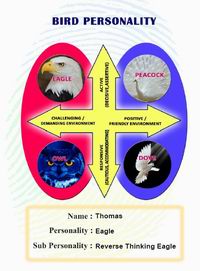
- Bird Personality : Dove
- Bird Personality : Mild Dove
- Bird Personality : Smart Dove
- Bird Personality : Brave Dove
- Bird Personality : Genius Dove
- Bird Personality : Wizard Dove
- Bird Personality : Reverse Thinking Dove
- Bird Personality : Changeable Dove
- Dove Personality in Relationships: How They Show Love