Personality Traits Hiring Managers Actually Look For
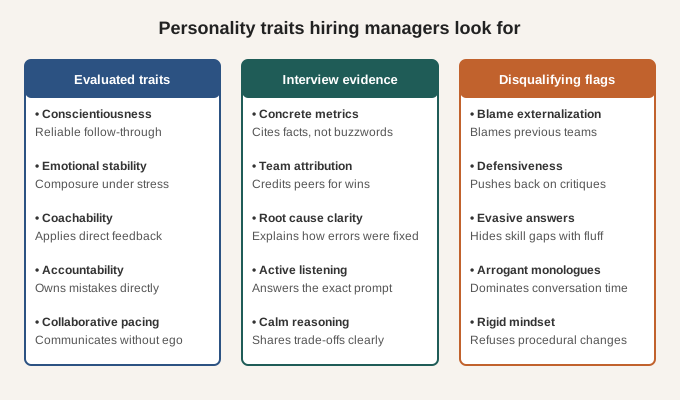
Hiring managers evaluate personality to determine whether an applicant completes assignments autonomously, absorbs critical feedback without defensiveness, and communicates clearly during workplace disruptions. Technical competencies qualify a resume for the initial screening stage, but behavioral stability and dependable execution decide who receives the offer letter. In industrial psychology, research by Frank Schmidt and John Hunter established that general mental ability paired with high conscientiousness provides the highest predictive validity for job performance across major occupational categories, yielding an operational validity coefficient of 0.31.
Candidates often prepare extensively for technical questions while overlooking the behavioral signals they emit during casual conversation. Interviewers assess tone, reaction times to difficult prompts, and the degree of personal ownership applicants take when discussing past mistakes. Understanding which traits hiring teams prioritize allows job seekers to present concrete evidence of professional maturity rather than relying on rehearsed buzzwords.
Conscientiousness and dependable task completion
Conscientiousness reflects personal discipline, meticulous attention to deadlines, and the habit of verifying work before submission. Managers look for individuals who complete projects without requiring constant managerial oversight or reminder messages. In workplace research published by Murray Barrick and Michael Mount in 1991, conscientiousness emerged as the single personality dimension that consistently predicted operational performance across management, sales, engineering, and administrative professions.
During an interview, hiring teams detect conscientiousness through the structure of candidate answers. An organized candidate explains workflows step by step, mentions quality-control measures, and recalls specific deadlines met under challenging conditions. Candidates who speak vaguely about duties without mentioning milestones or verification procedures often struggle with unstructured task loads. A dependable candidate reduces operational risk for a department because leadership does not need to audit basic deliverables.
I have observed hiring committees pass over technically skilled programmers and marketers because their interview stories revealed chaotic record-keeping or frequent missed milestones. Managers prize stability above flashes of brilliant but unpredictable productivity. Demonstrating a methodical approach to daily tasks proves to a hiring manager that projects will move steadily even during high-friction quarters.
Emotional stability during workplace friction
Emotional stability measures a candidate's capacity to maintain composure, analytical focus, and constructive interpersonal behavior when project scopes change or systems fail. Teams face shifting budgets, missed vendor deadlines, and ambiguous instructions on a routine basis. A professional with low emotional stability reacts to these routine disruptions with visible anxiety, anger, or paralysis, which drains collective energy from surrounding colleagues.
Hiring managers probe emotional stability by posing situational scenarios with no clear ideal answer. They may ask how you reacted when an executive canceled a project that consumed three months of labor, or how you responded to an unreasonable client demand. Applicants who pass this assessment describe the operational pivot calmly. They focus on reallocating resources, updating timeline estimates, and communicating realistic next steps rather than complaining about management incompetence.
Resilience also shows up in physiological composure during the interview itself. Candidates with steady emotional regulation pause before answering tough questions, maintain steady breathing, and listen attentively without interrupting the interviewer. This behavioral calm indicates that the applicant can represent the company in front of frustrated stakeholders without escalating tensions.
Coachability and the willingness to integrate feedback
Coachability describes how quickly a professional absorbs corrective feedback and applies operational adjustments without feeling personally attacked. Supervisors spend significant working hours correcting workflows and refining strategy. Working with an employee who responds to routine guidance with defensive arguments or sulking behavior creates severe management fatigue.
Interviewers test coachability by offering mild critiques or requesting alternative solutions during technical tests or portfolio reviews. An interviewer might state that a candidate's proposed marketing schedule looks too aggressive for a lean team. The coachable candidate does not argue reflexively; they acknowledge the observation, ask questions to clarify resource constraints, and adjust the timeline in real time. This exchange demonstrates whether the applicant views criticism as an attack or as collaboration.
Research across leadership development indicates that coachable workers adapt faster to new software systems, company reorganizations, and shifting consumer demands. Hiring a defensive worker risks team paralysis, because supervisors eventually avoid giving necessary feedback to prevent interpersonal drama.
Accountability versus externalized blame
Accountability means accepting personal responsibility for project shortcomings and explaining what concrete adjustments were made to prevent recurrence. Most professional careers involve missed targets, unexpected software outages, or lost client accounts. Experienced hiring managers care far less about the failure itself than about the psychological stance the applicant took in its aftermath.
Interviewers listen for telltale blame-shifting language when asking behavioral failure questions. Candidates who blame previous bosses, incompetent vendors, or difficult coworkers signal poor self-awareness and an external locus of control. These applicants imply that problems originate elsewhere, which means they will likely repeat identical mistakes in their next position.
Accountable applicants present a clear breakdown of the situation: they explain their original hypothesis, the exact point of failure, their personal role in that error, and the operational checklist they implemented afterward. This transparency communicates intellectual honesty. Hiring managers trust people who admit errors because hidden problems cannot be corrected before they damage company revenue.
Collaborative pacing and egoless communication
Collaborative pacing is the ability to coordinate workflows across cross-functional departments without creating communication bottlenecks or hoarding information. Modern organizations rely on interdisciplinary handoffs between engineering, design, legal, and revenue teams. An employee who performs tasks in isolation without updating shared trackers slows down the wider organization.
Hiring managers evaluate interpersonal style by observing how applicants assign credit for past achievements. An applicant who exclusively uses singular pronouns like "I built," "I solved," and "I delivered" when discussing large-scale enterprise projects raises immediate suspicion. Skilled interviewers probe deeper, asking who else contributed to the launch and what disagreements arose during execution.
High performers with strong collaborative pacing speak generously about their team members. They describe how peer reviews caught critical bugs, how junior analysts provided essential baseline research, and how cross-departmental partners resolved logistical hurdles. This humility shows that the candidate builds alliances rather than creating isolated silos.
Personality traits versus interview red flags
Hiring decisions hinge on identifying distinct behavioral contrasts between sustainable candidates and high-risk applicants. The following comparison table outlines the five evaluated traits, their positive interview expressions, disqualifying warning signs, and corresponding profiles within the DOPE bird framework.
| Personality trait | Positive interview signal | Disqualifying warning sign | DOPE / DISC archetype |
|---|---|---|---|
| Conscientiousness | Describes specific milestones, QA checklists, and verification routines. | Provides vague generalities about work habits and misses basic interview follow-ups. | Owl (High Conscientiousness) |
| Emotional stability | Maintains composure when asked stressful situational questions without irritation. | Becomes defensive, talks over the interviewer, or expresses visible frustration. | Dove (High Steadiness) |
| Decisive initiative | Presents clear examples of identifying problems and executing solutions autonomously. | Waits passively for direct instructions before taking action on obvious bottlenecks. | Eagle (High Dominance) |
| Coachability | Listens attentively to critiques and adjusts answers cooperatively in real time. | Argues reflexively, justifies flaws, or reacts with visible resentment to feedback. | Dove / Owl blend |
| Collaborative influence | Credits colleagues for shared wins and frames projects as cross-functional successes. | Monopolizes dialogue, claims exclusive credit, and talks disparagingly about past peers. | Peacock (High Influence) |
Candidate behavioral patterns mapped to the DOPE bird framework
The DOPE personality framework categorizes workplace behavior into four distinct bird archetypes: Eagle, Peacock, Dove, and Owl. These archetypes correlate directly with the DISC assessment developed by William Moulton Marston. Hiring managers intentionally build balanced teams that combine these behavioral profiles to match operational requirements.
Eagle candidates demonstrate high dominance and results-oriented drive. They address challenging problems directly, state clear revenue goals, and push projects through bureaucratic obstacles. In interviews, hiring managers value Eagle candidates for turnaround roles or ambitious sales targets. The risk hiring managers screen for in Eagles is interpersonal abrasiveness or an unwillingness to listen to dissenting opinions from junior staff.
Peacock candidates exhibit high influence, optimism, and verbal persuasiveness. They excel in client-facing environments, brand evangelism, and team motivation. During interviews, Peacocks present their stories with captivating energy and clear social warmth. Hiring managers evaluate whether this expressive enthusiasm is backed by meticulous documentation and concrete follow-through, or whether the candidate relies on charm to cover procedural gaps.
Dove candidates reflect high steadiness, patience, and team loyalty. They excel in customer support, cross-functional mediation, and long-term project stewardship. In interview settings, Doves come across as calm, respectful, and reliably cooperative. Hiring managers verify whether Dove applicants can make tough, time-sensitive decisions independently without waiting for unanimous consensus from all parties.
Owl candidates represent high conscientiousness, analytical rigor, and methodological precision. They thrive in software engineering, financial accounting, legal compliance, and systems architecture. In interviews, Owls provide meticulous documentation and exact data points. Hiring managers assess whether an Owl candidate can balance perfectionism with business speed, avoiding paralysis when working with incomplete datasets.
Practical strategies to demonstrate strong traits in interviews
Candidates can actively demonstrate these evaluated traits through specific behavioral adjustments during the recruitment process. First, prepare failure stories using a structured three-part formula: the operational error, the immediate mitigation step, and the long-term system installed to prevent repetition. This eliminates any perception of defensiveness and demonstrates self-directed accountability.
Second, incorporate measurable data into your interview responses. Rather than stating that you managed client onboarding efficiently, state that you reduced client onboarding churn from 14 percent to 6 percent across six months by introducing a weekly milestone tracker. Concrete numbers provide objective evidence of conscientiousness and analytical rigor.
Third, ask substantive questions about internal communication processes at the end of the interview. Inquire about how the engineering and product teams resolve conflicting sprint priorities, or how the department handles post-mortem reviews after a delayed launch. These questions signal emotional maturity, collaborative curiosity, and an understanding of real organizational dynamics.
Frequently asked questions
Can an introverted candidate demonstrate leadership traits in an interview?
Introverts demonstrate leadership traits by presenting analytical preparation, clear written communication, and steady one-on-one team support. Hiring managers value quiet competence that resolves systemic bottlenecks without unnecessary political posturing. Framing past projects around structured problem-solving shows organizational command regardless of social volume.
How do interviewers distinguish authentic confidence from arrogance?
Interviewers evaluate whether an applicant credits coworkers and acknowledges personal knowledge boundaries. Confident candidates state past results clearly while freely admitting what they do not know. Arrogant applicants claim sole credit for complex projects, dismiss alternative viewpoints, and react defensively when pressed for technical details.
What is the most effective way to answer questions about past failures?
The most effective approach is to state the specific operational mistake directly without blaming external factors or colleagues. Follow that description by detailing the corrective actions taken immediately and the preventative systems installed afterward. This demonstrates high accountability and practical coachability.
Do personality traits matter more than technical skills in hiring decisions?
Technical skills determine whether an applicant meets the minimum qualifications for an open role. Personality traits determine whether the candidate can apply those skills collaboratively within an existing department under high-pressure conditions. Most final hiring rejections stem from behavioral mismatches rather than technical deficiencies.
Can an applicant improve their perceived conscientiousness before an interview?
Applicants show conscientiousness through punctuality, concise resume formatting, and detailed post-interview follow-ups that address specific topics discussed during the meeting. Bringing organized notes and referencing company metrics accurately proves thorough preparation and reliable work habits.
- How to Bond With a Child Whose Personality Is Different From Yours
- Introduction to Criminal Psychology
- Personality Tests Used for Hiring
- Good Mental Health Vs Poor Mental Health
- Difference Between Stress and Depression
- Surviving the Holidays: Coping with Emotional Triggers
- Helping Your Child Reach Their Full Potential
- Bird Personality : Dove
- Bird Personality : Mild Dove
- Bird Personality : Smart Dove
- Bird Personality : Brave Dove
- Bird Personality : Genius Dove
- Bird Personality : Wizard Dove
- Bird Personality : Reverse Thinking Dove
- Bird Personality : Changeable Dove
- Dove Personality in Relationships: How They Show Love