How Birth Order Affects Sibling Personality Differences
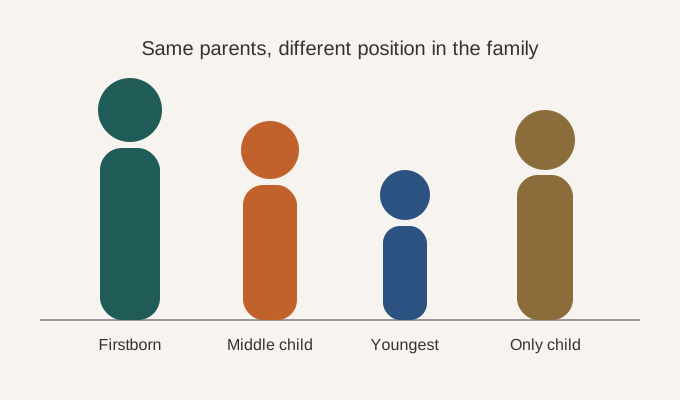
Birth order has a much smaller effect on personality than popular books suggest. Large studies using hundreds of thousands of participants find no meaningful differences between firstborns, middle children, and youngest children on the Big Five traits, though firstborns score slightly higher on intelligence tests and people strongly believe in the stereotypes anyway.
I am the youngest of three, and I have been told my whole life that I am the funny, spoiled, rule-bending one. I am funny on a good day. I also pay my bills on time, which does not fit the "baby of the family" script. My older sister, supposedly the responsible firstborn, once lost a passport three days before a wedding abroad. That mismatch made me curious about the evidence, and the evidence turned out to be messier than the stereotypes.
What does birth order theory say about personality?
The theory says that your position among your siblings shapes your role in the family, and that role shapes your personality. Alfred Adler, an Austrian psychiatrist, proposed this in the 1920s and 1930s. He described firstborns as "dethroned" when a sibling arrives, middle children as competitive, and the youngest as pampered.
The popular version has hardened into a set of labels that most people can recite.
| Position | Common stereotype | What large studies find |
|---|---|---|
| Firstborn | Responsible, conscientious, bossy | No reliable Big Five difference; slightly higher IQ scores on average |
| Middle child | Peacemaker, independent, overlooked | Little research focuses on this group; no consistent personality signature |
| Youngest | Charming, funny, rebellious | No reliable difference in extraversion or agreeableness |
| Only child | Spoiled, lonely, mature for their age | No consistent difference in social skills or personality |
Is there scientific evidence for birth order effects?
Early studies and one famous book found effects, but the largest and best-controlled studies since 2015 have not. Frank Sulloway, a historian of science, published Born to Rebel in 1996, arguing that firstborns are more conscientious and conservative while later-born children are more open to new ideas and more likely to back scientific revolutions. His analysis covered thousands of historical figures and many studies, and it made birth order respectable again.
Critics found problems. Jeremy Freese, Brian Powell, and Lala Carr Steelman reanalyzed Sulloway's social attitudes data in 1999 for the American Sociological Review. They found the birth order effects were inconsistent, and that many appeared in comparisons between families, where birth order is tangled up with family size and social class.
The decisive evidence came in 2015. Rodica Damian and Brent Roberts analyzed data from about 377,000 American high school students in the Project Talent sample, looking at the Big Five-related traits. The effects were close to zero. The same year, Julia Rohrer, Boris Egloff, and Stefan Schmukle published a paper in the Proceedings of the National Academy of Sciences using about 20,000 people in the United States, Britain, and Germany. They found no effect of birth order on extraversion, emotional stability, agreeableness, conscientiousness, or imagination. They found a small advantage for firstborns on intellect.
Do firstborns really have higher intelligence?
Slightly. The best-known evidence comes from Norway, where Petter Kristensen and Tor Bjerkedal studied more than 240,000 military conscripts and reported in Science in 2007 that firstborn men scored about 2.3 IQ points higher than second-born men. The gap was larger still against third-born men.
A 2.3 point gap is small. IQ tests have a standard deviation of 15 points, so the difference is about 15 percent of that spread. You cannot tell a person's birth order by how clever they are, and the average advantage is far smaller than the difference between a good school and a bad one.
The same Norwegian data gives a hint about the cause. Men who became the oldest surviving child after an older sibling died scored like firstborns. That points to the social role in the family, such as being the one who explains things to younger siblings and gets undivided attention in the early years, and away from anything biological about being born first.
Why do siblings turn out so different?
Siblings differ because genes shuffle at conception and because each child lives a different version of the family. Biological siblings share about half their DNA on average, but a sibling's personality similarity is lower than most people expect. Robert Plomin and Denise Daniels reviewed this in 1987 and found that personality correlations between siblings raised together were about .20, and close to zero for adopted siblings.
The environment is not the same for each child either. A firstborn has parents with no practice and a lot of anxious attention. A second child grows up with a sibling who competes for the same toys and a more relaxed set of parents. A child born during a layoff or a parental divorce faces a different household from one born during a promotion. Researchers call this the non-shared environment, and it explains more of the differences between siblings than their rank in the line-up does.
The age gap matters too, probably more than rank. A sibling born 8 years later often grows up like a firstborn in a family of two, with a role as the parents' only child at home for years. Birth order labels do not capture that.
Why do people still believe in birth order stereotypes?
People believe them because they fit memory, they are easy to say, and everyone has anecdotes. If you have an older sister who is bossy, you remember the bossy parts, and you forget the times she was neither bossy nor responsible. This is confirmation bias, and families reinforce it by assigning roles. A parent who calls the oldest "the responsible one" for twenty years makes responsibility part of how that child sees herself.
The role effect is real even if the trait effect is not. If your parents expect the youngest to be the joker, the youngest may play that part at family dinners without having a different personality at work. I think that is what happened with me. I behave one way around my sisters and another way in an office.
Delroy Paulhus, Paul Trapnell, and David Chen reported in a 1999 Psychological Science paper that birth order differences appeared mainly when people described themselves in the context of their family. Outside that frame, the differences faded. The family sees a pattern, and the pattern does not travel far beyond the family.
How do bird personality types relate to birth order?
No study connects the dove, owl, peacock, or eagle types to birth order. Treat any claim that "most firstborns are eagles" as folklore. The behaviors that define each bird type (dominance, expressiveness, steadiness, and precision) come from your temperament and your life experience, not from your position at the dinner table.
What birth order can do is shape which behaviors you were rewarded for. A dove in a family of strong-willed eagles may learn to keep the peace, and the same dove in a quiet household might speak up more. You can find your own pattern with the bird personality test, and compare it with your siblings' results. The differences between siblings are often more informative than the similarities.
What should parents do with this information?
Treat each child as an individual and avoid fixed labels. Describing one child as "the smart one" and another as "the sporty one" can lock them into a role, and children often live up or down to the label.
- Spend one-on-one time with each child, including the middle child, who often gets the least of it.
- Avoid comparing siblings out loud, even in a positive way, since the child who loses the comparison remembers.
- Give older children responsibility that matches their age and does not turn them into a third parent.
- Notice when the youngest is being excused from rules that the older children had to follow, and ask whether that serves them.
Frequently asked questions
Does birth order affect personality?
Not in a way that large studies can detect. A 2015 analysis of about 377,000 American high school students by Damian and Roberts found effects near zero, and a second 2015 study of about 20,000 people in three countries found no effect on the Big Five traits. The only consistent finding is a small intelligence advantage for firstborns.
Are firstborns more successful?
Firstborns have a slight edge in education and test scores in several large datasets, including Norwegian military records showing about a 2.3 IQ point gap over second-born men. That difference is small compared with the effect of family income or schooling. It does not mean firstborns are more capable of success.
What is middle child syndrome?
Middle child syndrome is a popular label for the idea that middle children feel overlooked, and it is not a clinical diagnosis. Middle children do sometimes get less one-on-one attention, because the oldest has milestones and the youngest has the "last baby" status. Research has not found a consistent personality pattern in middle children.
Do only children turn out spoiled or lonely?
Studies do not support that. Reviews of research on only children, including work by Toni Falbo and Denise Polit in the 1980s, found little or no difference in personality or social adjustment compared with children who have siblings. Only children do tend to score a little higher in achievement motivation.
Why are my siblings so different from me?
Siblings share about half their genes on average and have different experiences, friends, and family circumstances at each age. Personality correlation between biological siblings is only about .20, so large differences are normal. Birth order accounts for very little of it.
Does the age gap between siblings matter?
It likely matters more than rank. A gap of five years or more often makes the younger child grow up in a different family situation from the older one, with different parental finances, stress, and attention. Researchers have studied the age-gap effect less than birth order, so the evidence is thinner.
- Bird Personality : Brave Owl
- Toxic Relationship Signs Most People Ignore Until It's Too Late
- How to Shape a Positive and Confident Personality in Your Pet Bird
- Personality Traits Common in People-Pleasers
- Toxic Relationship Signs With Parents: What to Watch For
- Understanding the Signs That Someone Likes You
- Bird Personality : Smart Dove
- Bird Personality : Dove
- Bird Personality : Mild Dove
- Bird Personality : Smart Dove
- Bird Personality : Brave Dove
- Bird Personality : Genius Dove
- Bird Personality : Wizard Dove
- Bird Personality : Reverse Thinking Dove
- Bird Personality : Changeable Dove
- Dove Personality in Relationships: How They Show Love