Free Personality Traits Checklist You Can Print and Use
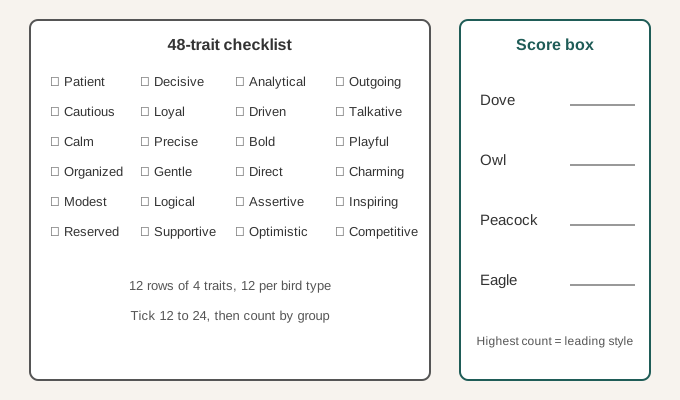
This free personality traits checklist lists 48 traits in a single table. Tick every word that describes you most of the time, count your ticks against the answer key below, and the group with the highest count shows your leading bird type: Dove, Owl, Peacock, or Eagle. It takes about five minutes, and you can print this page straight from your browser.
The checklist is informal. It is built on the four-style DOPE model that this site uses, not on a clinically validated instrument, so treat the result as a prompt for reflection. The sections after the checklist explain how to score it, how to read ties, and what the exercise can and cannot tell you.
How do you use the personality traits checklist?
Work through the table once, quickly, and tick each trait that describes how you usually behave. Use your ordinary self, not the version you are at your best or worst, and not the person you wish you were. Fast answers are more honest than careful ones.
- Print the page or copy the table. In your browser, press Ctrl+P (Cmd+P on a Mac) and choose "Print", or "Save as PDF" if you prefer a digital copy. The table fits on one page in portrait orientation.
- Think of the last three months. Picture a typical week at work or home. A trait counts if it describes you in most of those weeks.
- Tick between 12 and 24 traits. If you tick fewer than 12, you are being too strict, and if you tick more than 24, you are probably including aspirations. Go back and remove the weakest ones.
- Do not look at the answer key yet. Knowing which words belong to which type will bias your ticks.
The 48-trait checklist
| Column 1 | Column 2 | Column 3 | Column 4 |
|---|---|---|---|
| ☐ Patient | ☐ Decisive | ☐ Analytical | ☐ Outgoing |
| ☐ Enthusiastic | ☐ Cautious | ☐ Loyal | ☐ Competitive |
| ☐ Precise | ☐ Calm | ☐ Driven | ☐ Talkative |
| ☐ Supportive | ☐ Persuasive | ☐ Impatient | ☐ Systematic |
| ☐ Bold | ☐ Good listener | ☐ Optimistic | ☐ Organized |
| ☐ Expressive | ☐ Detail-oriented | ☐ Gentle | ☐ Independent |
| ☐ Direct | ☐ Agreeable | ☐ Reserved | ☐ Sociable |
| ☐ Logical | ☐ Playful | ☐ Demanding | ☐ Dependable |
| ☐ Modest | ☐ Strong-willed | ☐ Spontaneous | ☐ Perfectionist |
| ☐ Charming | ☐ Peacemaker | ☐ Skeptical | ☐ Risk-taking |
| ☐ Results-focused | ☐ Thorough | ☐ Inspiring | ☐ Empathetic |
| ☐ Methodical | ☐ Animated | ☐ Assertive | ☐ Cooperative |
How do you score the checklist?
Match each trait you ticked to the group it belongs to in the table below, and write down your count for each group. The highest count is your leading style. The second-highest is usually the style you shift into under pressure or at work.
| Bird type | The 12 traits in this group | Your count |
|---|---|---|
| Dove | Patient, loyal, calm, supportive, good listener, gentle, agreeable, dependable, modest, peacemaker, empathetic, cooperative | |
| Owl | Analytical, cautious, precise, systematic, organized, detail-oriented, reserved, logical, perfectionist, skeptical, thorough, methodical | |
| Peacock | Outgoing, enthusiastic, talkative, persuasive, optimistic, expressive, sociable, playful, spontaneous, charming, inspiring, animated | |
| Eagle | Decisive, competitive, driven, impatient, bold, independent, direct, demanding, strong-willed, risk-taking, results-focused, assertive |
What do your results mean?
A clear lead of four or more ticks suggests a dominant style. A spread where two groups are within two ticks of each other suggests a blend, which is the most common outcome. Very few people tick traits from only one group.
- Dove-leading results point to a patient, steady person who puts harmony first and may struggle to say no. The usual growth area is speaking up before resentment builds.
- Owl-leading results point to someone who values accuracy and planning. The usual growth area is deciding with incomplete information.
- Peacock-leading results point to an energetic, social person who wins people over quickly. The usual growth area is follow-through on details.
- Eagle-leading results point to a direct, goal-driven person who takes charge. The usual growth area is listening before acting.
I would pay as much attention to the traits you ticked from your lowest group as to your top group. If you scored low on the Dove list but ticked "loyal" and "good listener", that says something specific about you that a four-letter label would hide.
What does each bird type look like in daily life?
Seeing the traits in a concrete setting makes the scoring easier to trust. Picture the same event, a last-minute change to a team deadline, and the usual reaction of each type.
The Eagle asks who owns the decision and starts reassigning tasks within minutes. The Owl asks for the new requirements in writing and rebuilds the schedule in a spreadsheet. The Peacock calls a quick meeting to raise morale and talk through options out loud. The Dove checks that everyone on the team is coping and quietly takes on extra work to keep things moving.
None of these reactions is wrong, and a good team needs all four. If your own reaction matches one of them more than the others, that supports your tick count. If it matches none, you may be a blend, or the situation may call out a style you do not use often.
How accurate is a personality traits checklist?
A simple checklist like this one is a rough guide. It shows how you see yourself, and self-perception is useful but biased. The traits are also positively worded, so almost everyone can find twenty flattering words that fit.
That bias has a name. In 1949, psychologist Bertram Forer gave 39 students the same generic personality description, told each it was written for them, and asked them to rate its accuracy from 0 to 5. The average rating was 4.26. The effect is called the Forer or Barnum effect, and it is why you should be skeptical of any result that feels perfectly right on first read.
For stronger evidence, look to the Big Five model, which is the most widely tested framework in personality psychology. It measures openness, conscientiousness, extraversion, agreeableness, and neuroticism on scales from low to high, and decades of research link those scores to job performance, health, and relationship outcomes. This checklist does not replace that kind of assessment. It gives you vocabulary to start the conversation with yourself.
How can you get a more reliable result?
Take the same checklist twice, a week apart, and see whether the counts hold. Then ask two people who know you well to tick the traits they would pick for you. Compare their lists with yours. The traits that appear on all three lists are the ones to trust, and the traits only you ticked are the ones you may be telling yourself.
You can also run a longer questionnaire. The DOPE personality test asks scenario questions instead of letting you pick flattering words, which reduces the bias a checklist has. Our bird personality test uses a different format and a second result to compare.
What can you do with your results?
Use the counts to pick one behavior to work on. A Peacock who ticked "talkative" and "spontaneous" and nothing from the Owl list might commit to writing down every promise made in a meeting. An Owl who ticked "perfectionist" and "cautious" might set a deadline for a decision and stick to it, even with 80 percent of the information.
The results are also useful in teams. If everyone in a department completes the checklist, the group can see where the mix is thin. A team of six Eagles and a Dove probably argues more than it plans, and the Dove probably knows it. Showing the numbers gives that person a way to say so.
Keep the sheet. Re-do it in six months. Changes in your counts, especially after a job change, a move, or a major event, show how much of your style is a habit and how much is a fixed preference.
Frequently asked questions
Is this personality traits checklist free to print?
Yes. Use your browser's print command, Ctrl+P on Windows or Cmd+P on a Mac, and choose a printer or "Save as PDF". The table fits on one portrait page. You may print as many copies as you like for personal, classroom, or team use.
How many traits should I tick?
Tick between 12 and 24 out of the 48. Fewer than 12 suggests you are being too strict, and more than 24 suggests you are ticking traits you want to have. Remove the weakest ones if your total is high.
What if my scores are tied between two groups?
A tie is common and indicates a blend of styles. Look at the context: many people lean one way at work and another at home. The tied groups describe both of your modes, and you can use either set of growth areas.
Is a checklist as reliable as a personality test?
No. A checklist depends on self-image, and positive words are easy to tick. A scenario-based test or a validated Big Five questionnaire is more reliable. Use the checklist as a quick starting point and compare it with another source.
Can personality traits change over time?
Yes, gradually. Traits tend to be stable over short periods and shift over years, usually toward more conscientiousness and emotional stability with age. Retaking the checklist after a few months or a major life change can show whether your ticks have moved.
Can I use this checklist for hiring?
No. It is not a validated hiring tool and should not be used to screen candidates. Employers who use personality assessments should choose instruments with published evidence of validity and apply them alongside structured interviews.
- Bird Personality : Dove
- Bird Personality : Mild Dove
- Bird Personality : Smart Dove
- Bird Personality : Brave Dove
- Bird Personality : Genius Dove
- Bird Personality : Wizard Dove
- Bird Personality : Reverse Thinking Dove
- Bird Personality : Changeable Dove
- Dove Personality in Relationships: How They Show Love