Eagle Personality in Relationships: What to Expect
An Eagle in a relationship is decisive, direct, and protective. Expect them to take charge of planning, money, and problem-solving without being asked, to say what they think plainly, and to show love through action more than through talk. Partners usually get stability and honesty, and sometimes get steamrolled.
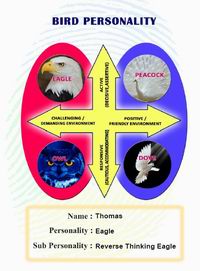
In the DOPE framework used on this site, the Eagle is the dominant, goal-driven type, close to the "D" in DISC. DISC traces back to William Moulton Marston's 1928 book Emotions of Normal People, and DOPE adapts the same four-style idea into bird types. Both describe behavioral tendencies, not diagnoses, and plenty of Eagles behave very differently at home than at work.
What is an Eagle personality like in a relationship?
An Eagle partner makes decisions quickly, dislikes long discussions that circle without a conclusion, and treats problems as things to be solved today. They are competitive, including in small matters like who parks better, and they tend to carry a private list of goals for the couple: the house, the savings number, the trip, the promotion.
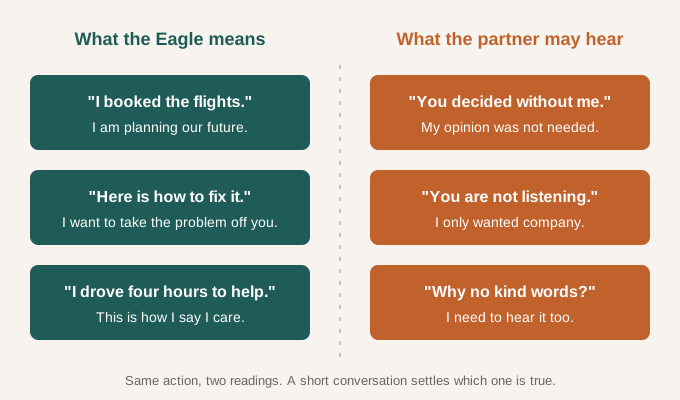
They are also loyal in a practical way. An Eagle will drive four hours to help your sister move and will not mention it again. The same Eagle may forget to ask how you felt about your sister's news.
Eagles dislike feeling dependent. That shows up as reluctance to say "I need you" or "I was hurt," even when it is true. The reluctance does not mean they feel nothing. It usually means they have not found a way to say the feeling that does not seem like losing.
How does an Eagle show love?
An Eagle shows love by doing things: fixing the car, booking the dentist, paying off your loan, planning the anniversary weekend down to the restaurant reservation. If you take the love language quiz, many Eagles land on acts of service or quality time, though some score high on words of affirmation and are simply bad at saying them out loud.
The gap is in translation. An Eagle thinks "I booked the flights" means "I love you and I'm thinking about our future." Their partner may hear "I made a decision without asking." Both readings are plausible, and only a conversation settles which one is right.
Eagles also show love by protecting. They step between you and an aggressive relative, argue with a landlord on your behalf, and take hard phone calls. This is a real strength. It becomes a problem only when the protecting turns into speaking over you.
Where do Eagle relationships get strained?
Strain tends to come from the same four behaviors, and none of them require bad intent. The table pairs each one with how a partner typically reads it and a swap that works better.
| Eagle behavior | How a partner may read it | A swap that works |
|---|---|---|
| Decides alone to save time | "My opinion does not count." | Ask one question before deciding: "Any objection to this plan?" |
| Offers a fix when you vent | "You are not listening." | Ask, "Do you want advice or just company?" |
| Argues to win | "I have to give in to end this." | Restate the other person's point before disagreeing with it |
| Rarely apologizes first | "I always have to repair things." | Say "I was wrong about that part" within a day of the argument |
The fourth row is the hardest for most Eagles, and I understand why. An apology feels like conceding a point. In a long relationship it works the other way, because the partner who can say "I was wrong" is the one whose later disagreements get taken seriously.
How does conflict research apply to Eagles?
John Gottman's research at the University of Washington identified four behaviors that predict relationship breakdown: criticism, contempt, defensiveness, and stonewalling. Eagles are most at risk of the first two, since bluntness can slide into criticism of the person ("you are careless") instead of the behavior ("the bill was late"), and impatience can turn into eye-rolling.
Gottman also found that stable couples had roughly five positive interactions for every negative one during conflict. For an Eagle, this has a practical translation: after a tense exchange, spend a few minutes on something warm. Make coffee, touch their shoulder, thank them for a specific thing they did that week. This is an action, which suits an Eagle, and it counts.
What happens when an Eagle pairs with each type?
Pairing is not destiny, and plenty of Eagle and Eagle couples are happy, but the friction points are predictable.
| Pairing | What usually works | What usually causes trouble |
|---|---|---|
| Eagle and Dove | The Dove's patience balances the Eagle's speed | The Dove stops stating needs, and the Eagle mistakes quiet for agreement |
| Eagle and Owl | Both value competence and respect plain talk | The Eagle wants a decision now and the Owl wants more data first |
| Eagle and Peacock | Shared energy, lots of plans, fun socially | Competition for the spotlight, and the Eagle may find the Peacock scattered |
| Eagle and Eagle | Direct communication, shared ambition | Power struggles over small decisions, and neither wants to apologize first |
The Eagle and Dove pairing deserves a closer look because it looks smooth from outside. The Dove avoids conflict, so the Eagle meets little resistance, and the Eagle reads this as harmony. Meanwhile the Dove stores resentment. Years later the Dove leaves, and the Eagle is baffled because "we never fought."
Six tips for dating or marrying an Eagle
- State your preference early and in one sentence. "I'd rather not move this year" works better with an Eagle than a long hint. They respond to clear input and miss subtle signals.
- Pick a calm moment for hard topics. Raising a grievance in the middle of an Eagle's workday puts them in problem-solving mode, and they will treat your feelings as a task.
- Tell them what you want from the conversation. "I need you to listen for ten minutes without fixing anything" gives an Eagle a clear assignment, which they can follow.
- Do not match their volume. Eagles escalate when they meet resistance. A steady, lower voice usually ends an argument faster than a louder one.
- Notice the actions. If you only wait for words, you may miss that the Eagle has been showing care all week through errands and plans.
- Hold the line on respect. Directness is fine. Contempt, name-calling, and silent treatment as punishment are not personality traits, and you are allowed to say so.
Six tips for Eagles who want a stronger relationship
- Ask before announcing. The decision may still go your way, but your partner will have had a say in it.
- Repeat back what you heard. "So you felt ignored at the dinner" costs ten seconds and prevents an hour of argument.
- Schedule non-goal time. A walk without a destination or a meal with no agenda trains you to be present when nothing needs fixing.
- Say the soft sentence once a week. "I'm glad you're here" or "I missed you today" does not need to be eloquent.
- Apologize in under a day. Waiting longer lets your partner build a case against you in their head.
- Let your partner win occasionally on something real. Choose the restaurant, the vacation, or the paint color, and leave it alone afterward.
Is the Eagle partner the "alpha" of the relationship?
I dislike that framing. It treats the Eagle's pace as leadership and other people's as following, when most couples run better with decisions shared by domain: one person handles the budget, the other plans the social calendar, and both know the rules. An Eagle who needs to be "the alpha" has confused control with competence.
Some Eagle partners are exactly the stable, decisive presence an anxious partner needs. The trait itself is neutral. The Eagle's treatment of the people who disagree with them decides whether it works.
What to expect over the long run
The couples who do well over decades tend to be the ones where the Eagle learned to ask and the partner learned to say what they wanted out loud. Neither change is dramatic. Both are small habits repeated for years, and the loyalty that was there from the start does the rest.
If you want a baseline, the DOPE test will tell you where you and your partner each lean. Compare the results over dinner and see where your first reaction to a problem differs. That single difference explains most arguments about money, schedules, and household chores.
Frequently asked questions
Are Eagle personalities good in relationships?
Yes, when they learn to ask for input and apologize quickly. Eagles bring reliability, honesty, and a drive to build a shared future. Problems come from speed and bluntness, both of which can be adjusted with habits like asking one question before deciding.
Why does my Eagle partner never apologize?
Many Eagles experience an apology as losing a point, so they delay it or replace it with an action, like doing a favor. Tell them directly that you need the words, and give them a short script such as "I was wrong about that part." Most Eagles can say it once they know it is expected.
What is the best match for an Eagle personality?
No pairing is best. Doves and Owls balance the Eagle's speed but need to state their own needs clearly, and Eagle and Eagle couples share ambition but argue over control. Communication habits predict satisfaction better than bird type does.
Do Eagles fall in love quickly?
Often they decide fast and commit fast, because they treat a relationship like any other goal once they have chosen it. Their feelings may be quieter than a Peacock's, so a slow-talking Eagle is not necessarily uninterested. Watch what they do over the first three months.
How do you argue with an Eagle without making things worse?
State your point in two sentences, avoid raising your voice, and say what outcome you want. Eagles respond to clarity and push back against vague complaints. If the argument heats up, agree to resume in an hour instead of forcing a resolution.
Can two Eagles have a healthy relationship?
Yes, if they divide decision areas and agree on a rule for who apologizes first. Both partners value directness, so honest conversations come easily. The risk is turning minor decisions into contests, which a clear division of responsibilities prevents.
- Bird Personality : Brave Eagle
- The Impact of Alexithymia on Mental Health and Relationships
- Managing Your Personal Development
- What is Somatic Therapy
- Self-Forgiveness 101: Understanding the Concept and How to Practice It for a Better Life
- How to Make a Career Change Without Losing Momentum
- Bird Personality : Mild Peacock