Personality Traits and Their Link to Sleep Habits
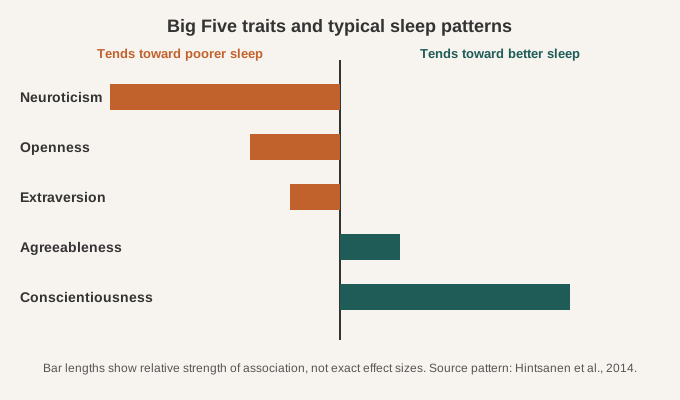
Personality traits are linked to sleep in measurable ways. High neuroticism goes with poorer sleep quality and more trouble falling asleep, while high conscientiousness goes with better sleep and an earlier schedule. The links are modest, not deterministic, and they leave plenty of room for habits to override temperament.
Sleep is also one of the easier places to act on what you know about yourself. If you tend to lie awake replaying conversations, or you stay up late finishing "one more task," the pattern probably has a trait behind it and a habit that feeds it.
Which personality traits affect sleep the most?
Neuroticism and conscientiousness show the most consistent relationships. In 2014, Mirka Hintsanen and colleagues published a study in Health Psychology that followed adults in two Finnish cohorts and found that higher neuroticism was associated with more sleep problems, such as difficulty falling asleep and waking up tired, while higher conscientiousness was associated with fewer problems. Extraversion and agreeableness showed weaker associations.
The reasons are fairly practical. A person high in neuroticism tends to ruminate, which raises arousal at the moment the body is supposed to wind down. A person high in conscientiousness tends to keep a routine, and a regular schedule is one of the best-supported predictors of good sleep.
| Big Five trait | Typical sleep tendency | Common sleep trap | Useful adjustment |
|---|---|---|---|
| High neuroticism | Longer time to fall asleep, lighter sleep | Replaying the day or planning tomorrow in bed | Write worries on paper two hours before bed |
| High conscientiousness | Regular schedule, earlier bedtime | Cutting sleep to finish a to-do list | Put bedtime on the calendar like a meeting |
| High extraversion | Later, more variable schedule | Late evening social events that shift the whole week | Keep wake time fixed, even after a late night |
| High openness | Often later chronotype, irregular hours | Staying up to read, create, or explore ideas | Set a hard stop for screens and projects |
| High agreeableness | Slightly better sleep in some studies | Staying up to answer other people's requests | Mute messages after a set hour |
Are morning people more conscientious?
Yes, on average. Researchers who study chronotype, the natural tendency to be a morning or evening person, have repeatedly found that morning types score higher on conscientiousness, and evening types score higher on openness and, in some samples, on neuroticism. The correlations are small to moderate, so plenty of conscientious people are night owls and the reverse.
One reason may be that the world runs on morning schedules. Evening types often live in a slight mismatch with school and work, sometimes called social jetlag, and they build up a sleep debt on weekdays that they repay on weekends. A conscientious person at 6 a.m. may simply be an evening person who has learned to cope, and the personality score might reflect the coping.
The bird type is a separate matter. An Owl in the DOPE model is the analytical, detail-oriented type, and the name says nothing about whether you stay up late. A Dove can be a night person and an Eagle can be an early riser. The DOPE test measures behavior style, not your body clock.
How much sleep do adults need?
Most adults need seven or more hours per night. In 2015, the American Academy of Sleep Medicine and the Sleep Research Society published a consensus statement by Nathaniel Watson and colleagues recommending that adults sleep at least seven hours regularly, and noting that sleeping less is associated with weight gain, diabetes, high blood pressure, and impaired performance.
Personality does not change that number much. A highly driven Eagle who brags about five hours is not showing a different biology. People who sleep that little tend to underestimate how impaired they are, since the sleepier you are, the worse you are at judging your own performance.
How do different bird types tend to handle sleep?
The patterns below are tendencies drawn from the traits each type tends to emphasize, not findings about birds or DOPE styles themselves. No study I know of tests the DOPE types against sleep data directly, so treat this section as informed observation.
- Eagles often trade sleep for output. They are decisive about getting up, and many have no bedtime routine. The risk is a chronic deficit that they interpret as toughness. A fixed bedtime and a rule against work email after ten help.
- Owls tend to prepare for sleep well, with set routines and sensible rooms, but they can overthink. An Owl who lies awake analyzing a decision benefits from a "parking" notebook by the bed.
- Peacocks are social and energetic, and their sleep suffers from late nights and caffeine. They respond well to having one fixed anchor, such as the same wake time seven days a week.
- Doves are often good sleepers, but they absorb other people's stress, and a partner's snoring or a child's cough can keep them awake without complaint. They should speak up about the bedroom conditions they need.
Why does overthinking at night happen, and what helps?
At night the mind has no tasks to occupy it, so unfinished business comes forward. Neurotic and conscientious people are both prone to this, for different reasons: one worries about what could go wrong, the other about what is not done yet.
- Write a to-do list before bed. A 2018 study by Michael Scullin and colleagues in the Journal of Experimental Psychology: General found that participants who spent five minutes writing a specific to-do list fell asleep about nine minutes faster than those who wrote about tasks they had already finished. Specific lists worked better than general ones.
- Stop caffeine at least six hours before bed. A 2013 trial by Christopher Drake and colleagues in the Journal of Clinical Sleep Medicine found that 400 mg of caffeine taken six hours before bedtime reduced total sleep by more than an hour. That is about four cups of brewed coffee.
- Keep the same wake time daily. A fixed wake time anchors your body clock more than a fixed bedtime does. A 30-minute drift is fine, and a two-hour weekend swing causes a mini jetlag on Monday.
- Get out of bed after about twenty minutes awake. Read something dull in dim light and return when drowsy. Lying in bed frustrated teaches your brain to link the bed with alertness.
- Use the bed for sleep. Working, scrolling, and arguing in bed weakens the association. If you need to do those things, find another chair.
Can you change your sleep by changing your personality?
You do not need to. Traits are relatively stable and respond slowly to effort, while habits respond within a few weeks. A neurotic person who adopts a fixed wake time, a worry-writing routine, and a caffeine cutoff can gain a lot of sleep without becoming a calmer human being.
The reverse direction is more interesting. Poor sleep can push personality-like behavior in a bad direction: you become more irritable, less open to new ideas, and less conscientious. After a week of five-hour nights, almost everyone looks a little more neurotic than usual. If you took a personality quiz that week, the result might not describe you at your normal baseline.
When should you see a doctor about sleep?
See a doctor if you have trouble sleeping at least three nights a week for three months, if you snore loudly and wake gasping, or if you feel unable to stay awake during the day. Those patterns can indicate insomnia disorder or sleep apnea, and both respond to treatment.
For chronic insomnia, the American College of Physicians recommended in a 2016 guideline that cognitive behavioral therapy for insomnia (CBT-I) be the first treatment, before medication. It usually runs six to eight weekly sessions, and many programs are available online. People who are anxious by temperament often respond well because the therapy targets the habits and thoughts that keep them awake.
Frequently asked questions
Does personality affect how well you sleep?
Yes, modestly. Higher neuroticism is linked to more sleep problems and higher conscientiousness to fewer, according to a 2014 study in Health Psychology that followed Finnish adults. Habits such as bedtime, caffeine, and screen use usually matter more than the trait itself.
Are introverts or extroverts better sleepers?
Neither group sleeps clearly better. Extroverts tend toward later and more variable schedules because of social activity, while introverts may sleep more regularly. Individual routines have a larger effect than extraversion.
Why can't I sleep when I am anxious?
Anxiety raises physical arousal, including heart rate and muscle tension, which makes falling asleep harder. Rumination also keeps the brain active at night. Writing down worries earlier in the evening, and treating chronic anxiety with therapy, both reduce the problem.
Is being a night owl a personality trait?
Chronotype, the tendency to prefer evenings or mornings, is partly genetic and tends to stay stable for adults. It correlates weakly with personality, since evening types score a little higher on openness and morning types higher on conscientiousness. It is not a character flaw.
How many hours of sleep do I need?
Most adults need at least seven hours per night, according to the 2015 consensus statement from the American Academy of Sleep Medicine and the Sleep Research Society. A few people function well on slightly less or more, but fewer than seven hours regularly is associated with health risks.
Can a bad night of sleep change my personality test results?
It can shift your answers on a given day. Sleep-deprived people report more irritability and lower motivation, so a test taken after poor sleep may overstate neuroticism and understate conscientiousness. Retake the test after a normal week to compare.
- The Surprising Benefits of Giving Back for Your Happiness
- Exploring Real-world Applications of Kinesthetic Intelligence
- The Power of Music for Your Happiness and Emotional Well-being
- How To Improve Your Life?
- Emotional Regulation Tips for Each Personality Type
- Not Sure What to be Grateful For? Here are Some Ideas
- How To Write A Personal Vision Statement For Your Life?
- Bird Personality : Dove
- Bird Personality : Mild Dove
- Bird Personality : Smart Dove
- Bird Personality : Brave Dove
- Bird Personality : Genius Dove
- Bird Personality : Wizard Dove
- Bird Personality : Reverse Thinking Dove
- Bird Personality : Changeable Dove
- Dove Personality in Relationships: How They Show Love